below: A large mural by Dom Laporte featuring a Locomotive 2037 pulling a long freight train. The history of Smiths Falls was always closely tied to the railways. In February 1859 the first train arrived in town – on the B & O (Brockville & Ottawa) railway, pulled by a wood burning locomotive. In the 1880’s B & O was amalgamated into the CPR (Canadian Pacific Railway)network. a few years later a second rail line, the Canadian Northern, came to town.
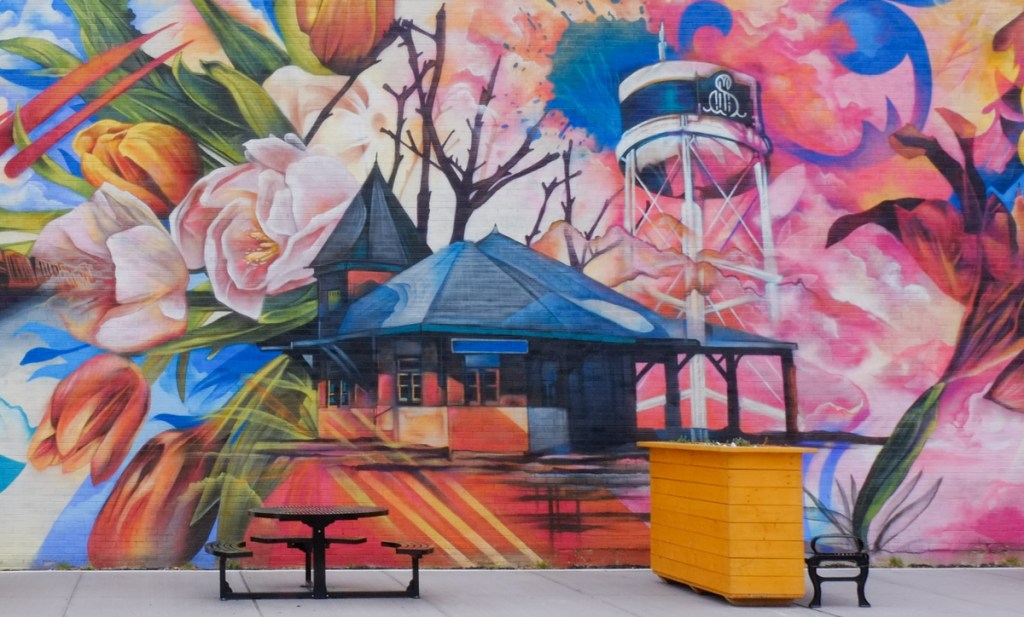
below: Smiths Falls railway station with its distinctive turret – built in 1912 for the Canadian Northern line on their Toronto to Ottawa route. It is now a National Historic site.
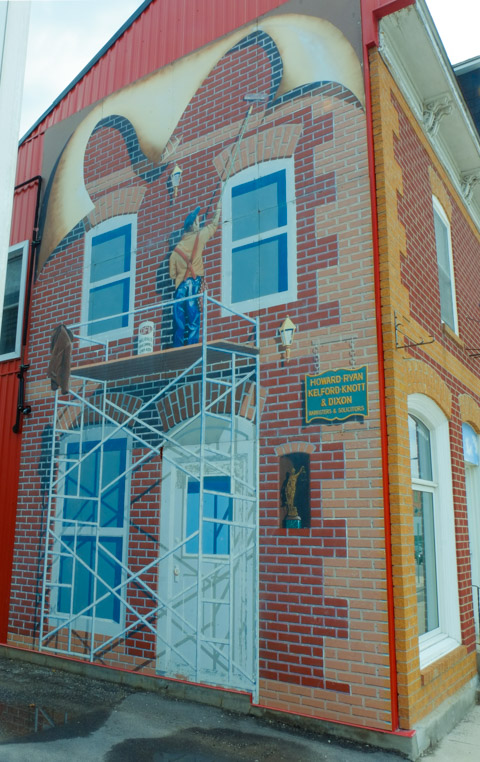
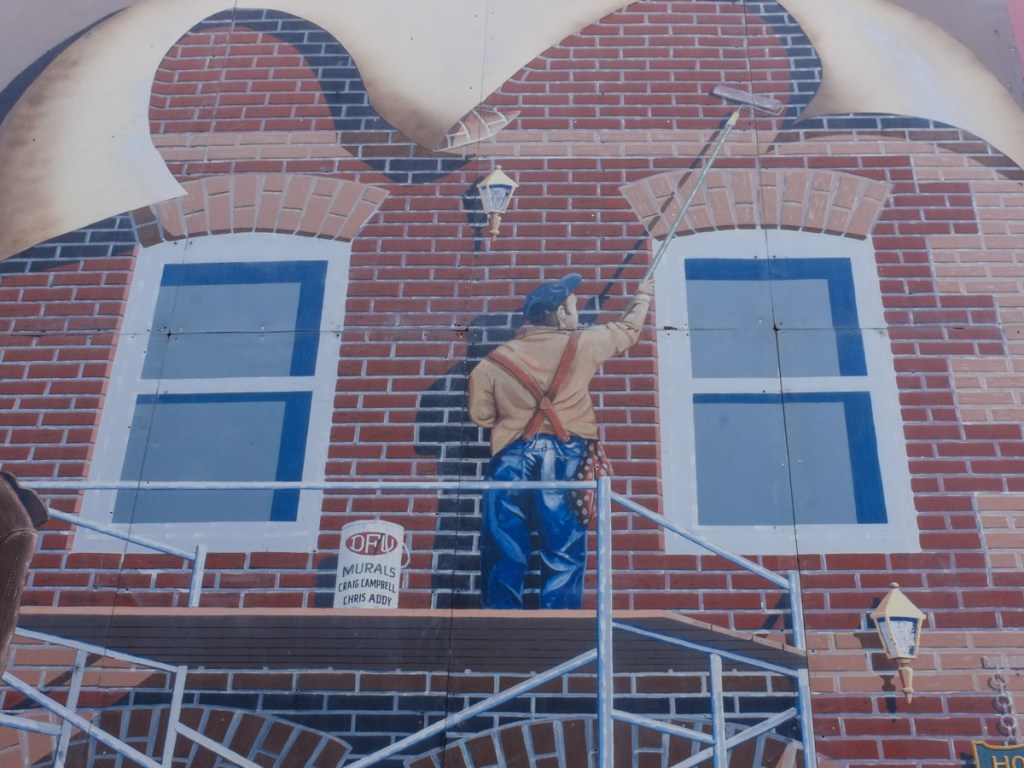
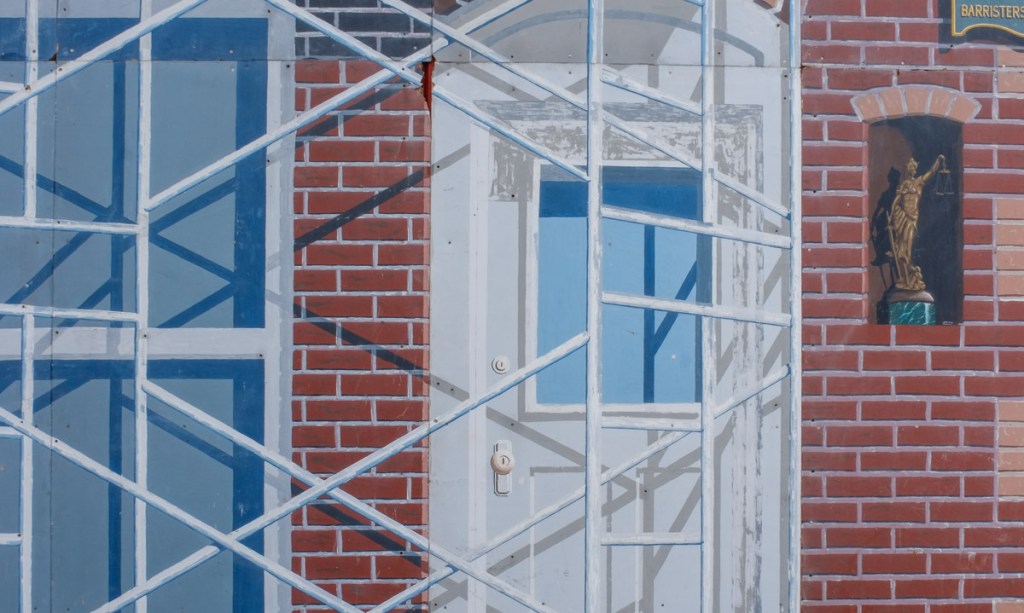
below: High above the street on scaffolding, working to “renovate” the lawyer’s office – a twist on the historic mural. Ryan, Knott & Dixon would probably be quite happy with the facelift that Craig Campbell and Chris Addy have given their brick building.
below: An older mural painted on wood and then attached to the wall. A winter scene on a downtown street.
Carrer Petritxol is a narrow street in the Gothic Quarter (Bari Gotic) section of Barcelona. It dates from the 15th century when it was a shortcut through the backyard of a local property owner. It runs from Portaferissa to Plaça del Pi. Today it has many small unnique stores including chocolate stores.
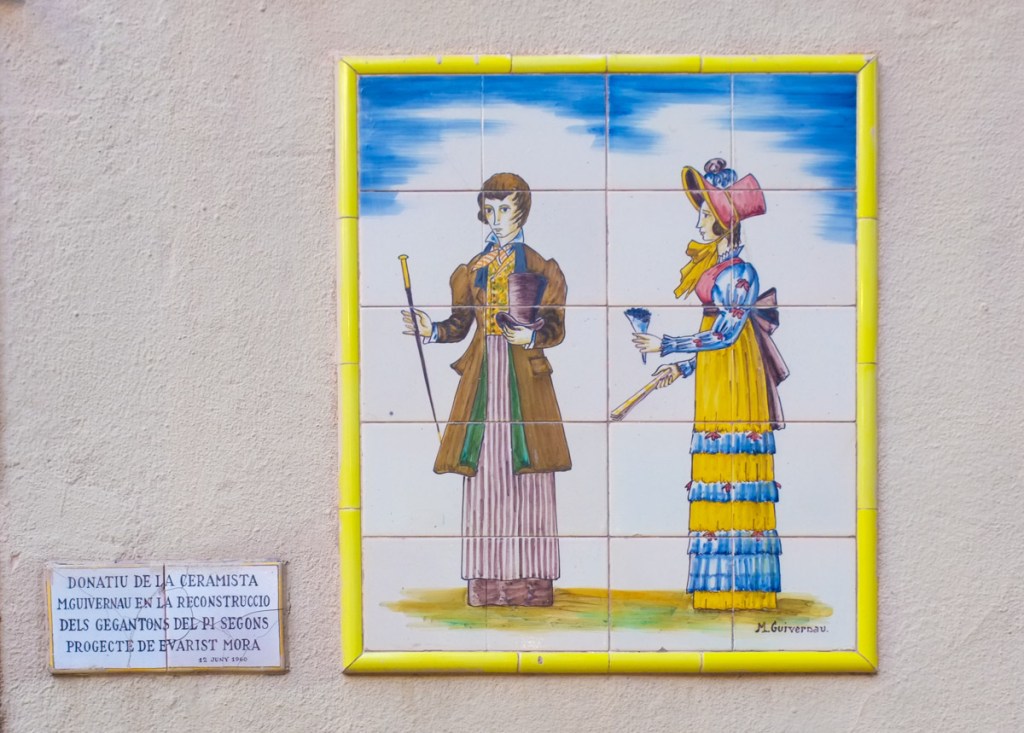
below: Catalan text: “Donatiu de la ceramista M. Guivernau en la reconstruccio dels gegantons del pi segons progecte de Evarist Mora.” Translation from Catalan: “Donation of the ceramist M. Guivernau in the reconstruction of the “Giants of Pi” according to Evarist Mora’s project. Note: The Giants of Pi – On display at the parish church of Santa Maria del Pi are two wearable puppet costumes, one male and one female, known as the Giants of Pi. They have a long history but the part most relevant to this blog post is the fact that they were restored in 1960 by the artist Evarist Mora. In 1985 they were named Mustafa and Elisenda. They are two of the many “gegants” that are brought out for special events in Barcelona such as the Corpus Christi procession and the Santa Eulalia festival.
M. Guinervau signed the above plaque but there are many other ceramic pictures on this street, all unsigned. They tell stories about the street including famous residents or visitors. What follows here are photos and a few details about some of them.
below: “Aci la mare de Déu ens diu que el temps passa lleu” , translation: “Here the mother of God tells us that time passes easily (or easily)”
below: “Amb capa i barret llue cada nit “peius” gener”, translation: “With cape and hat, shine every night “Peius” Gener”. This image shows the Spanish writer, journalist and playwright, Babot Gener Pompey (1848-1920), often known as Peius wandering the streets after dark.
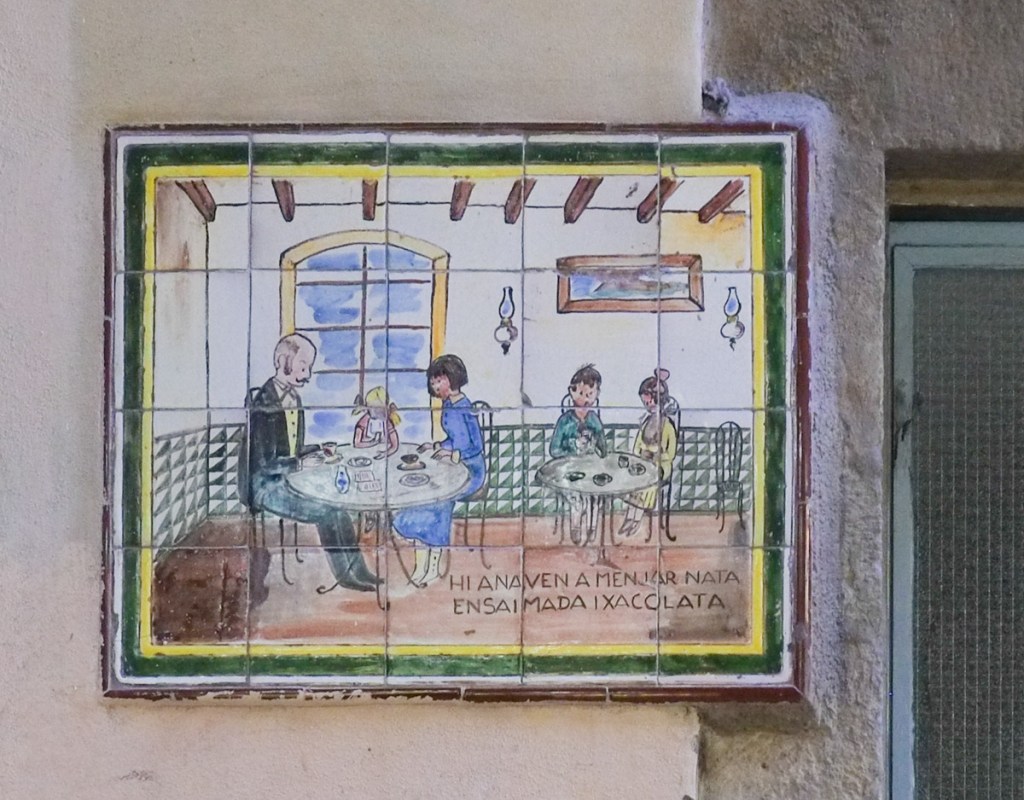
below: “Hi anaven a menjar nata ensaimada xocolata”, translation: “They were going there to eat chocolate cream” Carrer Petritxol has been a destination for chocolate for many years; there are at least 4 stores specializing in chocolate on this short street, two of which have a long history – Granja La Pallaresa and Granja Dulcinea. Granjas (Granges) were once shops specializing in dairy products.
below:Upper “De quant encara era nou i romantic el dinou”. The translation could be either “how new and romantic the nineteenth was still”, or “From when the nineteenth was still new and romantic” Lower: “De llavent ide ponent tot el da hi passa gent”, translation: “From dawn to dusk, people pass by all day”. This presumably refers to people walking along this street.
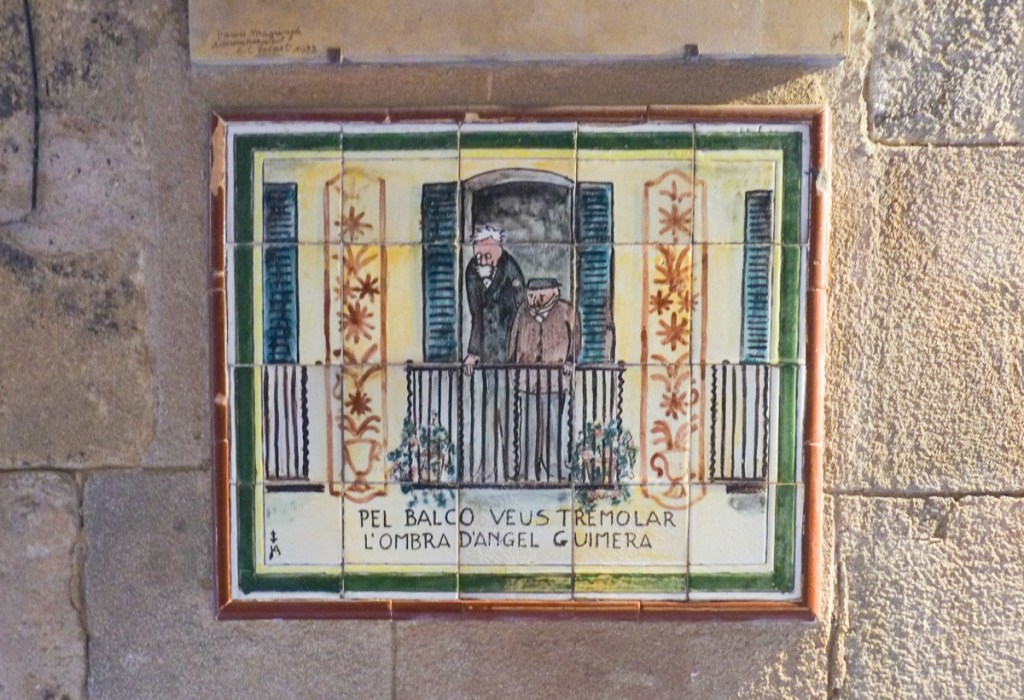
below: Catalan text: “Pel balco veus tremolar l’ombra d’angel Guimera”, translation: “On the balcony you see the shadow of Angel Guimera trembling”. Note: Angel Guimera (1847-1924) was a Catalan playwright.
below: “En un pis no sabem quin hi va viure Moratin” translation: “We don’t know which apartment Moratin lived in” . Note: Probably the writer Leandro Fernandez Moratin, (1760-1828) who lived in a hostel on this street in July 1814.
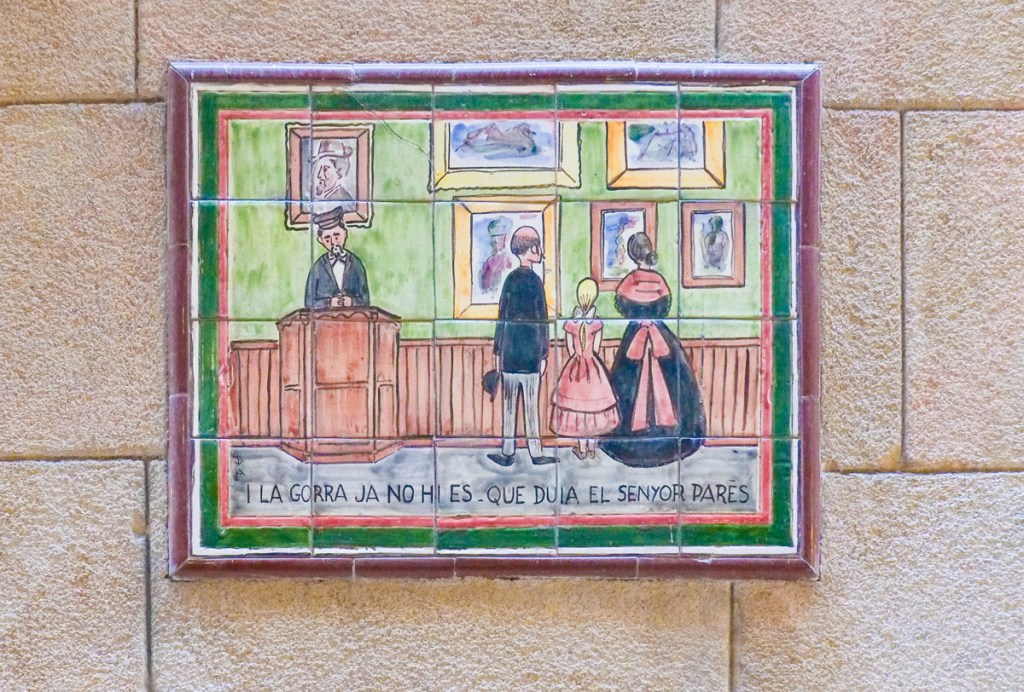
below: “I la gorra ja no hi es… que duia el Senyor Pares”. Transation: “And the cap is no longer there… that Mr. Pares wore” In other words, Sr Pares took off his hat when he and his family were at the art gallery.
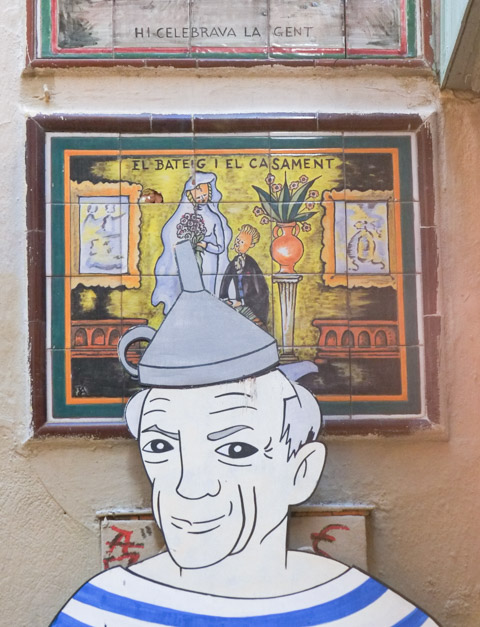
below: “El bateig i el casament”. Translation: “The baptism and the wedding.” That’s a rather short looking groom? The cutout of the man in the blue and white shirt with the funnel on his head is an added bonus!
‘Out and About – Windows of Time’ is a large mural by Christiano De Araujo that features scenes from the social history of Weston village. Unfortunately, the (painted) young man who is sitting on the sidewalk and playing a guitar is hidden by the (real) car parked in front of the mural.
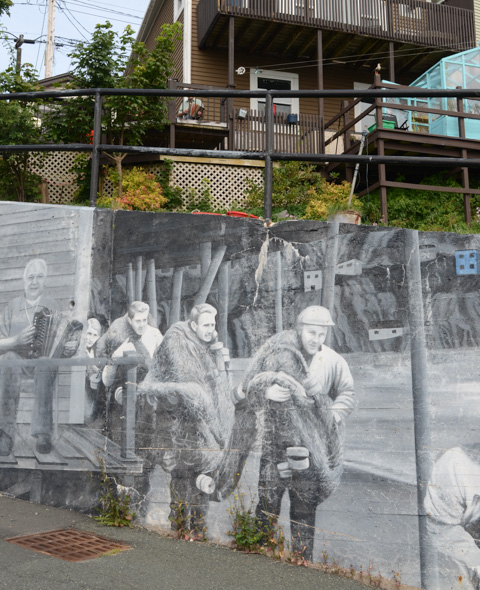
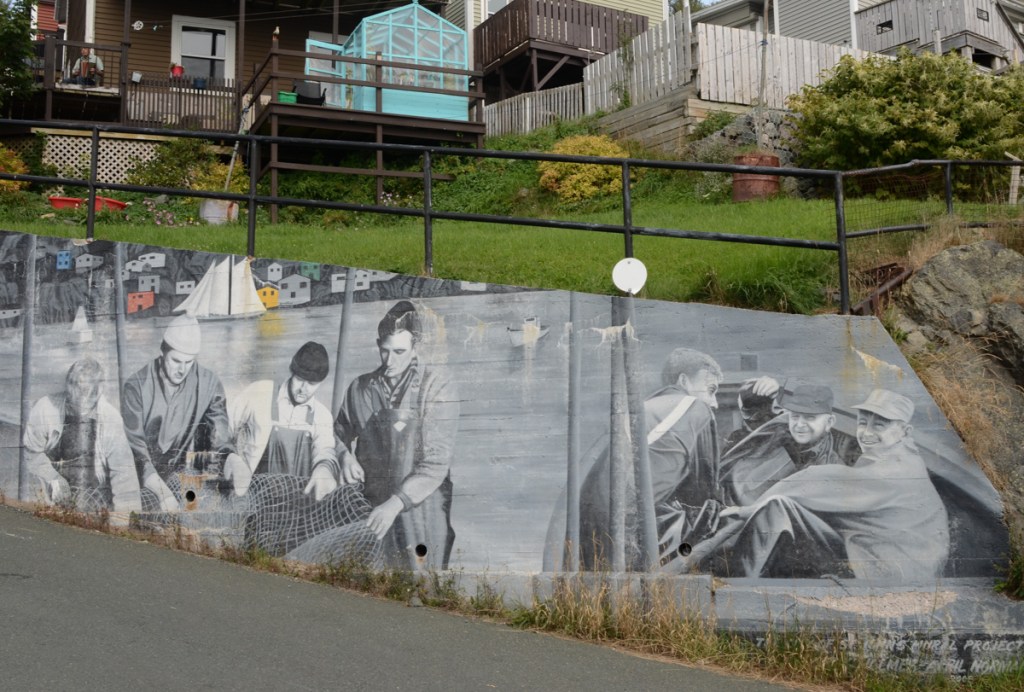
This is one of at least two murals in the village of Petty Harbour (on the east coast of Newfoundland). Like many of the historic murals in Newfoundland, it shows locals hard at work in the fishing industry – out in boats catching fish, on shore cleaning fish, maintaining nets, etc.
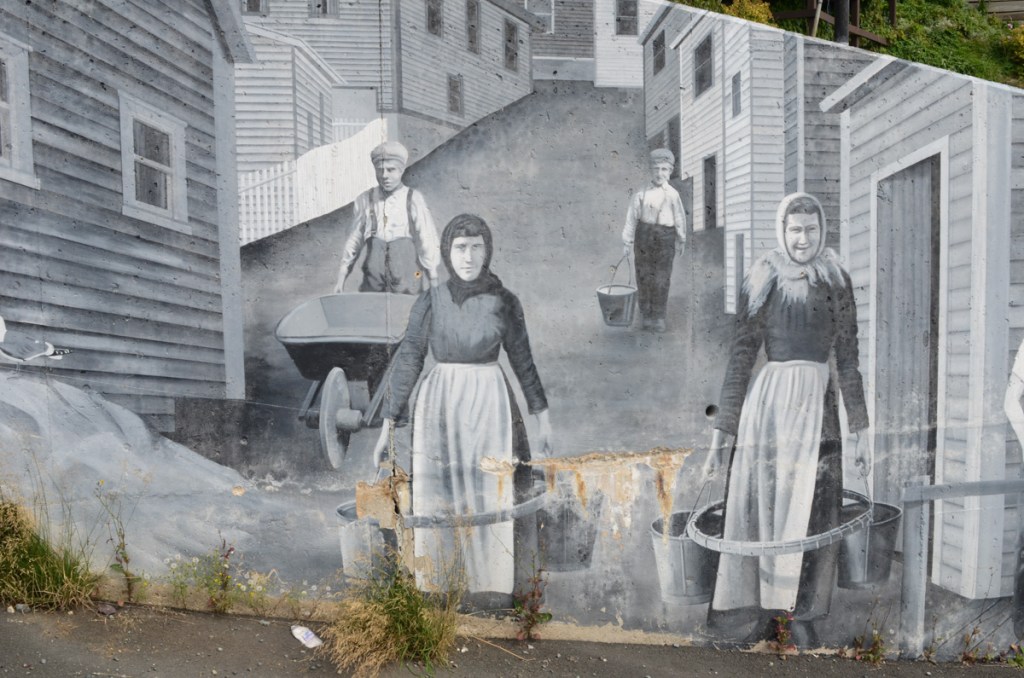
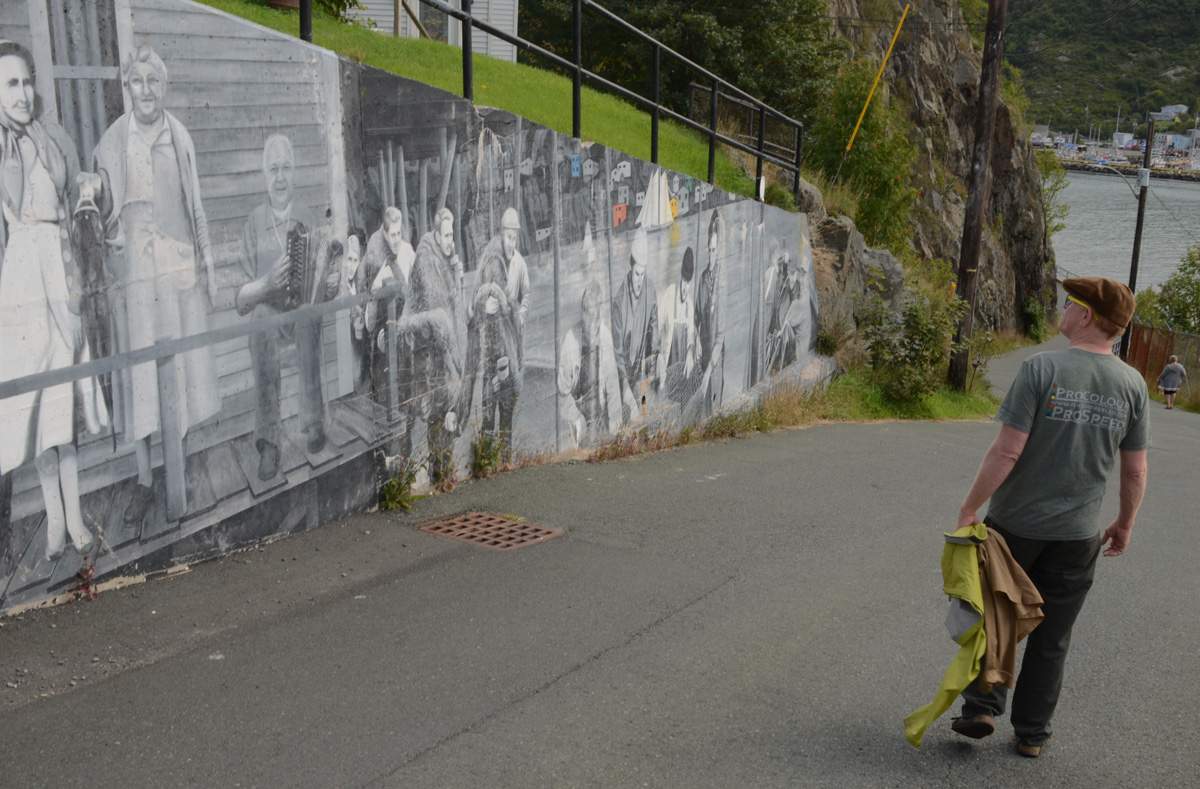
Painted in 2008, this mural depicts life in the early days of the fishing communities of Newfoundland. It is found on a retaining wall on Battery Road, one of the narrow hilly roads in the Outer Battery neighbourhood.
Before the second World War, about one quarter of the population of Kaunas LIthuania was Jewish – about 30,000 people. Known in Yiddish as Kovno, it was a city As part of the City Telling Festival (Istoriju Festivalis) in 2020 a couple of large murals were painted in memory of a few of these people. This festival was one of the events leading up to 2022 where Kaunas was one of the “European Capitals of Culture”
below: Leja (or Leah) Goldberg, b. 1911, poet. It was painted by Lithuanian artist Linas Kaziulionis and it measures 15 by 10 meters. The text is one of her poems “Oren” (Pine) written in Hebrew and Lithuanian.
Goldberg was the daughter of Abraham and Cilia Goldberg. Her father was an economist at an insurance company before WW1. During the Great War (i.e. WW1), most of the Jews were “evacuated” from Lithuania and sent to the interior of Russia. Lea was three years old when the family was forcibly deported from Kaunas. When they returned after the war and the defeat of Germany, Lea’s father was tortured by Lithuanian soldiers who accused him of being a Communist. He died before Lea emigrated to Palestine in 1935; her mother followed her the next year.
One translation of the poem:
PINE
Here I will not hear the voice of the cuckoo. Here the tree will not wear a cape of snow. But it is here in the shade of these pines my whole childhood reawakens.
The chime of the needles: Once upon a time – I called the snow-space homeland, and the green ice at the river’s edge – was the poem’s grammar in a foreign place.
Perhaps only migrating birds know – suspended between earth and sky – the heartache of two homelands.
With you I was transplanted twice, with you, pine trees, I grew – roots in two disparate landscapes.
below: Another mural with a poem that was also part of the same festival. It was painted by Tadas Vincaitis-Plūgas. The is mural dedicated to another Jewish family that lived in Kaunas before WW2.
The words are those of Hirsh Ošerovičius (1908-1994) written in 1964. The text is in Lithuanian but one English translation is:
Ah, do you really believe, Oblivion has the final say in what is to be forgotten? For it is often only an image from the ashes rising And stand in flesh, in full reality Forever framed for every day to come.
The mural depicts a mother, Greta, and her daughter Rosian Bagriansky. Rosian was born in 1935 in Kaunas. Her father, Paul (or Polis) Bagriansky, was a textile merchant and her mother was a concert pianist and music teacher. Rosian survived the Holocaust after her parents dug a hole next to the fence of Kaunas Ghetto and pushed Rosian through it and into the hands of one of their former employees, Bronė Budreikaitė. Rosian became Irena Budreikaitė
Back in 2014, Vytenis Jakas decided to turn a residential courtyard into an art gallery.
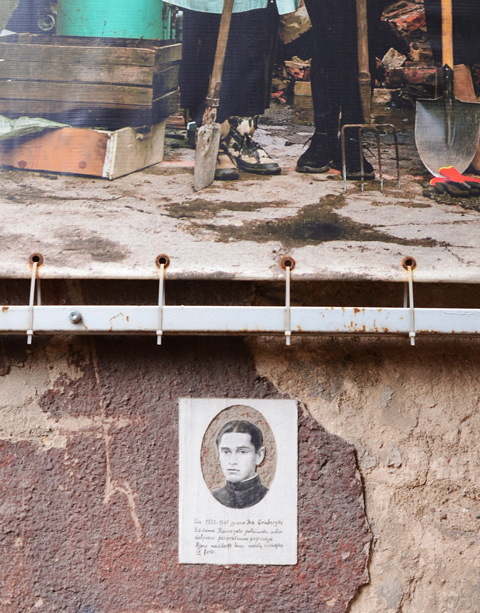
below: Charlie Chaplin oversees the entrance to the yard. The black plaque above Chaplin’s head is in memory of Juda Zupavicius (1914-1944) who was a lieutenant in the Lithuanian military and a chief on the Kaunas ghetto police force. In 1941 the Jewish residents of this area were forced out and had to relocate to the Kaunas ghetto. Zupavicius was also one of the leaders of the underground resistance during WW2.
below: The words under the photo of the couple: „Čia 1939 m. – 1941 m. gyveno Dita ir Juda Zupavičiai. Juda buvo vienas iš Kauno geto pogrindžio vadovų, žiauriai nacistų kankintas neišdavė geto vaikų slėptuvių. Dita buvo kovos bendražygė“ (English translation: “Here in 1939 – 1941 lived Dita and Juda Zupavičiai. Juda was one of the underground leaders of the Kaunas ghetto, he was brutally tortured by the Nazis and did not reveal the hiding places of the ghetto children. Dita was a comrade in the struggle”)
below: Venus probably never had to do the grocery shopping
Yard Gallery
Upon noticing that the neighbours living in the yard had become alienated and had forgotten the common past of the yard, the artist Vytenis Jakas started creating a “Yard Gallery” – a courtyard surrounded by apartment buildings built in the inter-war period. In the past, the yard inhabitants knew each other well, communicated warmly, celebrated holidays together, and supported each other in troublesome times. The yard had a large table, a fountain and a sculpture, the Dapkevicius sisters grew flowers, and lilacs grew near the windows of the neighbour Regina. Over time, the population and the social environment changes, the number of cars increased, and the yard space became too small.
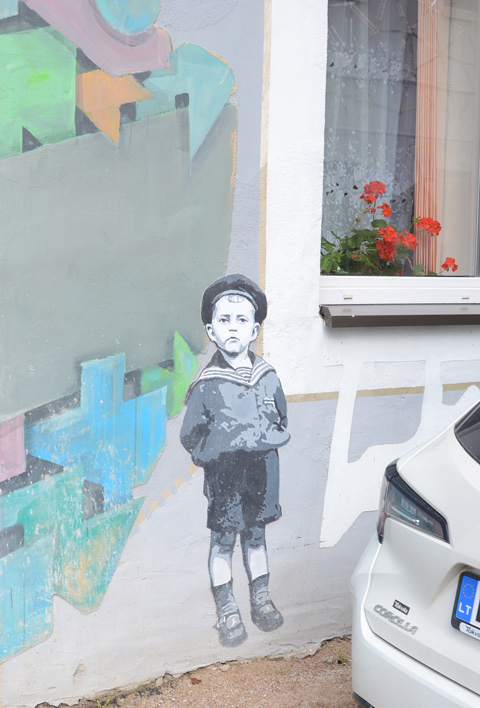
Seeing this situation, Vytenis Jakas, with the help of other artists and neighbours, turned the derelict yard into a centre of attraction, the open air “Yard Gallery”. Various artistic projects are implemented here: Portraits of the Jews who lived in this house before the Holocaust, along with the current residents, characters of various works are painted on the facades of the apartment buildings; mirror mosaics and stained glass windows are created, and community events are organised, with community festivals celebrated together. “
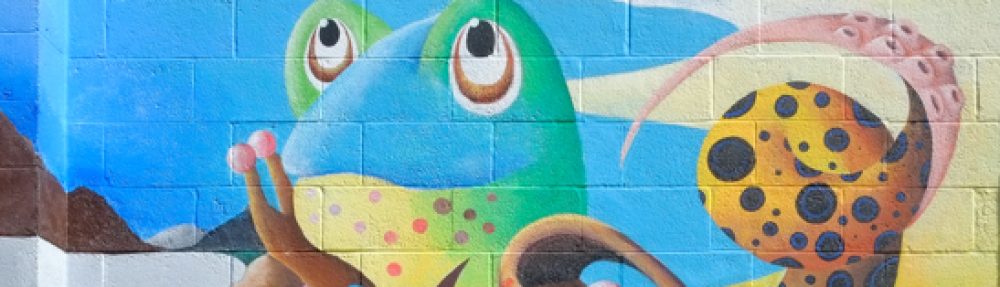
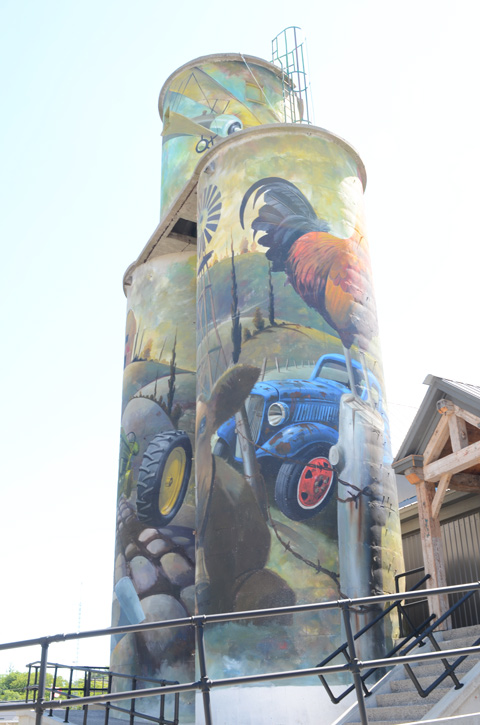
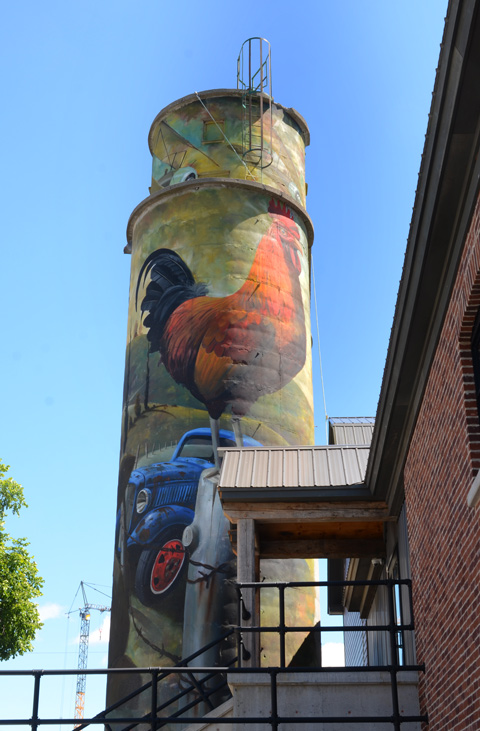
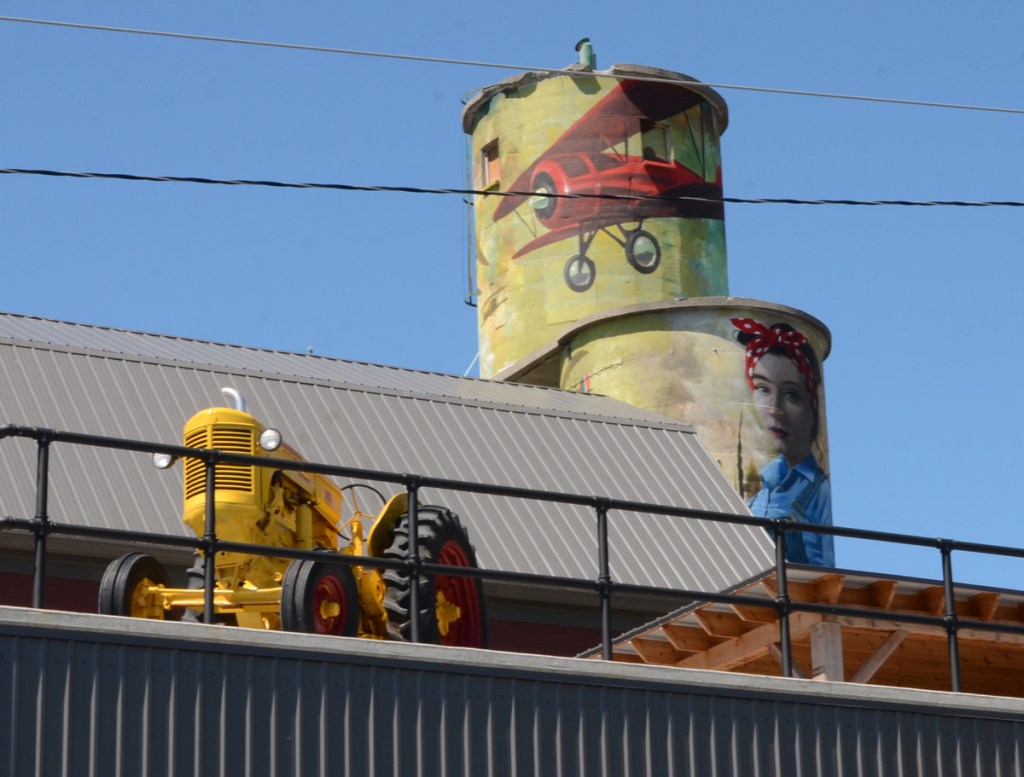
… and rooster … and tractor.. paintings in Napanee Ontario.
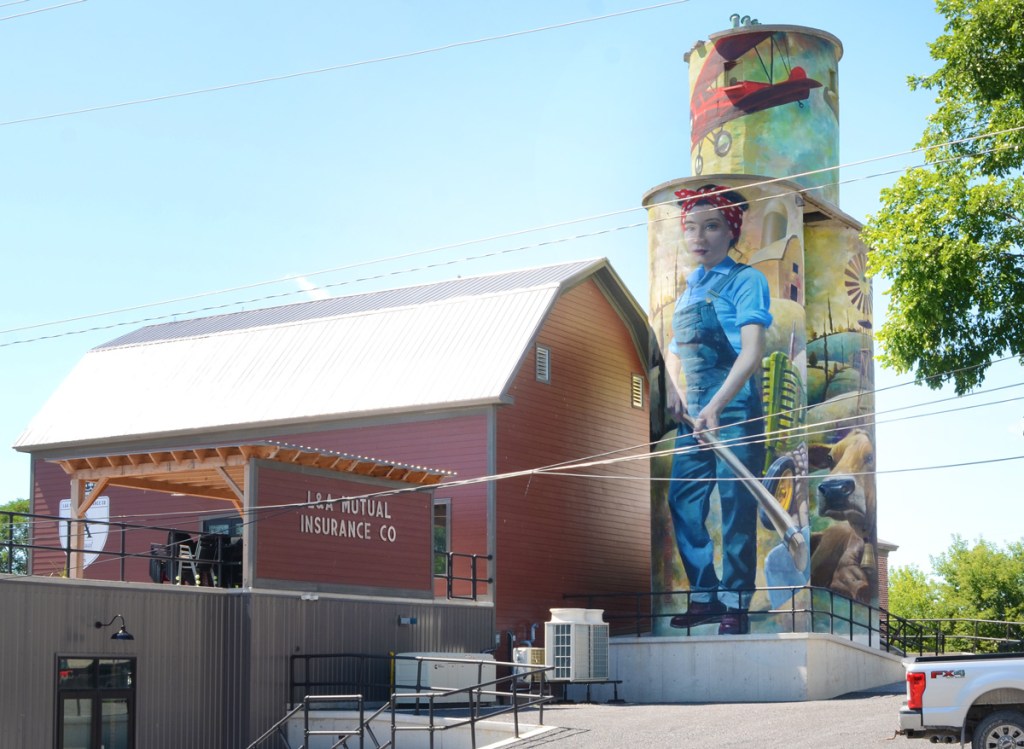
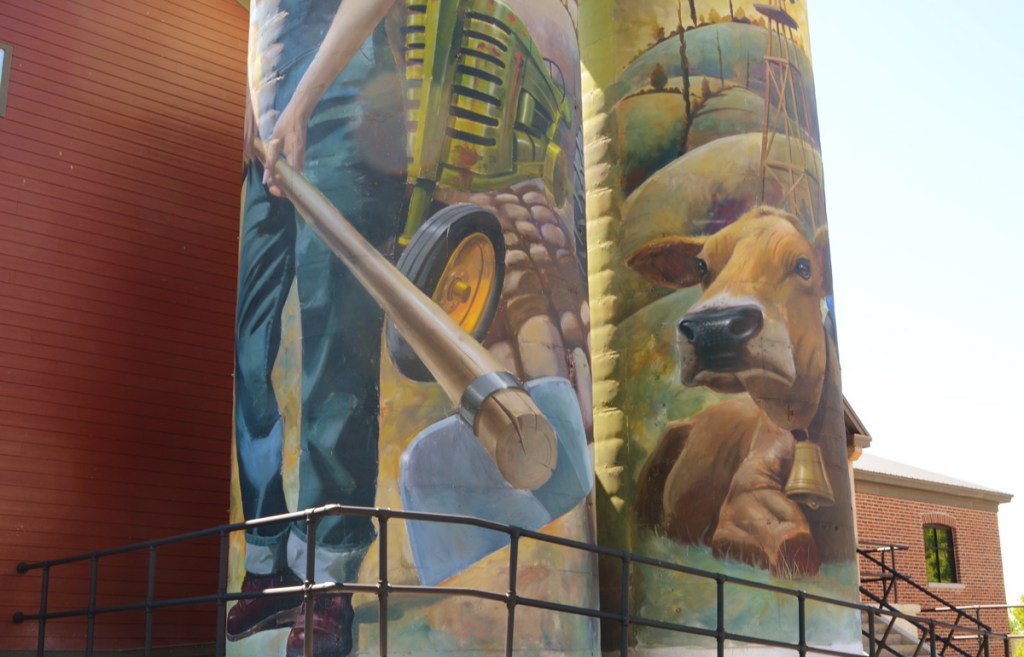
Once used for storage, these silos were painted by Shane Goudreau as part of the redevelopment of the site – from County Depot to insurance company. An excellent way to preserve some of the history of the area.
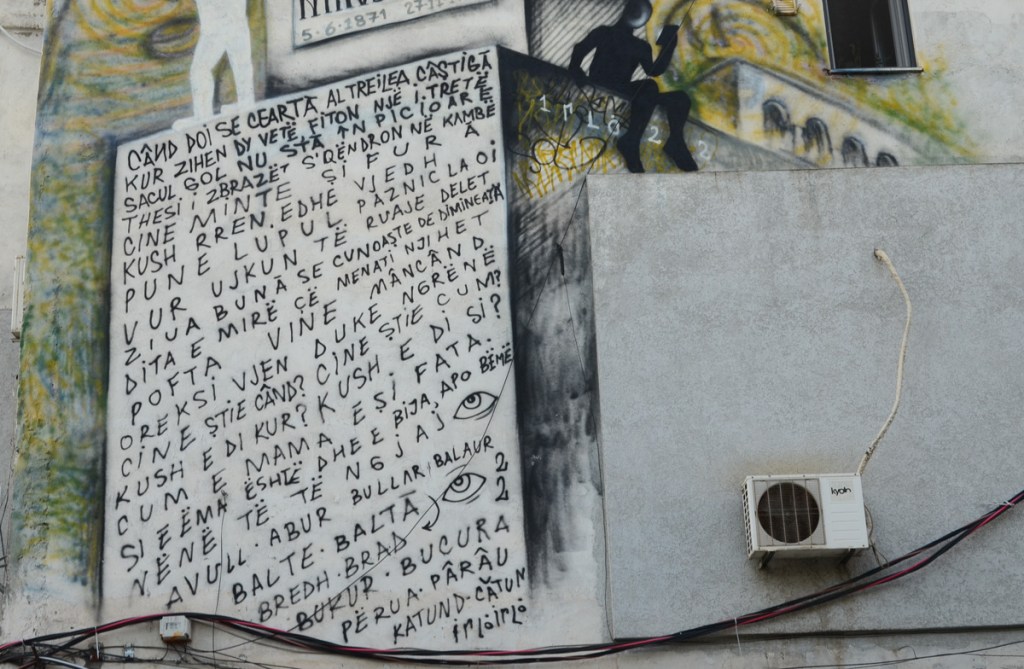
He was born Nicu N. Iorga in Romania on 17 Jan 1871. He was a prolific writer and cultural historian. His biography is long and it gets complicated when discussing his scholarly works and opinions so I will leave that for you to read on Wikipedia (or similar) if you are interested. I haven’t figured out why he is featured on a mural in Albania. He was murdered in 1940 by the Iron Guard, a Romanian militant revolutionary fascist movement and political party.
The text is written in Albanian (or Romanian, google translate had trouble with this) but the first few words translate as “When two quarrel, the third wins”
This mural was painted by Irlo Doidoi for MurAL Fest 2019.
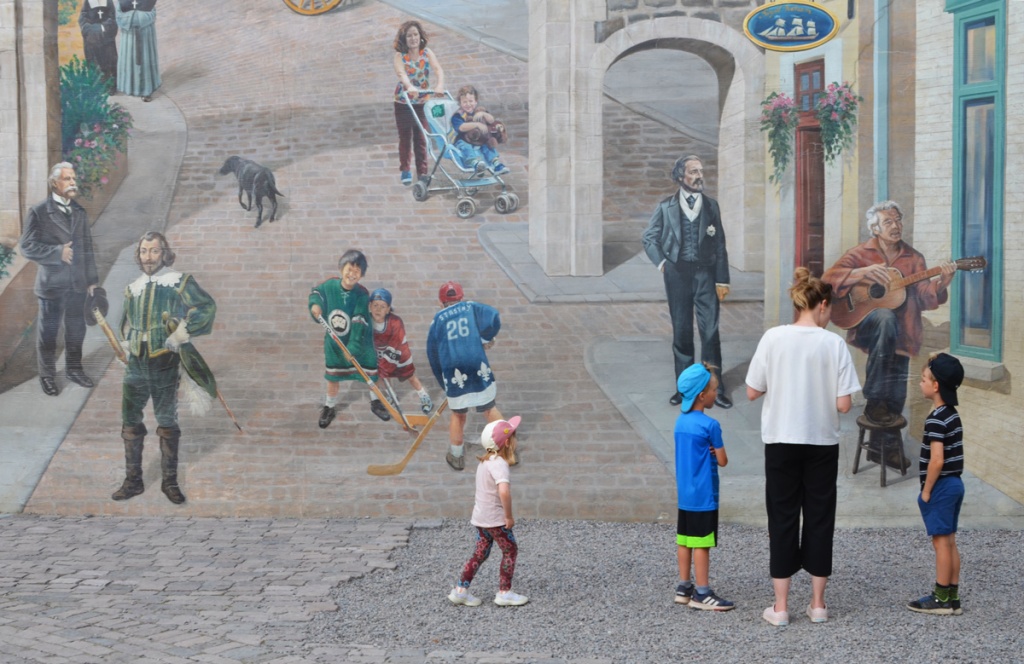
La Fresque des Québécois is the title of a 420 m2 mural found on the side of Maison Soumande on rue Notre-Dame in Old Quebec City. It depicts figures from 400 years of Quebec City history. Twelve painters from France and Quebec contributed to the mural.
New France was the name of the French colony in North America beginning in 1593 with the arrival of Jacques Cartier. The French relinquished the colony to the British and the Spanish in 1763, at the end of the Seven Years War
Looking out of the upper windows are (on the left) Jean Talon (1626-1694) who was steward of New France; in this position he was in control of the civil administration of the colony. The other man is Louis de Baude Comte de Frontenac et de Palluau (1622-1698) was Governor General of New France for many years.
In 1763 what is now Quebec became the Province of Quebec, a British colony. In 1791 this colony was divided into two, Upper Canada along the upper parts of the St. Lawrence River, and Lower Canada, along the lower section of the river. Upper Canada is approximately what is now Ontario while Quebec has grown from Lower Canada. Quebec City was in Lower Canada.
François-Xavier Garneau (1809-1866), national historian of French Canada stands on a balcony with (on the right) Louis-Joseph Papineau (1786-1871), Member of Parliament in Lower Canada. Playing his guitar is Félix Leclerc (1914-1988). Just behind him is Frederick Temple Blackwood, Marquis de Dufferin and d’Ava (1826-1902), Governor General of Canada from 1872-1878; He’s probably best remembered as Lord Dufferin. During his time as Governor General, Quebec City officials began the demolition of the old city walls. Blackwood persuaded them to stop and rebuild the parts that they had damaged. In 1985 Old Quebec was recognized as an UNESCO World Heritage Site. Samuel Champlain (1570-1635) poses in his green jacket while holding onto his hat with the large white feather. He founded Quebec in 1608. Just behind him is Alphonse Desjardins (1854-1920) founder of the Desjardins Cooperative Movement. Coming down the stairs is Louis Jolliet (1645 -1700), along with Jesuit priest Father Jacques Marquette, was the first non-Native to explore the upper parts of the Mississippi River. Jolliet was born near Quebec City.





















 Eyes on the Streets