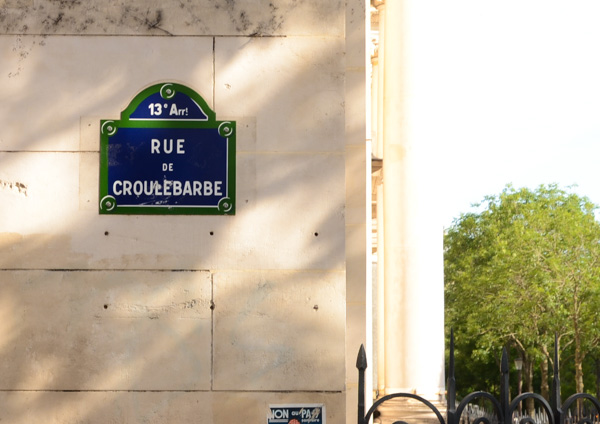
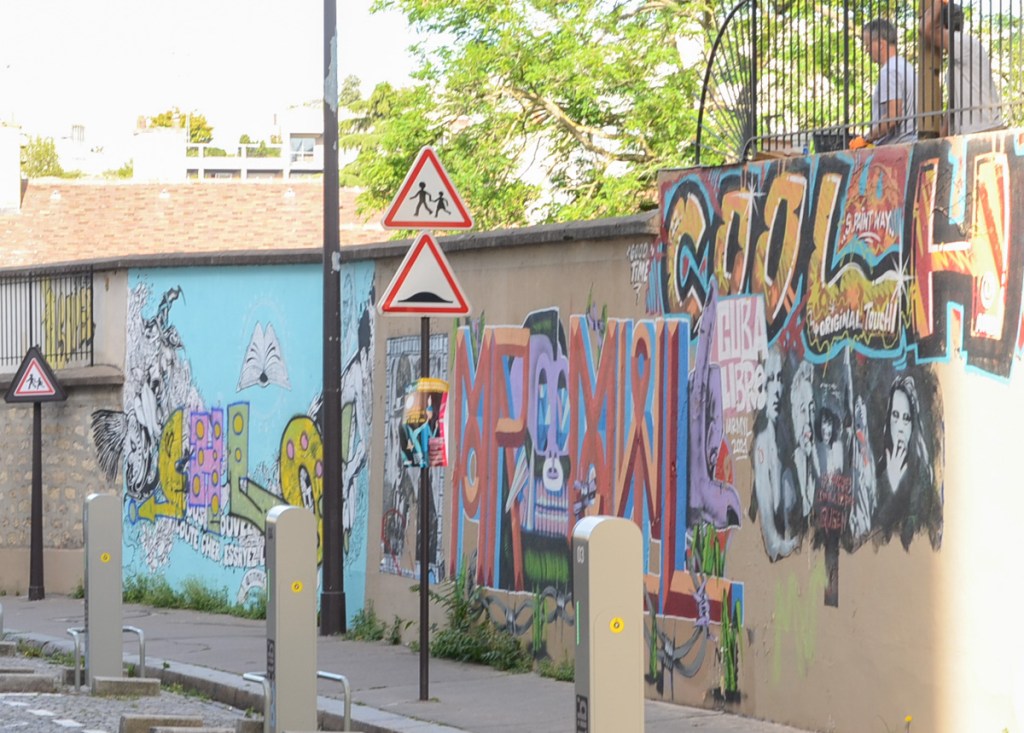
In the 13th arrond. of Paris, on rue de Croulebarbe, there is one segment of wall covered with street art.
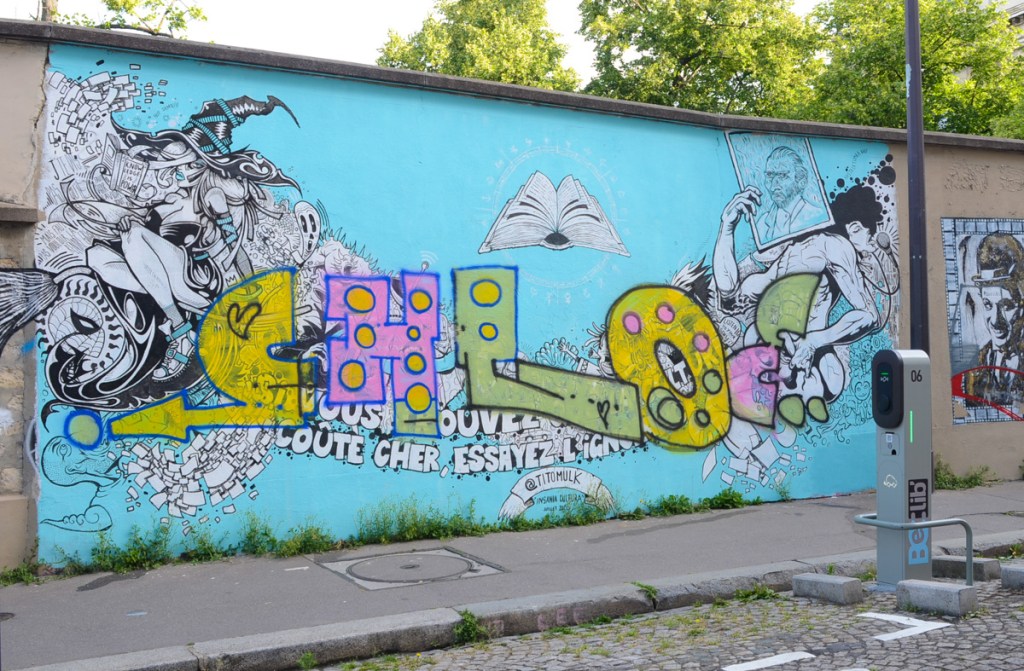
below: Unfortunately Chloe’s name has been added on top of this mural by Titomulk, a pair of French artists. It hides some of the intricate black and white details, as well as some of the text, of the “Insania Cultura” mural. A singer with her microphone, a portrait of Van Gogh, a book with the title “Knowledge is Power”, a Spiderman mask, and a very naked man. “Si vous trouvez [illegible] culture, coute cher, essayez l’ignorance” translates to ‘If you find culture too expensive, try ignorance.’
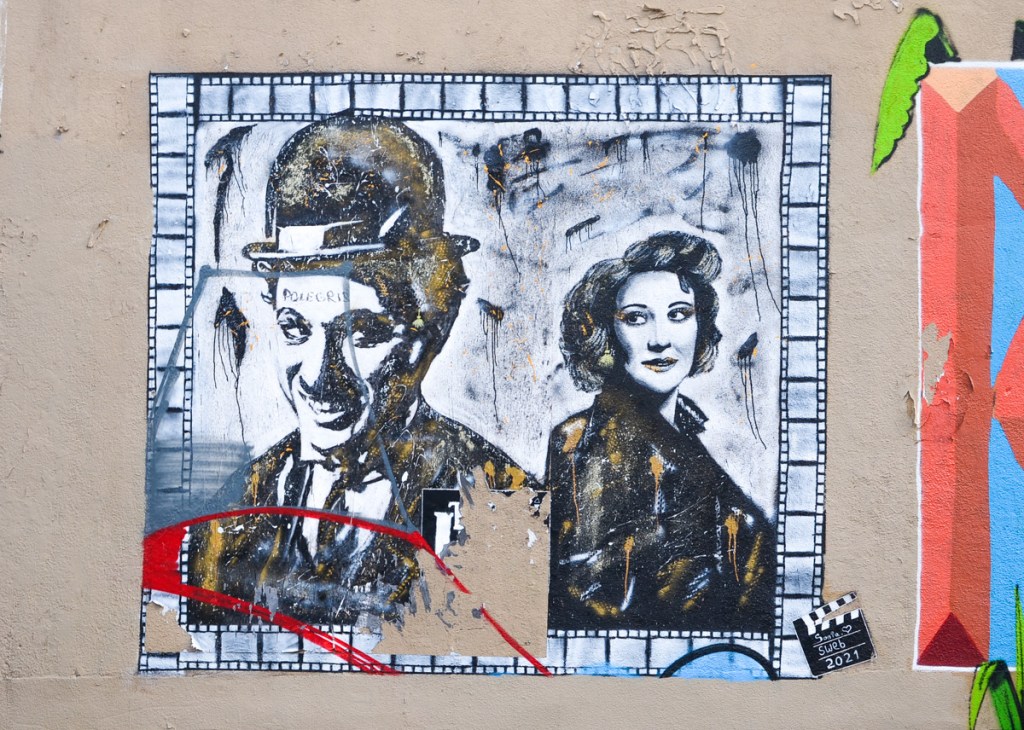
below: Painted to celebrate the 50th Anniversary of “The Kid”, a silent movie starring Charlie Chaplin, by Sweb and Sonia O.
below: A Mr. Myl creation – text and a toothy purple guy with a white nose ring, greenery, and barbed wire
below: Five black and white portraits of women with red text, “Hey Heroes, I will be your Queen”.
Lodz Poland is home to many large murals that have been funded and promoted by organizations such as Urban Forms Gallery (Fundacja Urban Forms). Although not as common as in some cities, there are smaller works to be found – paste ups, stickers, and stencils by a number of artists. These are ones that I saw the day that I was in Lodz back in May 2022.
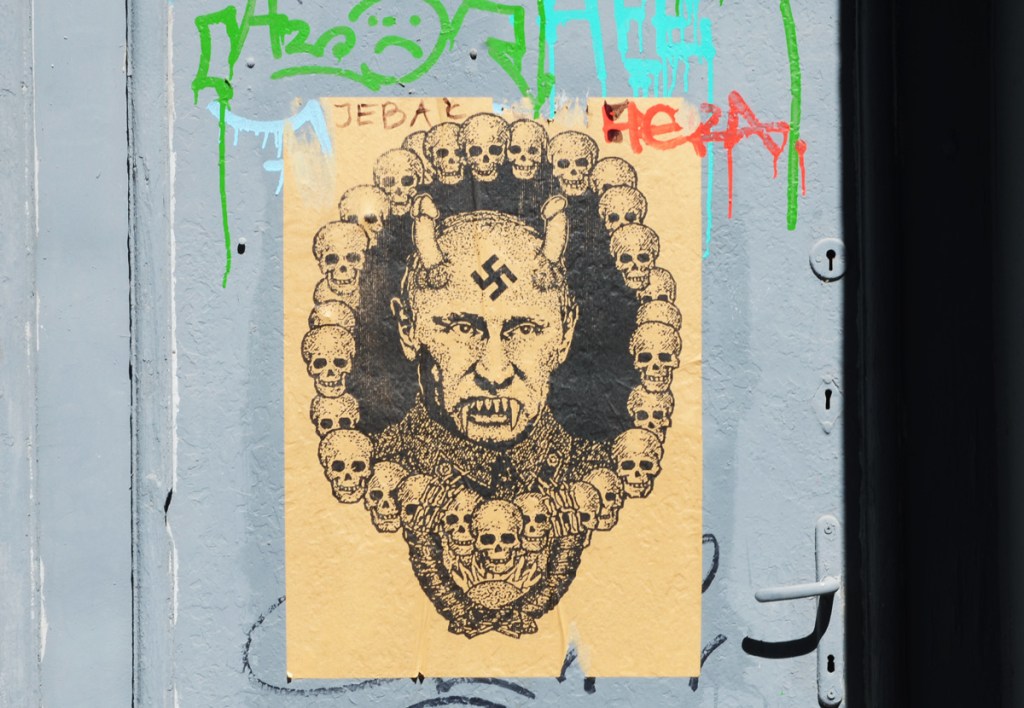
below: Putin as the devil, a Nazi devil surrounded by skulls and death.
below: blue hand grenade
below: Gu-tang Clan dog headed hand grenades plus a 2020 view of Earth.
below: A pasteup on a sidewalk box in Centrum that shares many similarities with the 2020 Earth above.
below: This balck and white dog head features on many gu-tang works…
below: …. such as this one.
below: A 3fala portrait of Katarzyna Kobro (1898-1951), a Polish sculptor.
below: Man with a beard. More on 3fala (if your Polish is good): TrzyFala
below: 3-D mask with a square nose and eyes closed
below: A masked swordsman painted on a fence
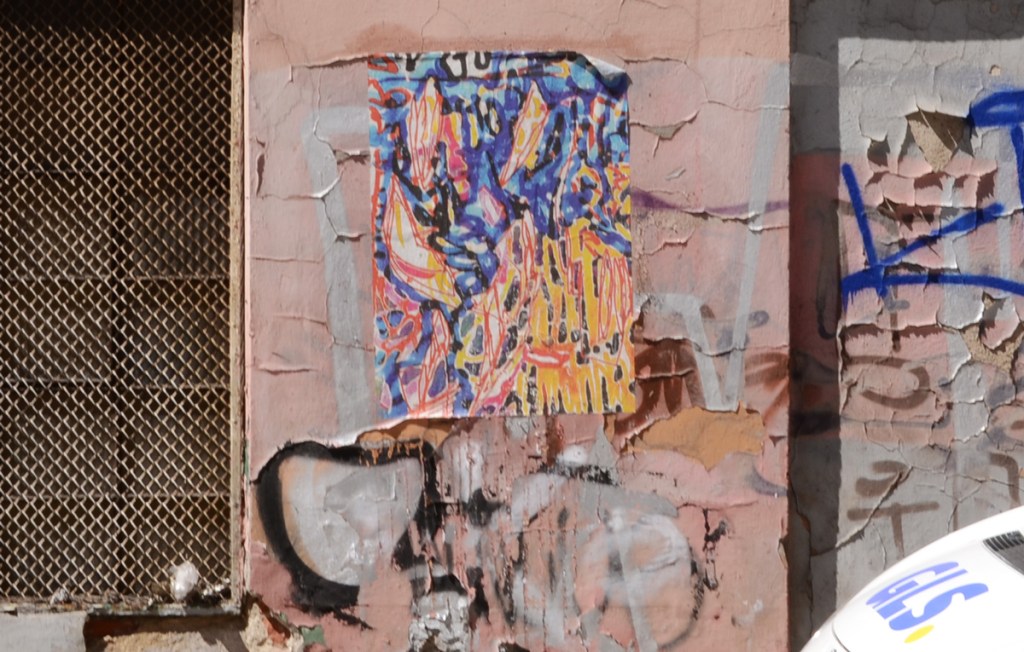
below: An abstract painting that was pasted to a wall.
below: A pink balloon dog crosses the street at the crosswalk. The sticker on the left says “Moje ciato, moj wybor”, or: my body, my choice.
below: A grumpy, angry bald man growling at the world.
below: A house for a body? Or a house with legs? Whatever it is, it seems to be wearing adidas shoes. It too is angry and letting the world know it. Random words, win, and sugar.
below: Flower
below: square happy faces
below: Lodz, No Surrender
below: Small pink happy cat with twinkling yellow heart.
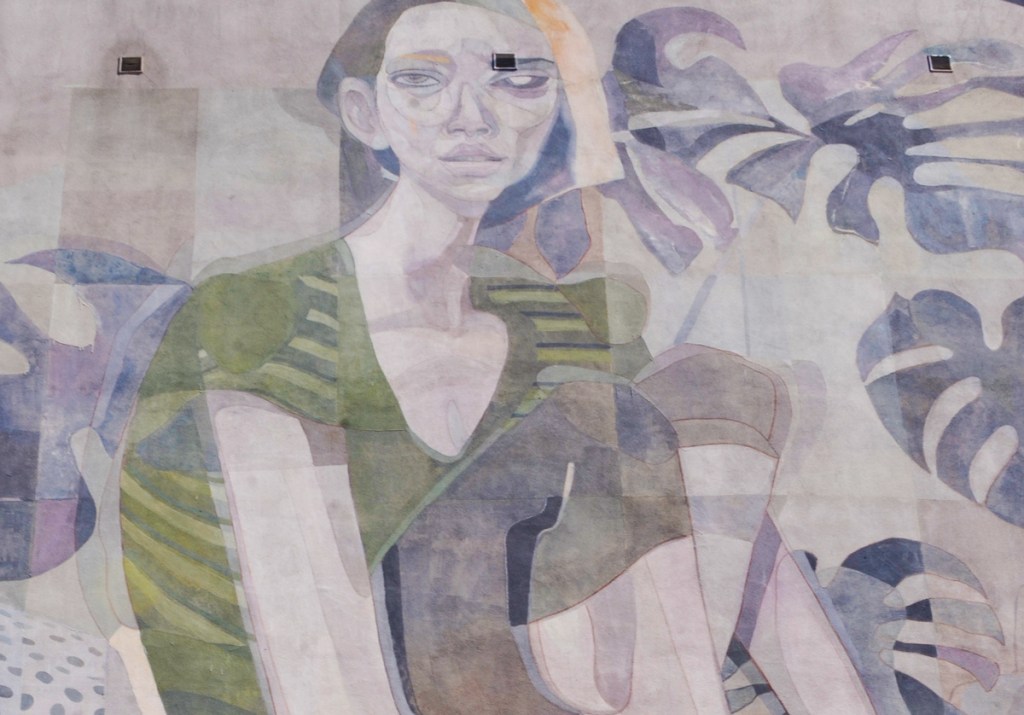
below: A red headed woman wrapped in a blue shawl and holding a white rose. White roses are symbols of purity and innocence as well as love and affection. Traditionally the Virgin Mary is depicted with a blue shawl or similar clothing. The mural is ‘Oblicze Piękna’, painted in 2018 by Paulina Nawrot. The title translates to Face of Beauty, or Vision of Beauty.
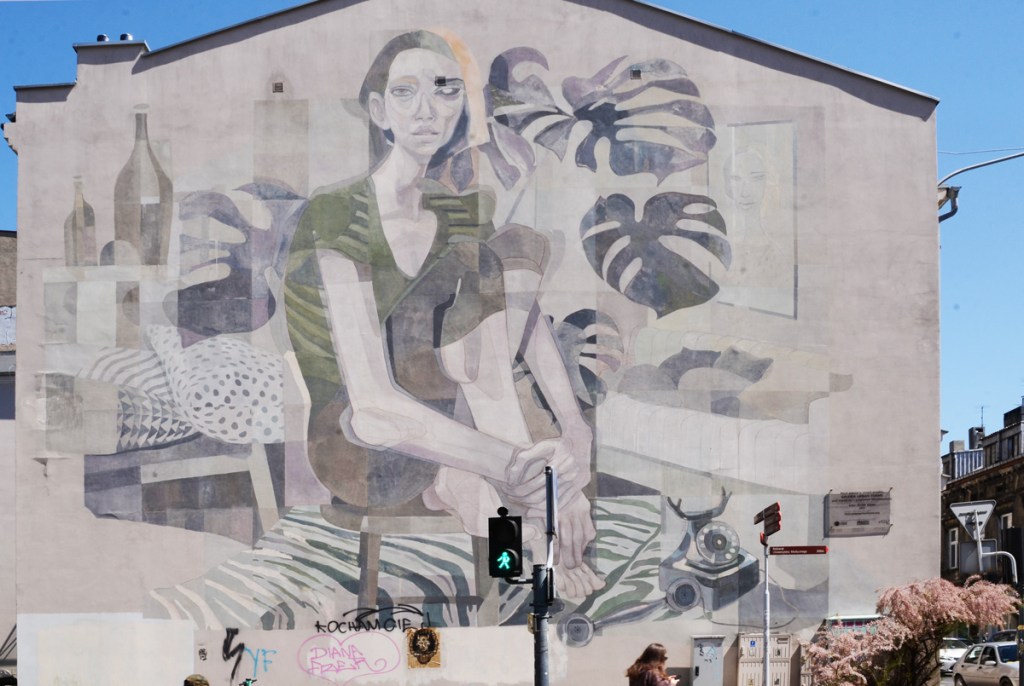
below: A faded woman sits by her telephone in a 2014 mural by Russian artist, Morik as part of Galeria Urbans Forms.
below: Another faded mural, this one shows an anatomically correct heart with half of a butterfly on each side. Above the heart grows a large tree. The mural was painted in 2015 by Puerto Rican artist Alexis Diaz and is titled “Czuć” (or in English, “Feel”)
“The Vision of St. Dominic”, 2017, by Paulina Nawrot and Ola Adamczuk, one of three murals sponsored by the Dominican order of Łódź in honor of its 800th birthday.
below: Part of one of the other St. Dominic murals. There are three birds in the mural.
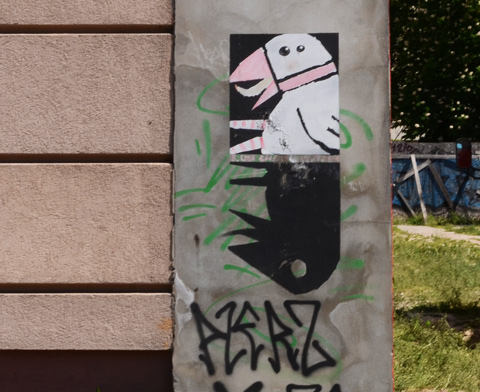
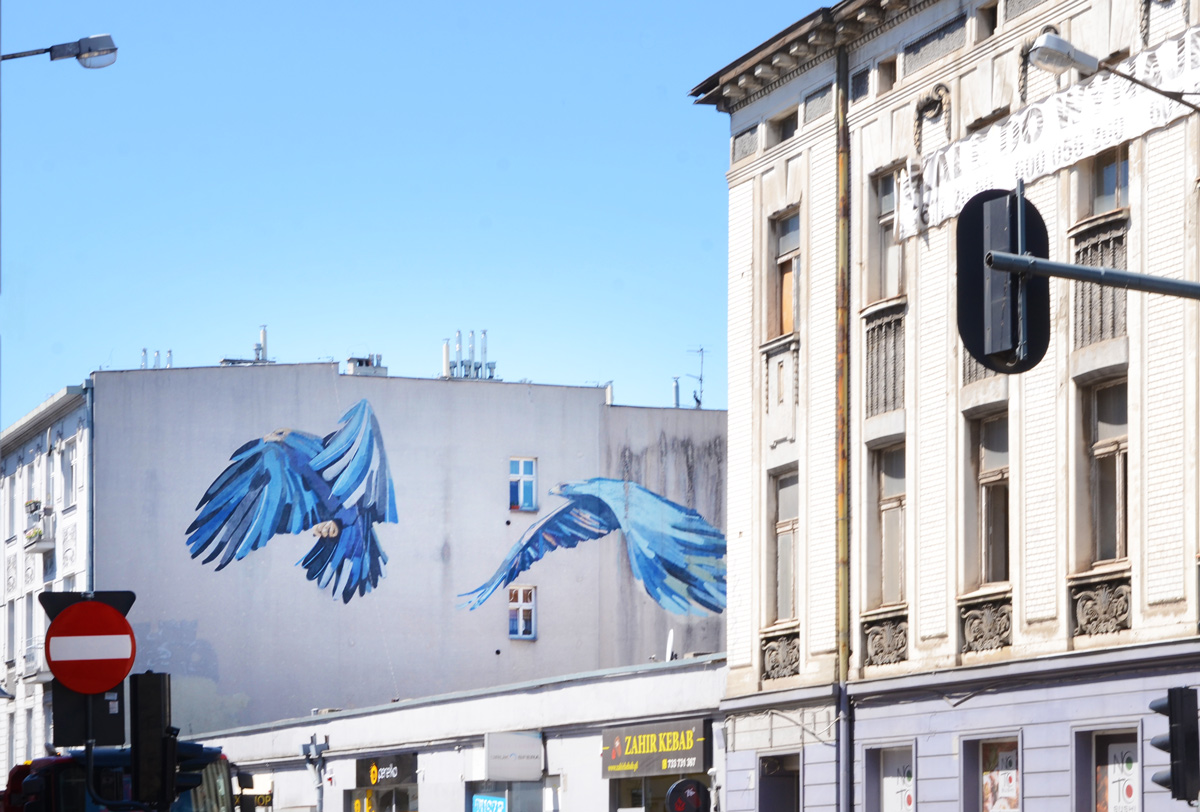
below: ‘Ptak” by Axl Studio, aka Alexander Mehlhorn, 2016
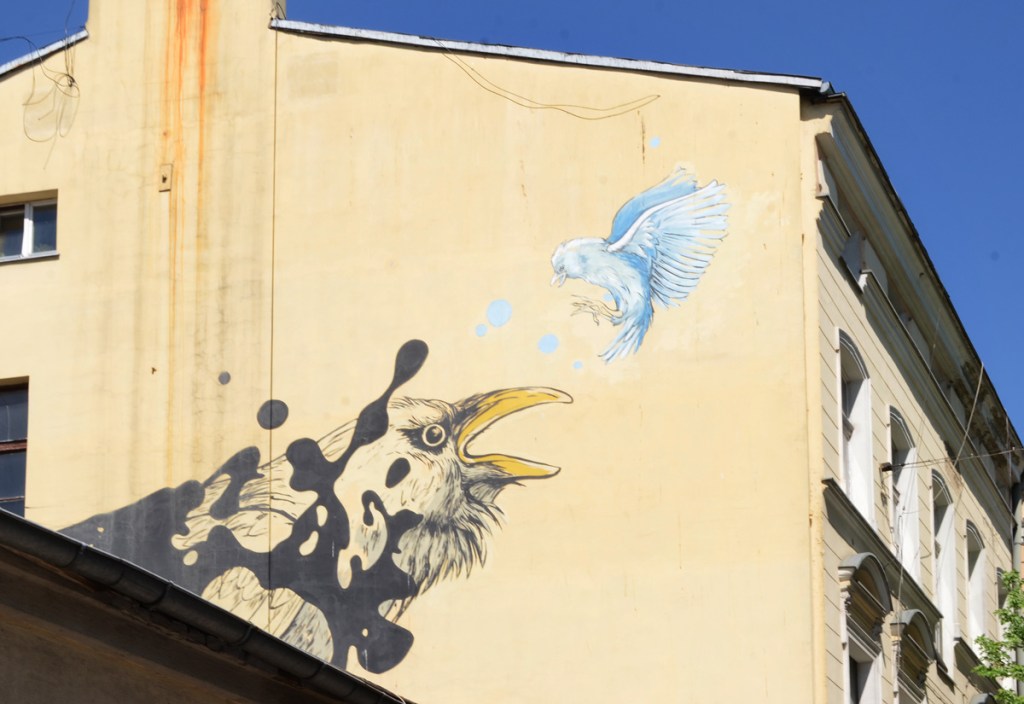
below: Chasing the bluebird but not quite able to catch it.
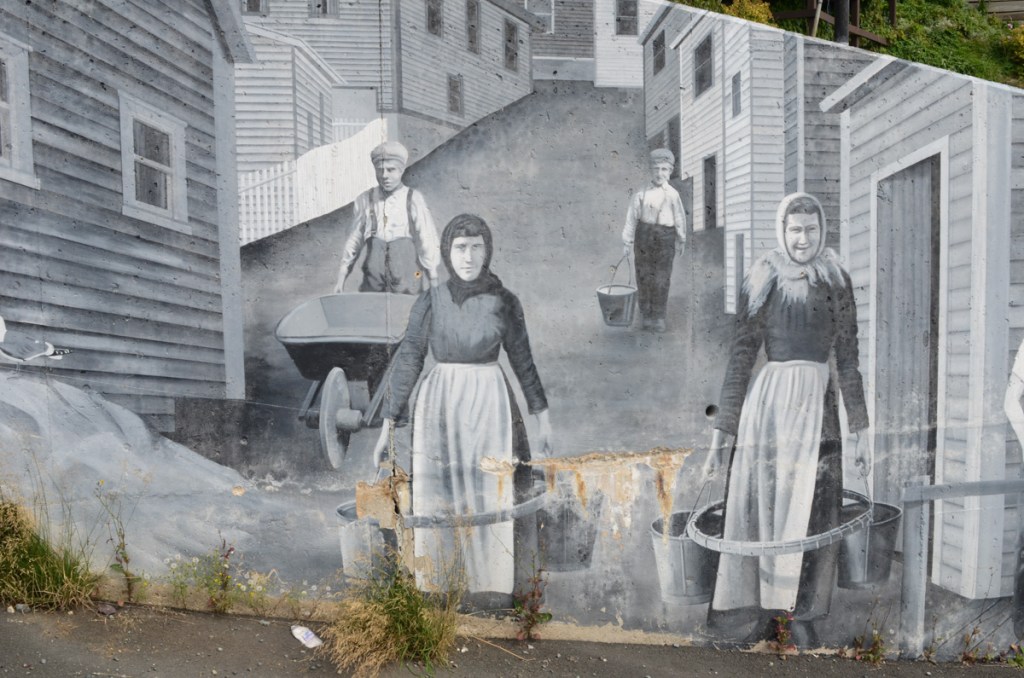
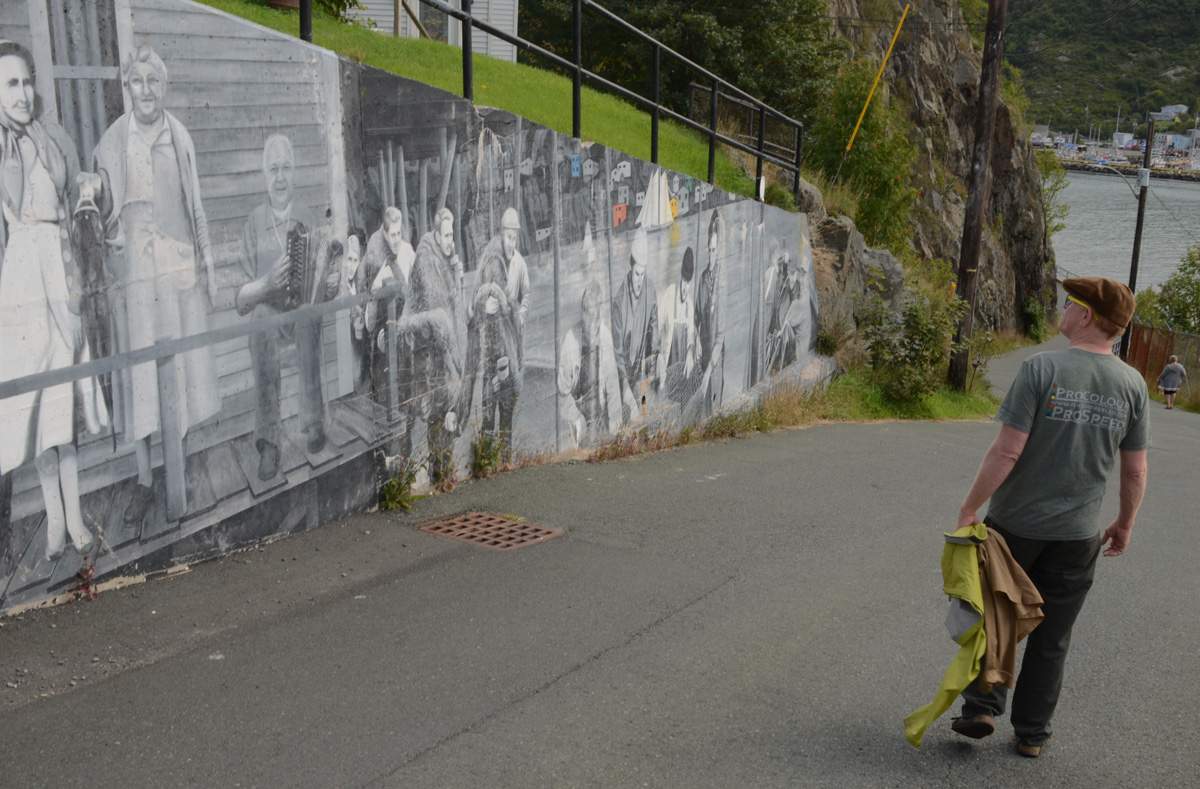
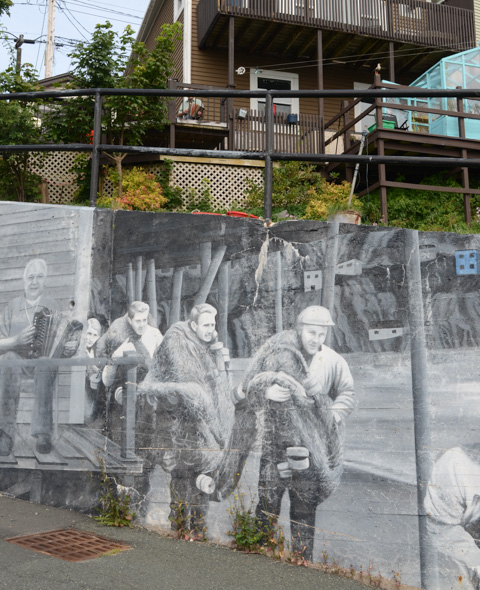
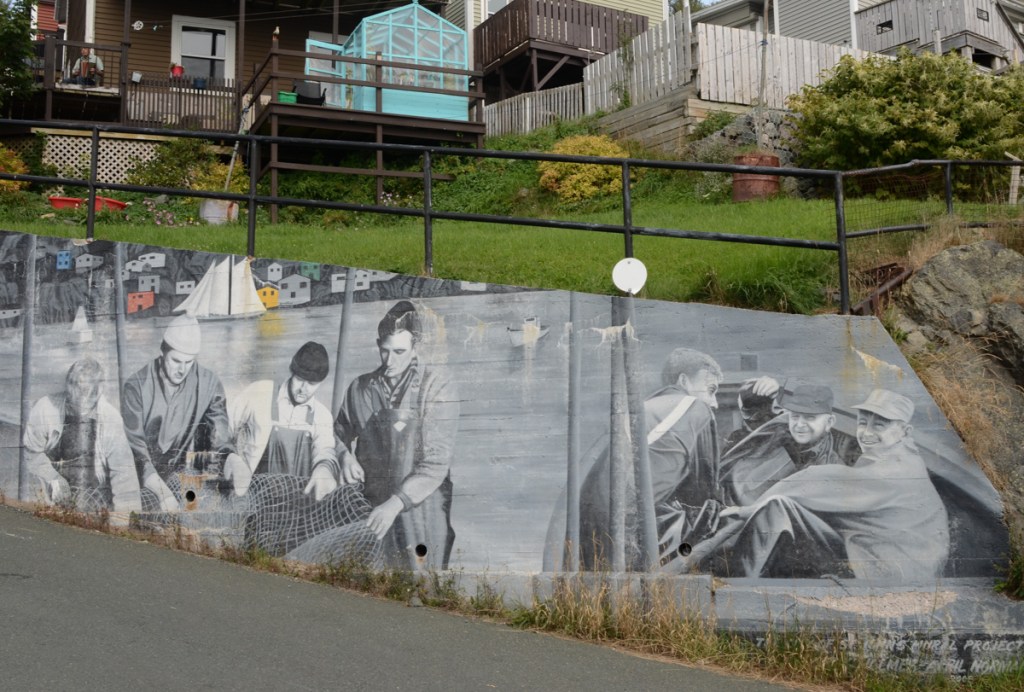
This is one of at least two murals in the village of Petty Harbour (on the east coast of Newfoundland). Like many of the historic murals in Newfoundland, it shows locals hard at work in the fishing industry – out in boats catching fish, on shore cleaning fish, maintaining nets, etc.
Painted in 2008, this mural depicts life in the early days of the fishing communities of Newfoundland. It is found on a retaining wall on Battery Road, one of the narrow hilly roads in the Outer Battery neighbourhood.
In an alley near Dovercourt and Queen West in Toronto are two garage door murals unlike any others.
below: ‘Elephancy’ by Zirco Fish – It’s an elephant but it’s not. Tusks like an elephant and the ears seem to be big a floppy. But the mouth is like a beak and the eyes are certainly not those of an elephant. A crazy fantastical creature, the product of someone’s imagination.
Before the second World War, about one quarter of the population of Kaunas LIthuania was Jewish – about 30,000 people. Known in Yiddish as Kovno, it was a city As part of the City Telling Festival (Istoriju Festivalis) in 2020 a couple of large murals were painted in memory of a few of these people. This festival was one of the events leading up to 2022 where Kaunas was one of the “European Capitals of Culture”
below: Leja (or Leah) Goldberg, b. 1911, poet. It was painted by Lithuanian artist Linas Kaziulionis and it measures 15 by 10 meters. The text is one of her poems “Oren” (Pine) written in Hebrew and Lithuanian.
Goldberg was the daughter of Abraham and Cilia Goldberg. Her father was an economist at an insurance company before WW1. During the Great War (i.e. WW1), most of the Jews were “evacuated” from Lithuania and sent to the interior of Russia. Lea was three years old when the family was forcibly deported from Kaunas. When they returned after the war and the defeat of Germany, Lea’s father was tortured by Lithuanian soldiers who accused him of being a Communist. He died before Lea emigrated to Palestine in 1935; her mother followed her the next year.
One translation of the poem:
PINE
Here I will not hear the voice of the cuckoo. Here the tree will not wear a cape of snow. But it is here in the shade of these pines my whole childhood reawakens.
The chime of the needles: Once upon a time – I called the snow-space homeland, and the green ice at the river’s edge – was the poem’s grammar in a foreign place.
Perhaps only migrating birds know – suspended between earth and sky – the heartache of two homelands.
With you I was transplanted twice, with you, pine trees, I grew – roots in two disparate landscapes.
below: Another mural with a poem that was also part of the same festival. It was painted by Tadas Vincaitis-Plūgas. The is mural dedicated to another Jewish family that lived in Kaunas before WW2.
The words are those of Hirsh Ošerovičius (1908-1994) written in 1964. The text is in Lithuanian but one English translation is:
Ah, do you really believe, Oblivion has the final say in what is to be forgotten? For it is often only an image from the ashes rising And stand in flesh, in full reality Forever framed for every day to come.
The mural depicts a mother, Greta, and her daughter Rosian Bagriansky. Rosian was born in 1935 in Kaunas. Her father, Paul (or Polis) Bagriansky, was a textile merchant and her mother was a concert pianist and music teacher. Rosian survived the Holocaust after her parents dug a hole next to the fence of Kaunas Ghetto and pushed Rosian through it and into the hands of one of their former employees, Bronė Budreikaitė. Rosian became Irena Budreikaitė
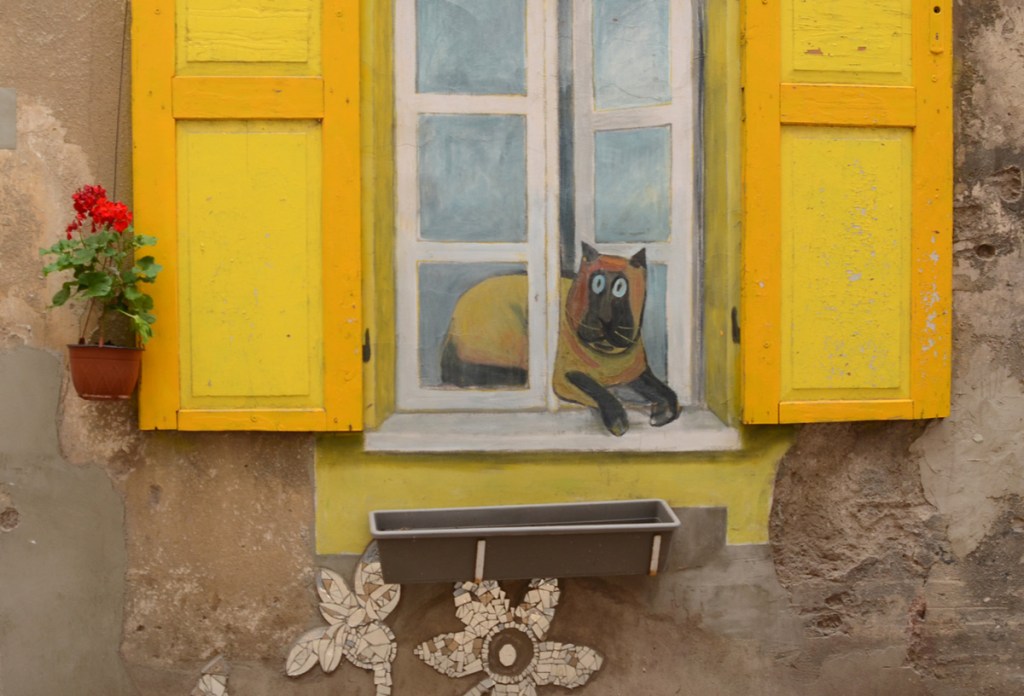
Back in 2014, Vytenis Jakas decided to turn a residential courtyard into an art gallery.
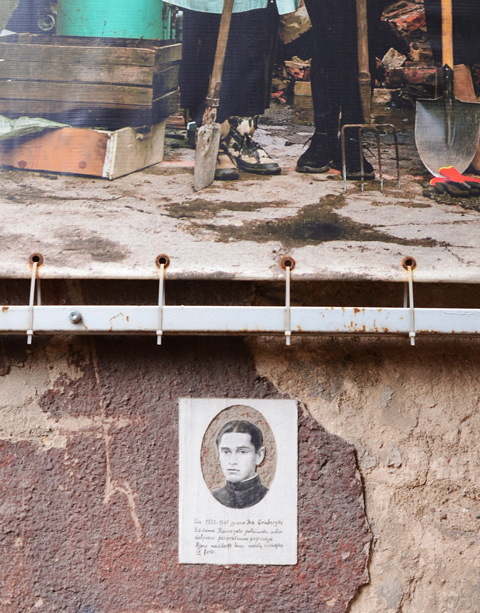
below: Charlie Chaplin oversees the entrance to the yard. The black plaque above Chaplin’s head is in memory of Juda Zupavicius (1914-1944) who was a lieutenant in the Lithuanian military and a chief on the Kaunas ghetto police force. In 1941 the Jewish residents of this area were forced out and had to relocate to the Kaunas ghetto. Zupavicius was also one of the leaders of the underground resistance during WW2.
below: The words under the photo of the couple: „Čia 1939 m. – 1941 m. gyveno Dita ir Juda Zupavičiai. Juda buvo vienas iš Kauno geto pogrindžio vadovų, žiauriai nacistų kankintas neišdavė geto vaikų slėptuvių. Dita buvo kovos bendražygė“ (English translation: “Here in 1939 – 1941 lived Dita and Juda Zupavičiai. Juda was one of the underground leaders of the Kaunas ghetto, he was brutally tortured by the Nazis and did not reveal the hiding places of the ghetto children. Dita was a comrade in the struggle”)
below: Venus probably never had to do the grocery shopping
Yard Gallery
Upon noticing that the neighbours living in the yard had become alienated and had forgotten the common past of the yard, the artist Vytenis Jakas started creating a “Yard Gallery” – a courtyard surrounded by apartment buildings built in the inter-war period. In the past, the yard inhabitants knew each other well, communicated warmly, celebrated holidays together, and supported each other in troublesome times. The yard had a large table, a fountain and a sculpture, the Dapkevicius sisters grew flowers, and lilacs grew near the windows of the neighbour Regina. Over time, the population and the social environment changes, the number of cars increased, and the yard space became too small.
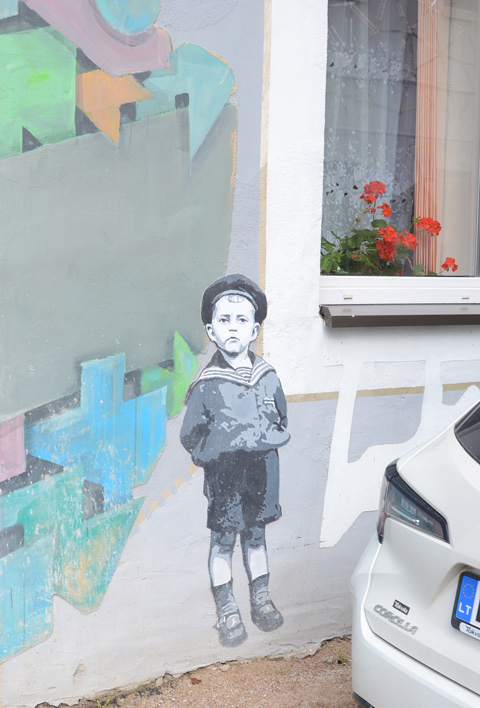
Seeing this situation, Vytenis Jakas, with the help of other artists and neighbours, turned the derelict yard into a centre of attraction, the open air “Yard Gallery”. Various artistic projects are implemented here: Portraits of the Jews who lived in this house before the Holocaust, along with the current residents, characters of various works are painted on the facades of the apartment buildings; mirror mosaics and stained glass windows are created, and community events are organised, with community festivals celebrated together. “
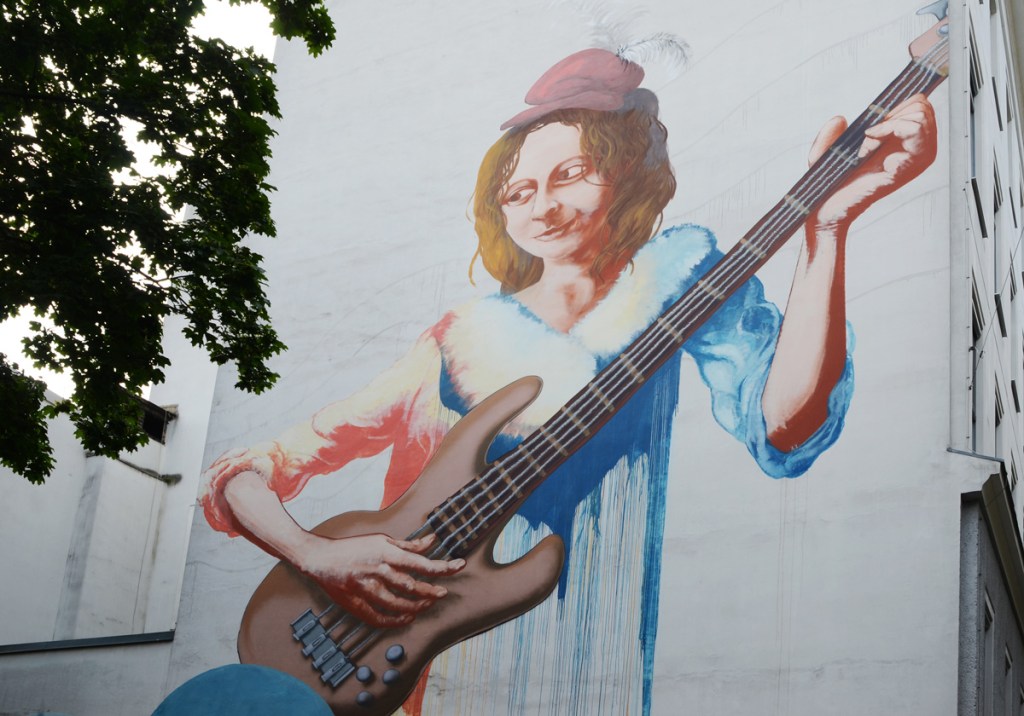
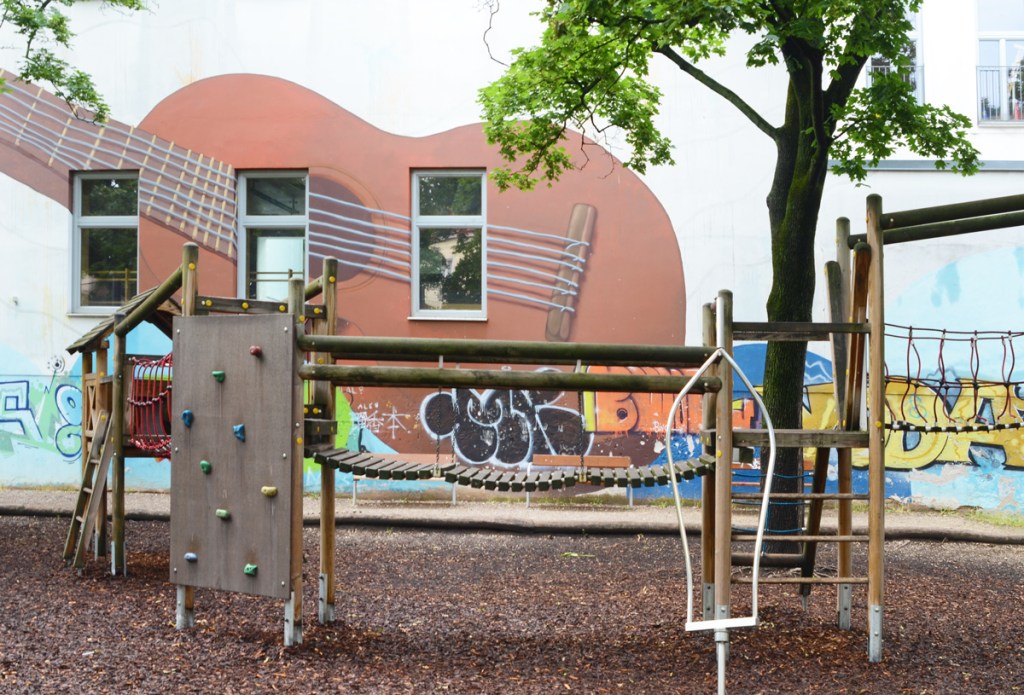
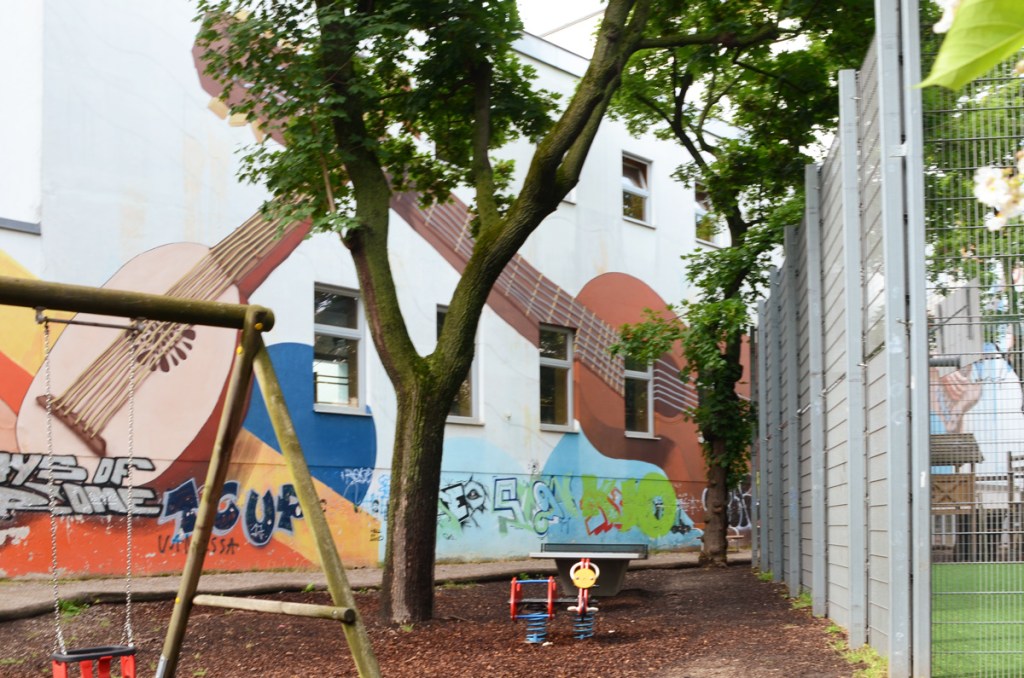
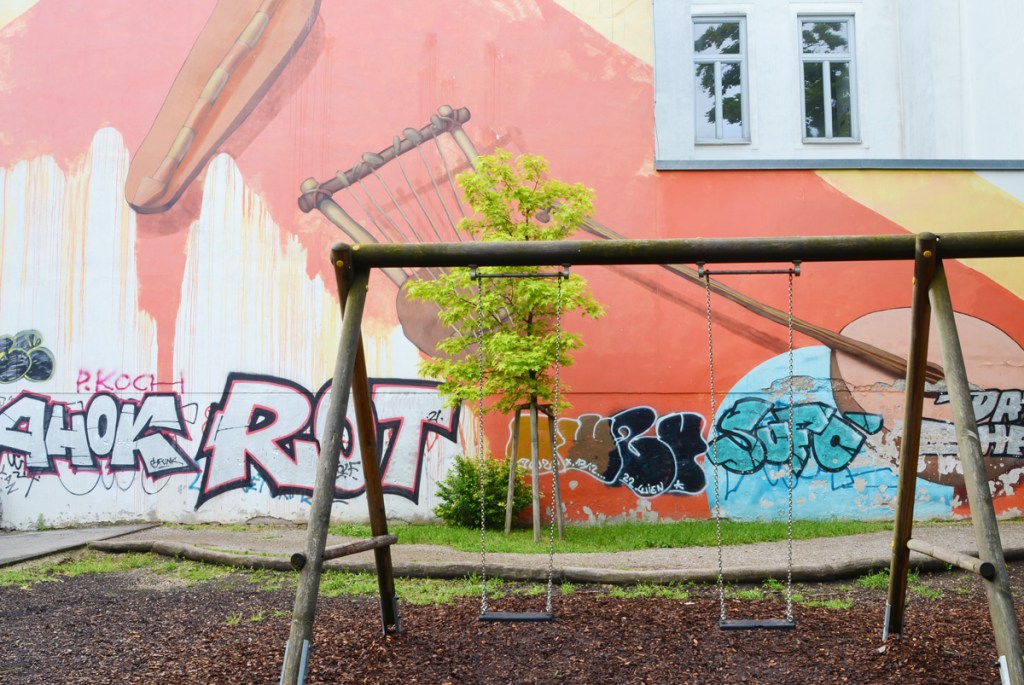
There is a large mural on the the side of a school beside a small park (Ernst Lichtblau Park) and playground near the intersection of Einsiedlergasse and Siebenbrunnengasse. Because of the size of the mural as well as all the trees, playground equipment, and caged soccer field in front it, a proper picture of the whole mural was impossible. Instead, I have a series of photos taken from the musician playing the electric guitar depicted on the right to the different instruments on the left.
The mural was painted by El Jerrino, a Vienna based artist.
























 Eyes on the Streets