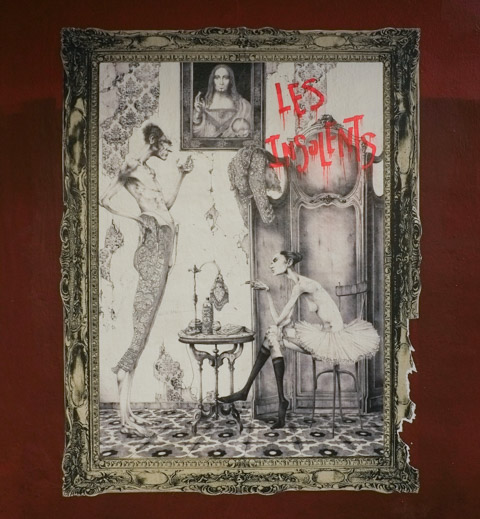
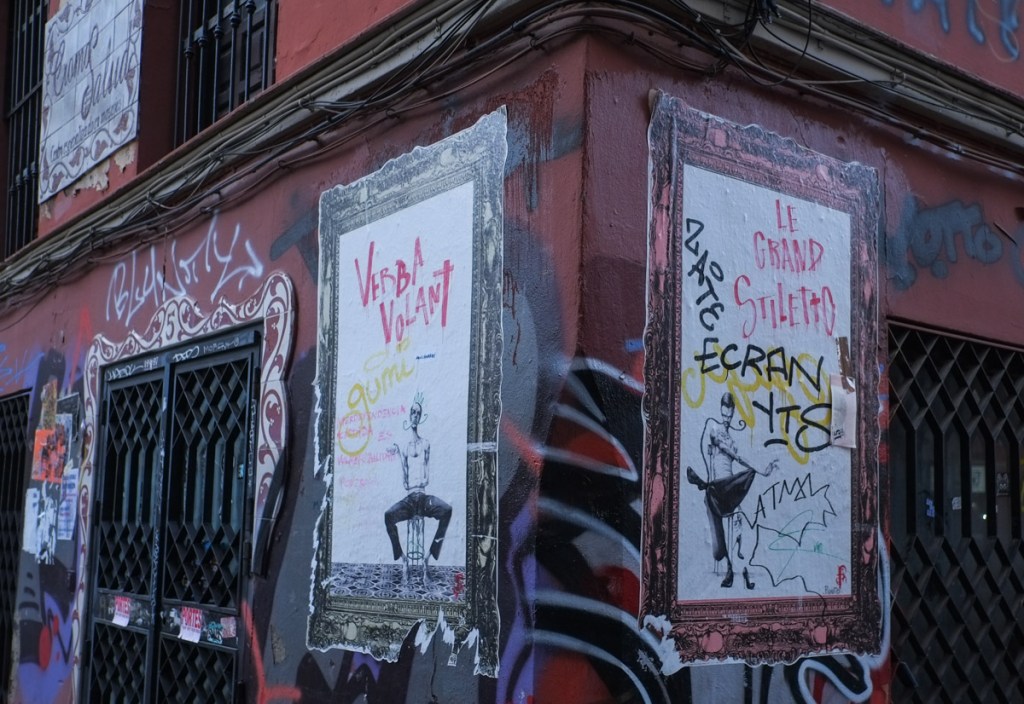
Hannging on walls in Seville. by Adolfo Arenas Alonso. Scenes in run down rooms with peeling wallpaper. Once grand but now not so much. Religious icons and figures in paintings and sculptures look down on the human characters. Characters that either impossibly skinny or overweight. Crosses on the walls. Indolent. Slovenly. A macabre sense of place and time verging on the profane.
below: The Matador and the Insolents
below: Ars Amandi, The Dreamers (Ars Amandi is Latin, ‘The art of loving’)
below: Volaveront (Latin, translates to “They will fly). The Hall
below: Verba Volant (The words fly) and Le Grand Stiletto
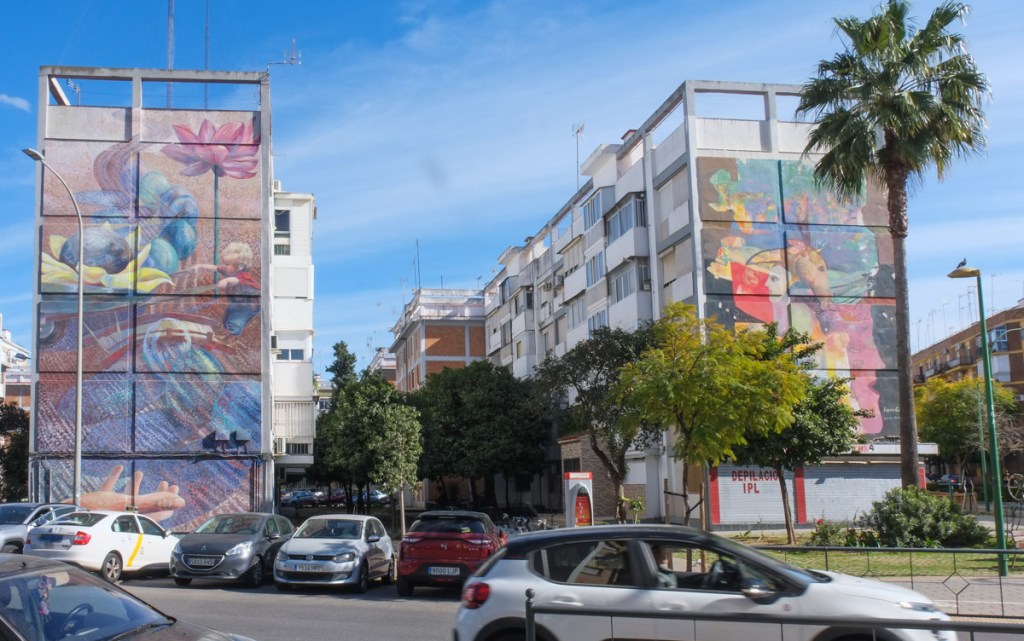
In Seville’s Poligono de San Pablo neighbourhood there is a growing number of murals on the ends of the midrise buildings that in the area. Since 2010, the group Arte Para Todos has organized the painting of most of these murals.
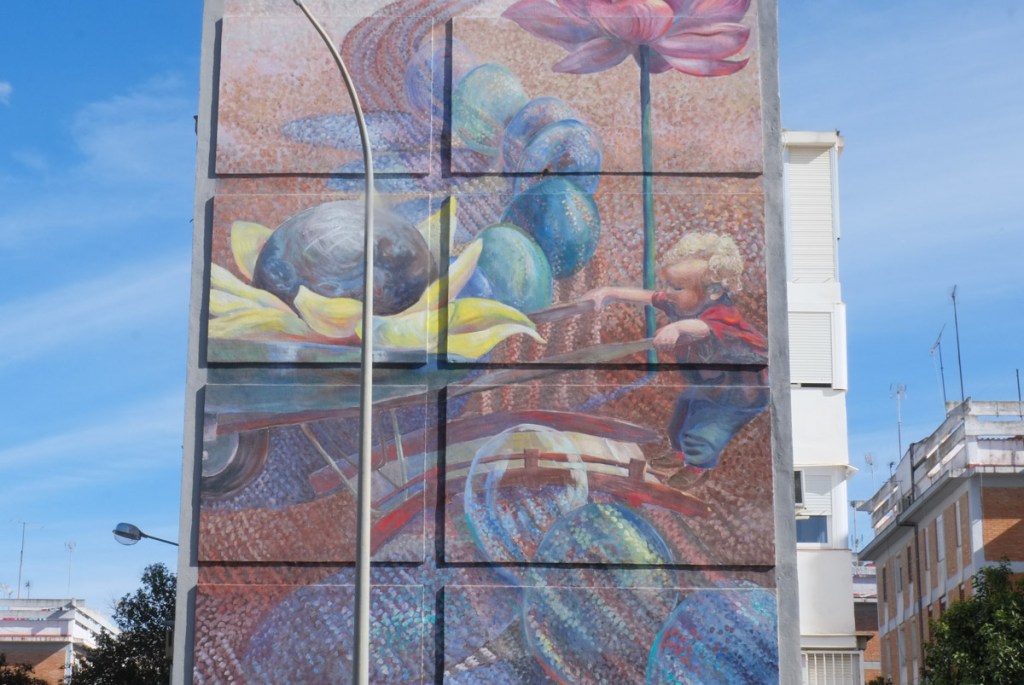
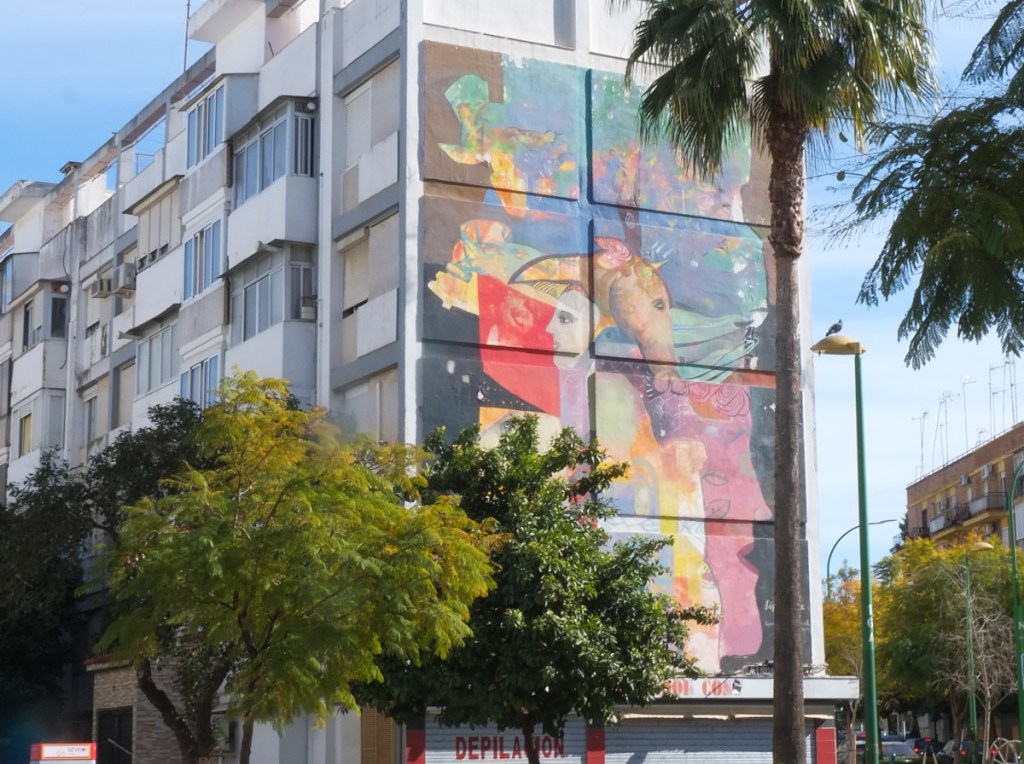
below: LEFT: “Younger Hands” by Josh Sarantitis. RIGHT: “Planeta Tierra” by Luis Alberto López Cruz
below: A closer look at the mural on the left, a young child pushes a wheel barrow.
below: And next, a closer look at the faces and abstractions in “Planeta Terra” – a horse, pink faces, flowers, and leaves.
below: “Flemenca” dancer by Maya Angelon, Verónica Werckmeister, and Cristina Werckmeister, painted early in February 2023. The words were taken from two sources – a song and a poem. They say “NOW you understand just why my head’s not bowed – it’s in the CLICK of my heels and the BEND of my hair, the palm of my hand, the need of my care, ’cause I’m a PHENOMENALLY phenomenal WOMAN, that’s me.”
below: Blue Earth map on Plaza Adoracion de Los Pastores. “Will tomorrow’s world be free?”. Signed INO, Wang Lu, Fl Vincent, Art For All 2010.
below: A South American themed “Inca Dreams”
below: Sleeping baby, “El niño” by Elninodelaspinturas, painted February 2023.
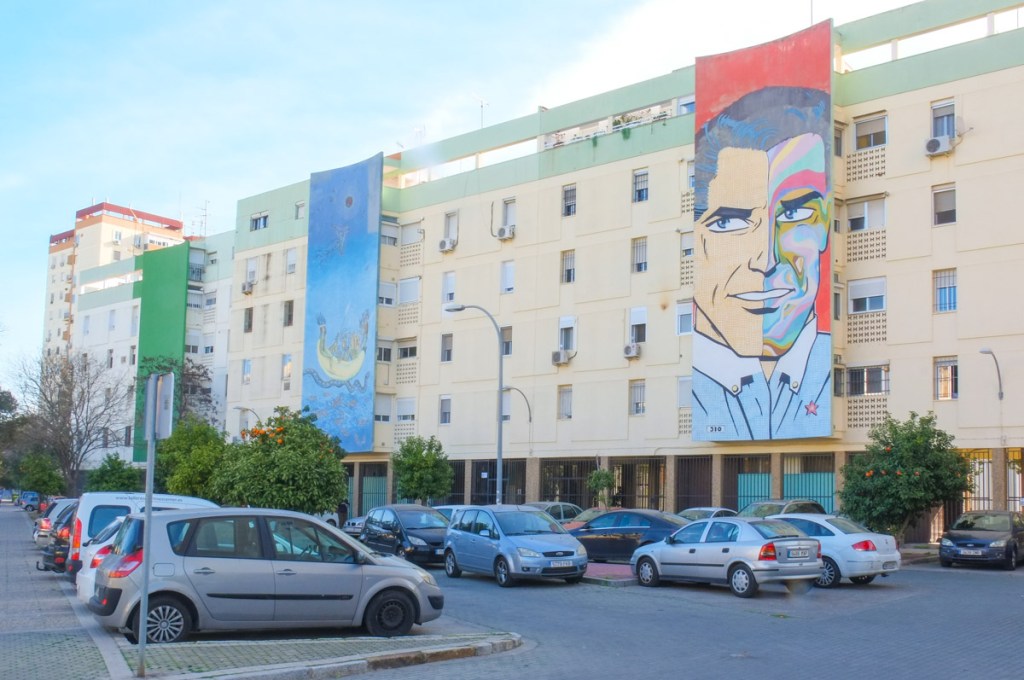
below: Two large murals and a green wall adorn the buildings.
below: A man divided, a man in two styles, a man painted by 310 Squad and given the title “Communist”. 310 Squad is a Russian artist, Stepan Krasnov.
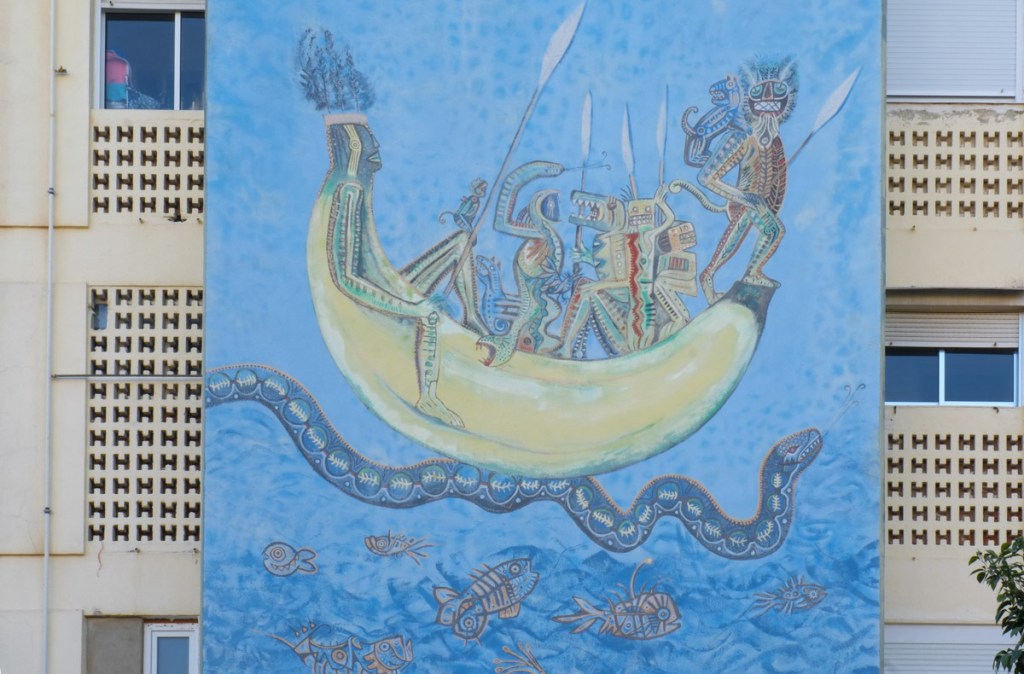
below: All together in a banana-man boat, sailing through the water with the snakes and fishes in an imaginative creation by Nelson Roman. “El Cacique Banana y sus Guerreros” (The Chief Banana and his Warriors).
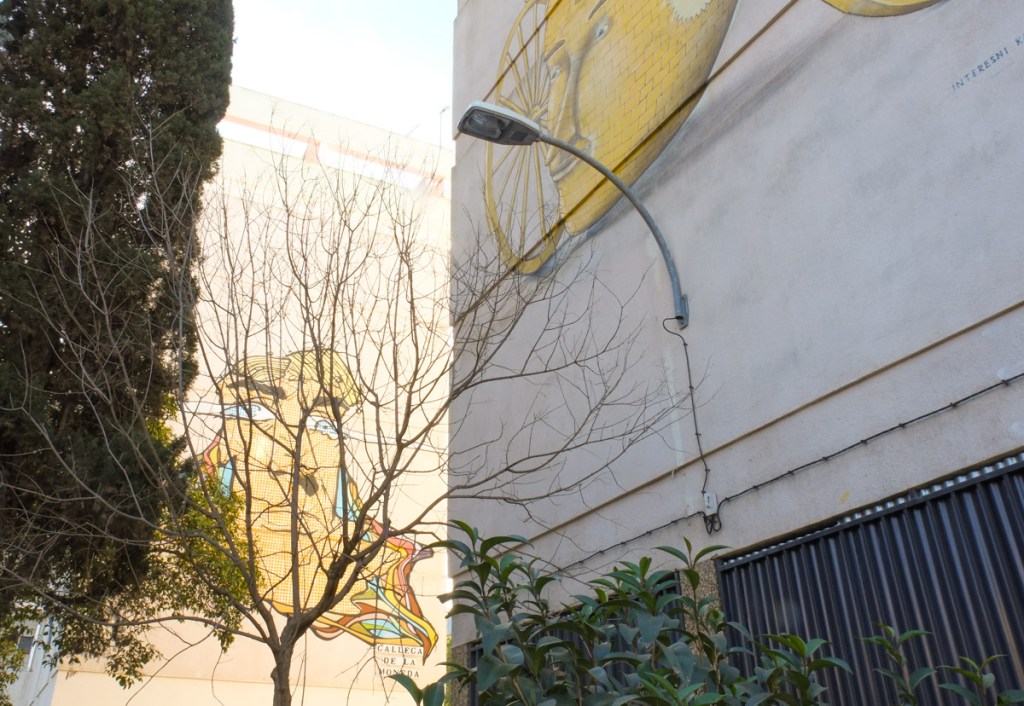
below: Yellow dots make the man – with a melting chin? Is he crying horizontal tears? The piece is titled “La Mirada Ilorona” (translates to the weeping look or the maudlin look) and it was also painted by 310 Squad.
below: Close by the weeping man, is another mural in yellow
below: “Agua Fértil” by Ivan Fiallos, rain falls into the water.
below: This is what lies under the water, a man on his back with his knees pointed upwards. A parrot sits on his knees while a dead? bird lies on his stomach.
below: She carries the city in a basket on her head as she wades past the ships and boats in a mural by Katie Yamasaki. The title is “Dedicado a la Infancia” (Dedicated to Childhood)
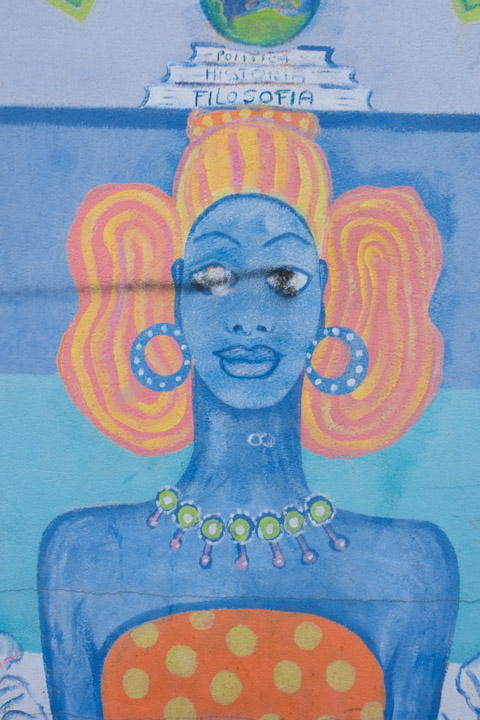
below: Filosofia, philosophy personified or brought to life?
below: Dancing in the garden
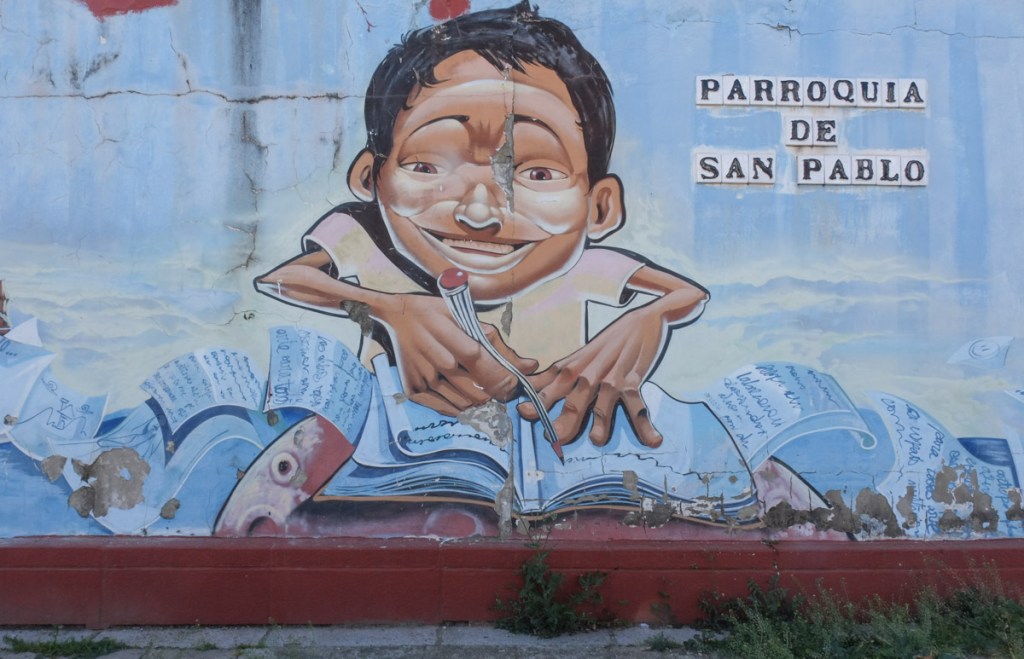
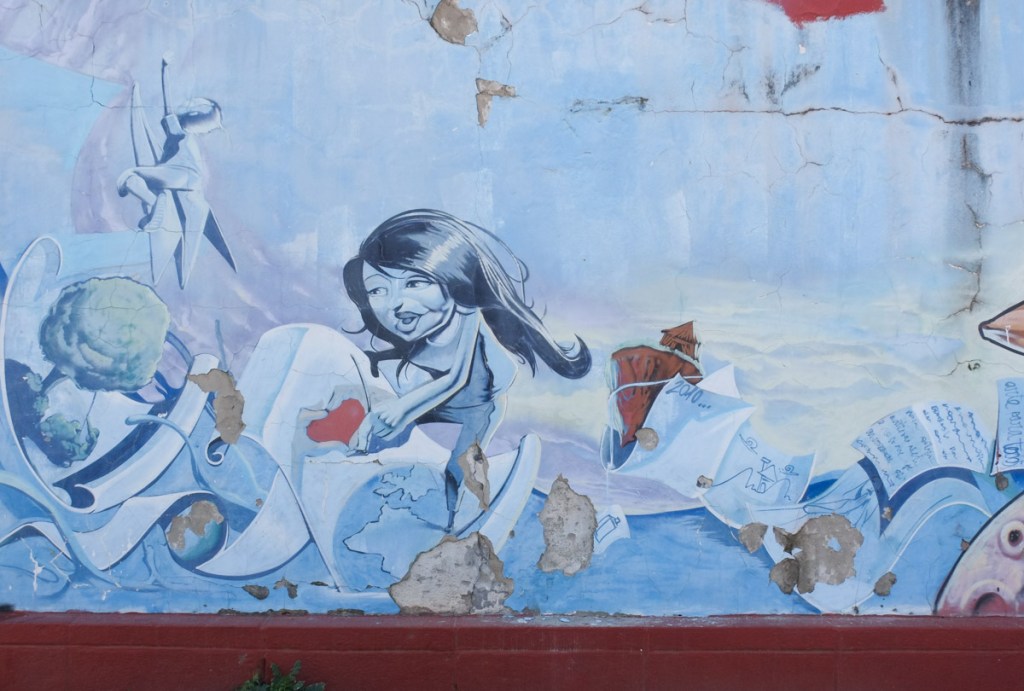
below: The next three go together with this first photo being the center of the artwork on a Parroquia de San Pablo wall.
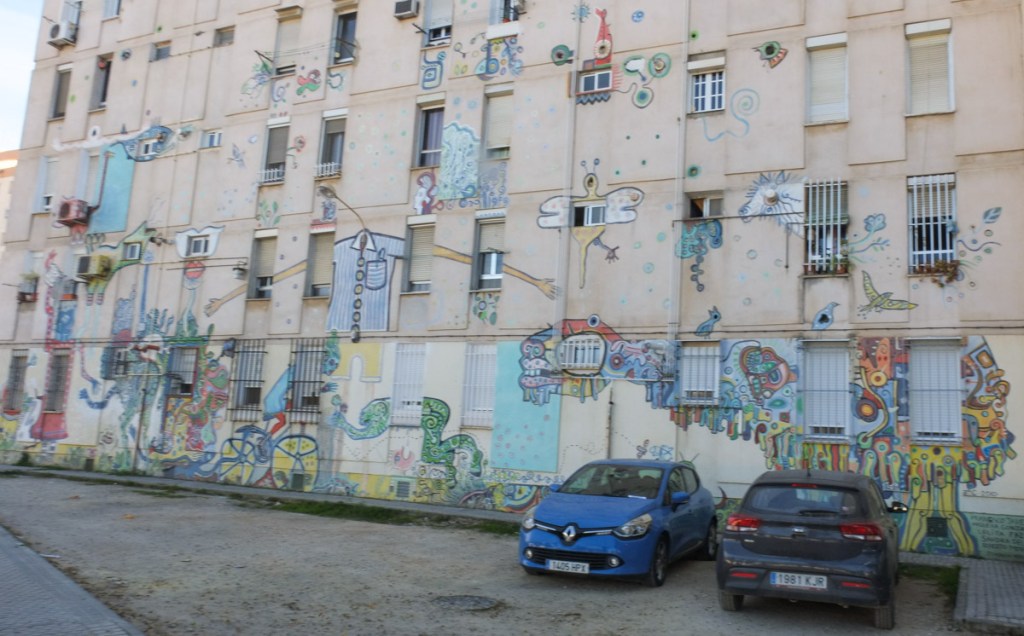
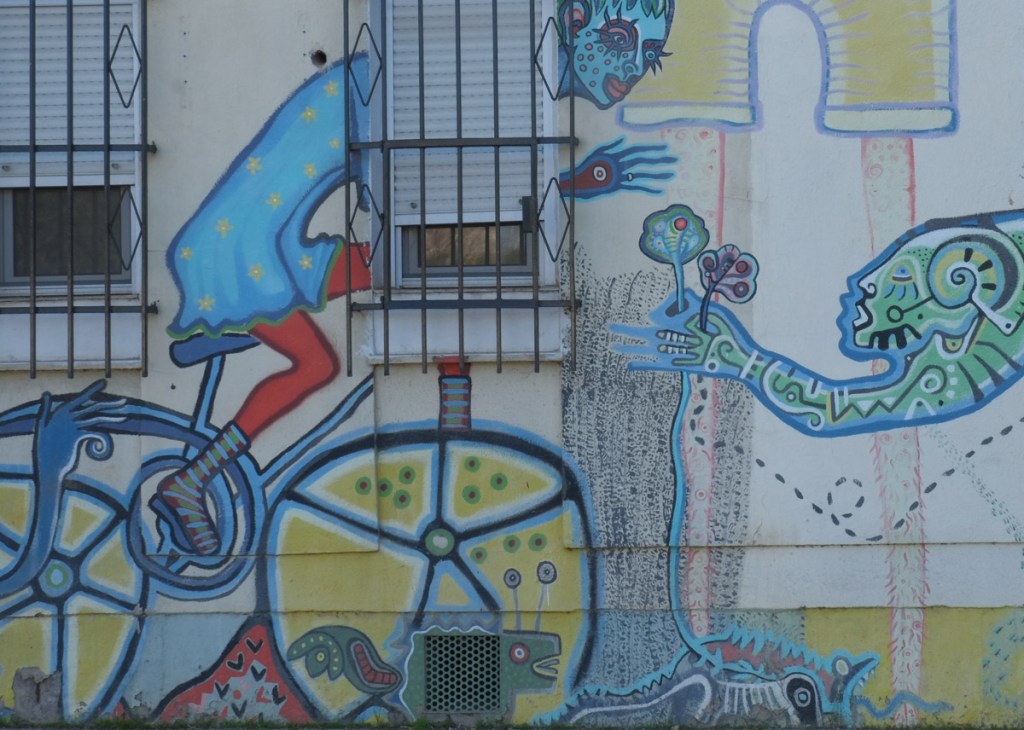
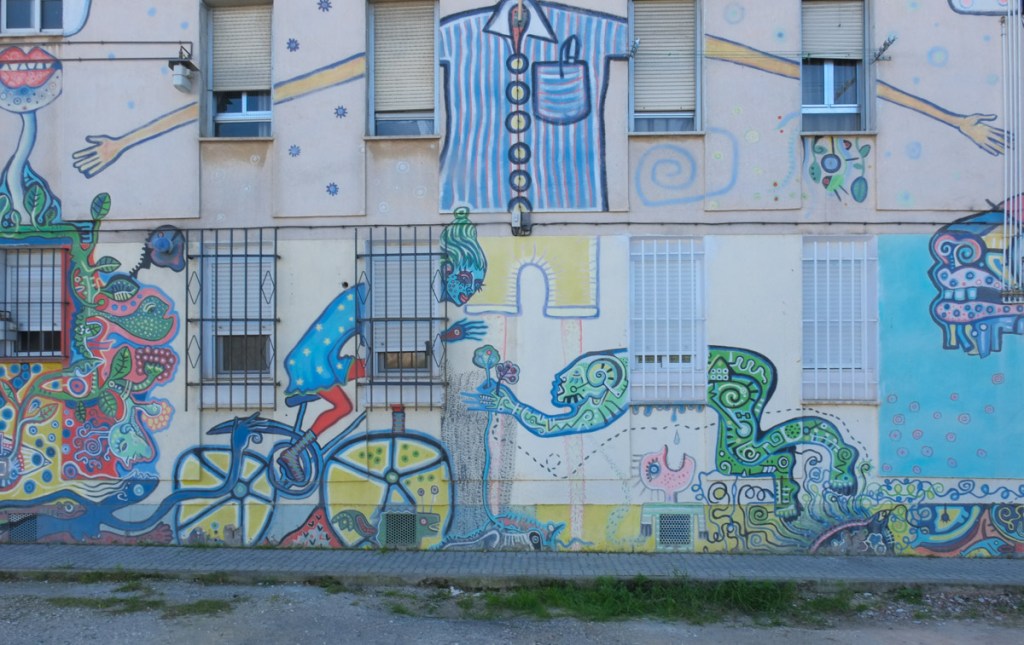
On the back of an apartment building in Seville (Sevilla) Spain there is a mural that is a collection of scenes involving fantasy animals and characters.
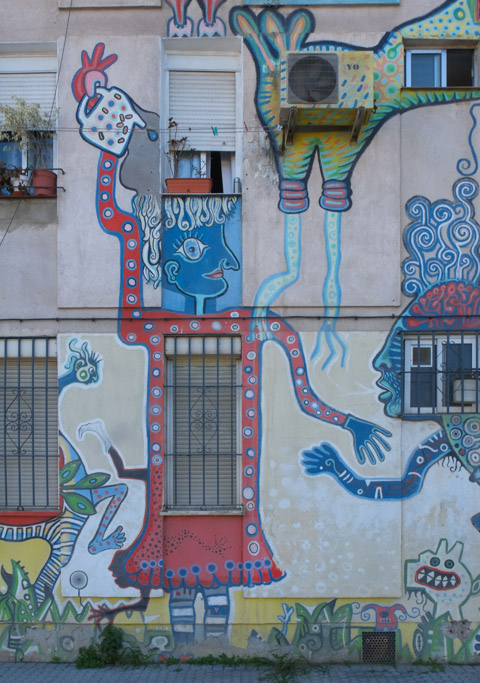
below: Long and flexible arms make it possible for her to water the flowers and reach out to others at the same time. … even if she’s got wet hair.
Six artists were involved: Francisco Javier, Hiquera Gonzales, Lolita Paz, Sandra Del Gado, Roberto Moreno and Joaquin Heredia.
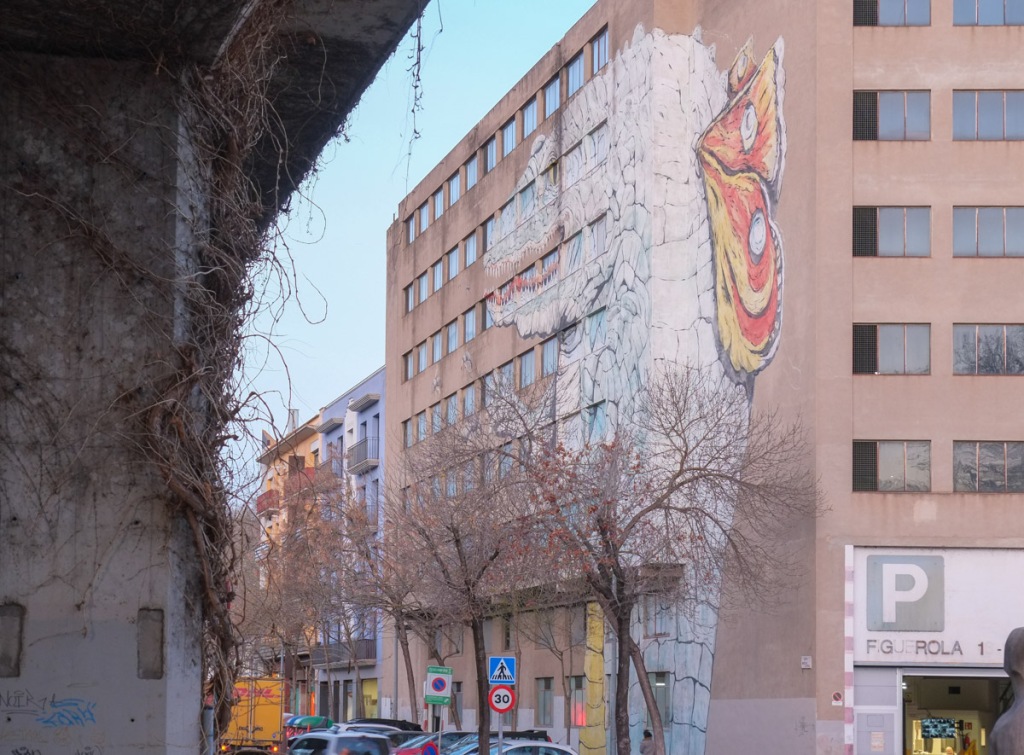
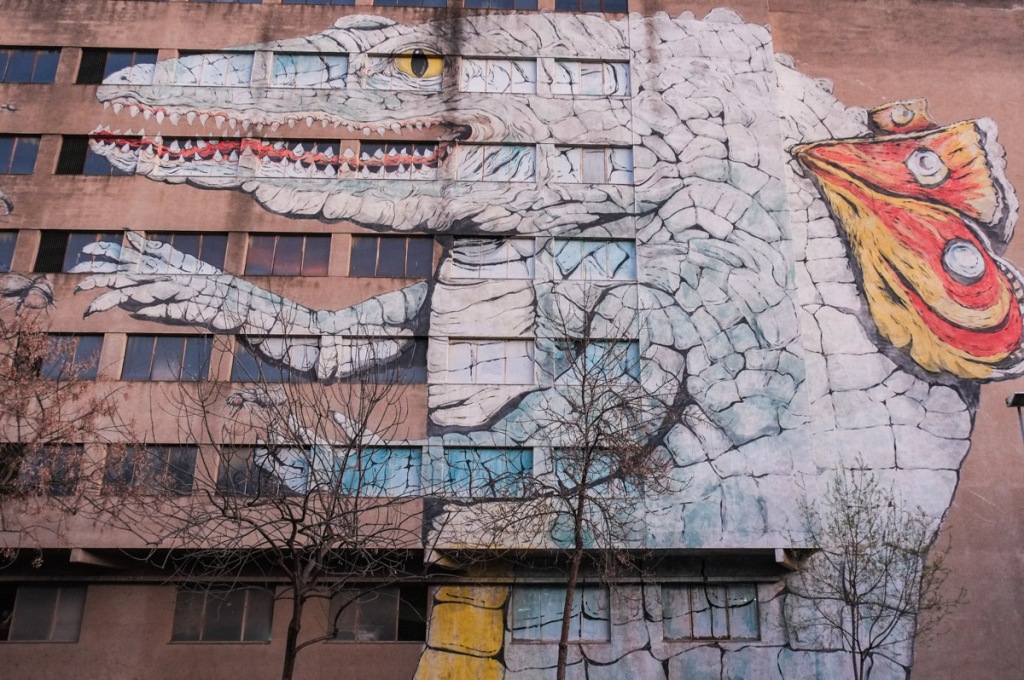
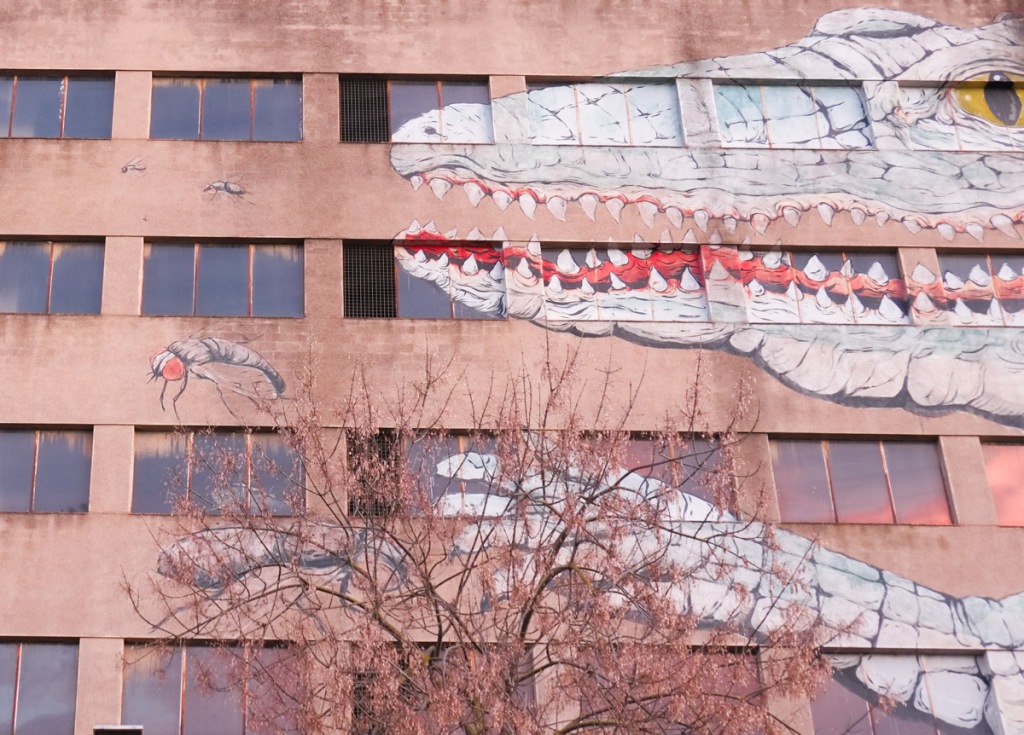
A large mural in Girona Spain painted by Erica Il Cane (ericailcane) oof a crocdile with wings on its back.
Over the years her scaly skin has lost its greenish blue colour but otherwise she is aging well.
From Wikipedia: “According to legend, she was once a nun who, due to her lack of faith, was punished and imprisoned in the dungeon of the city’s monastery, and could only leave to go to the river that runs through the city (Onyar River). After many years, due to her undernourishment and isolation, she grew scales until she fully metamorphosed into a crocodile-like creature. In spite of this punishment, she was still somewhat saintly, which manifested as a pair of butterfly wings.
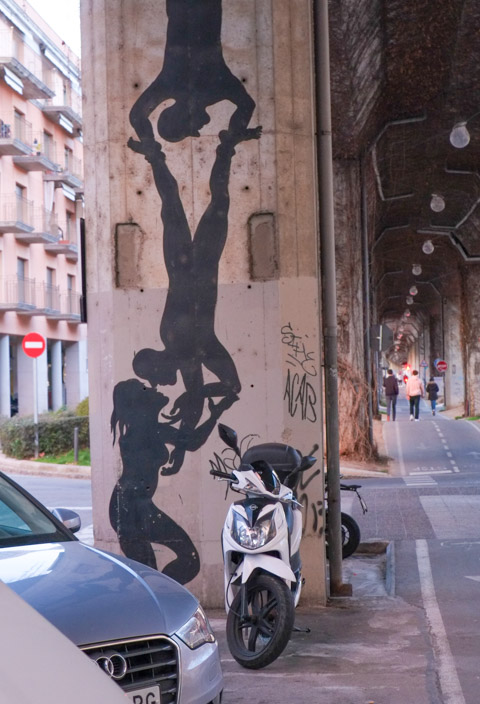
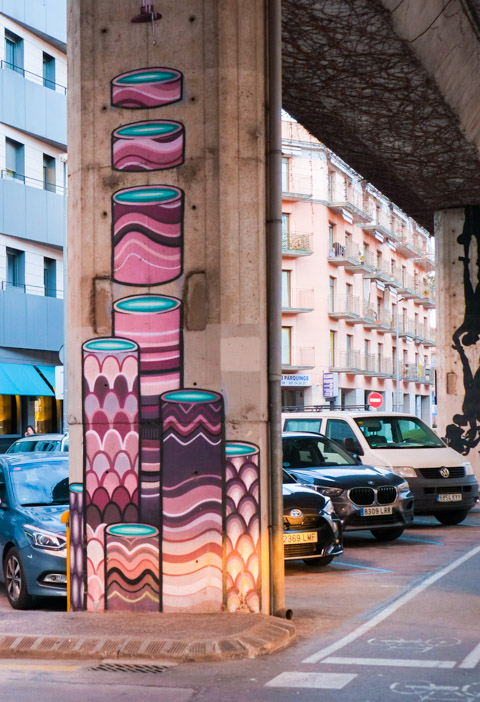
A long stretch of railway is elevated as it passes through the city of Girona, Spain. A bicycle and pedestrian path runs underneath. Some of the pillars supporting the railroad have been decorated by street artists.
below: Birds in flight
below: Cyop & Kaf have painted a few of the pillars with their black silhouette-like people such as this stolen kiss.
or this very tall man – He’s all tied up with his feet in the mud? in concrete?
below: KRAM is responsible for two pillars including this blue character on a swing.
below: The other KRAM pillar is this one – quite different from the first.
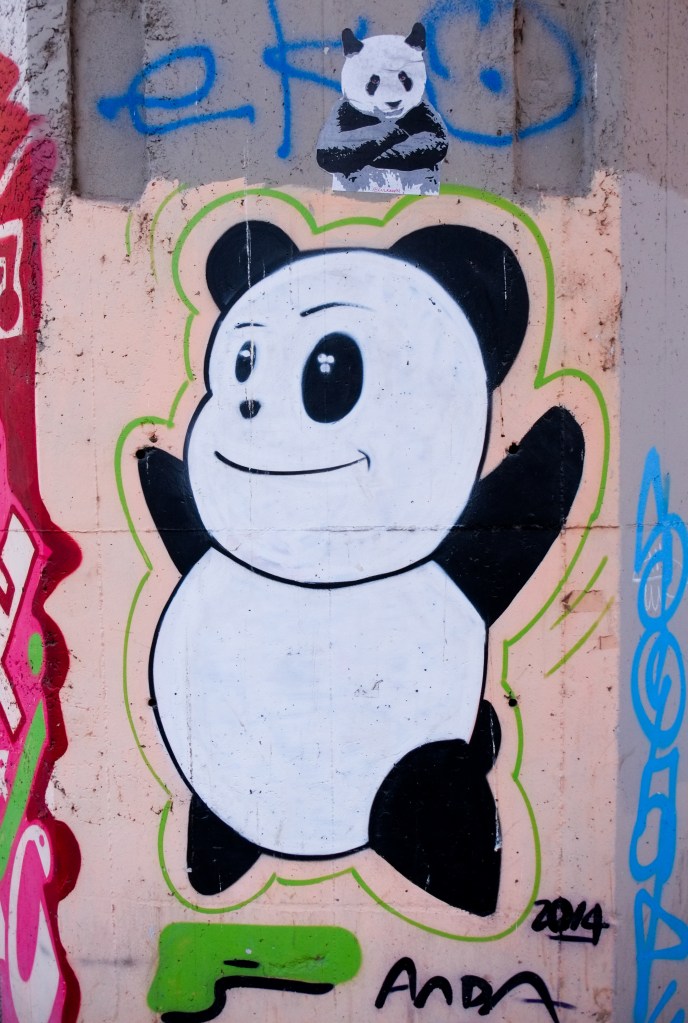
below: Two pandas
below: A brush to clean the toilet bowl. Not your average painting subject matter.
below: A few pillars are decorated with these red and blue guys – stylized yet anatomically correct – painted by Boris Hoppek
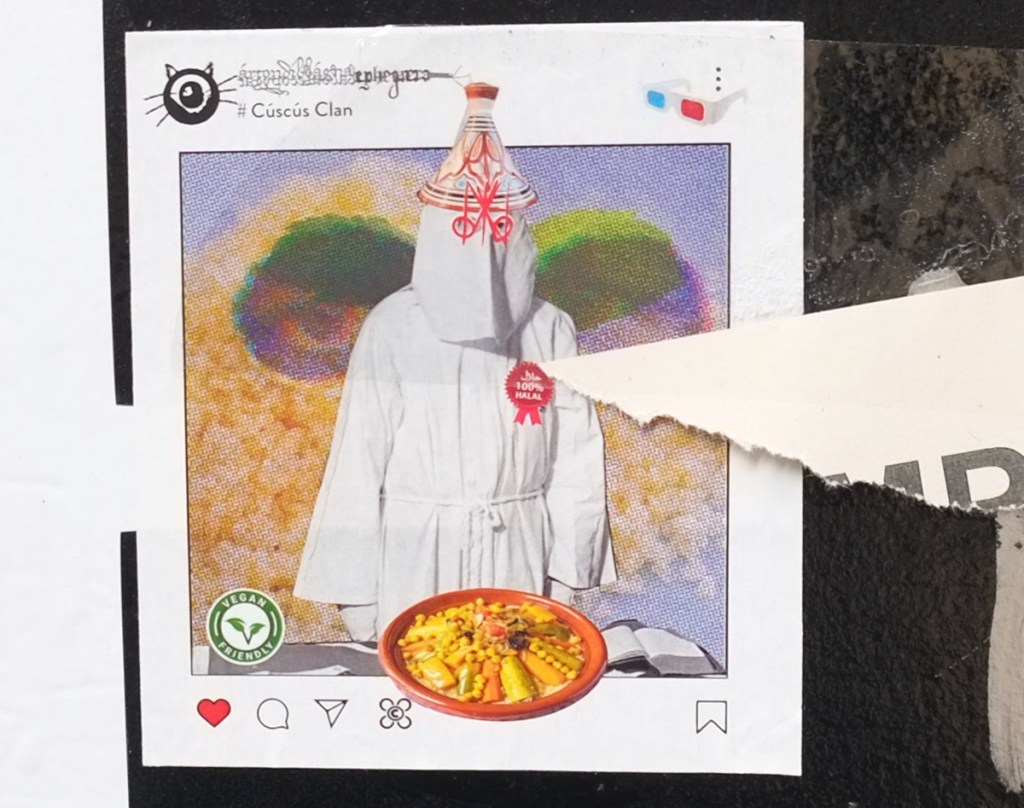
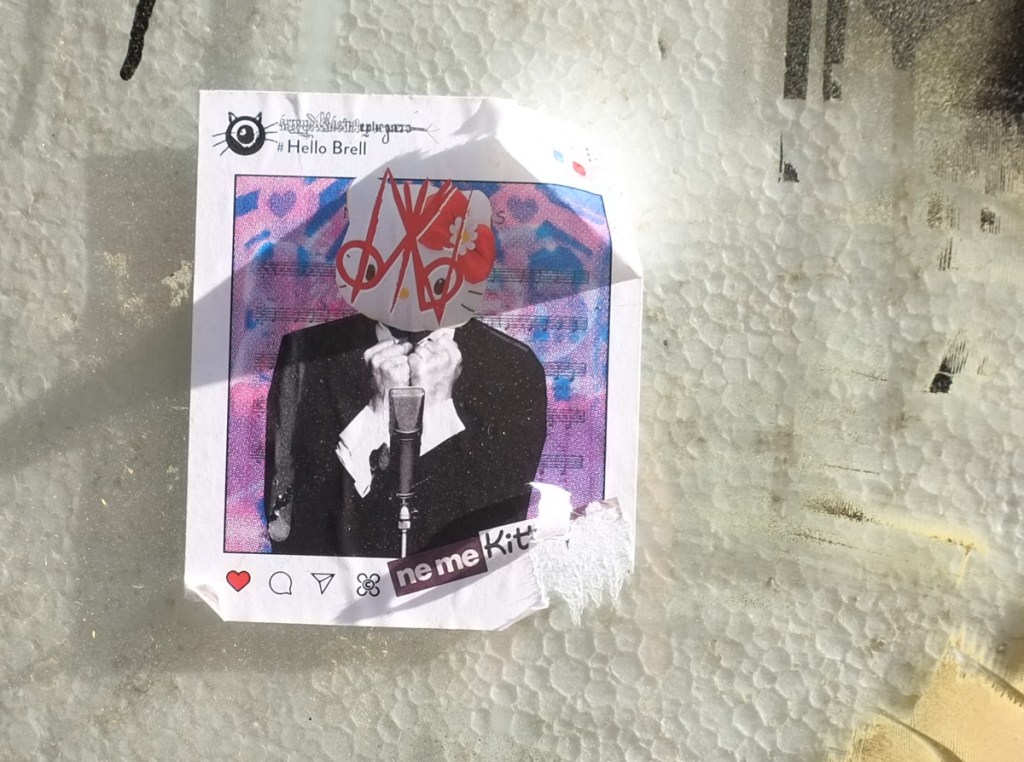
Back in March I kept seeing these little pictures all over Barcelona. Pasted to poles, walls, and other surfaces were images made to look similar to an instagram page. In each case the subject in the picture was a combination of two people or things with similar names. The same symbol was drawn on their faces – upside down scissors within three parallel vertical lines.
So far I haven’t been able to find any information about the artist. I suspect that the clue to his/her identity is at the top left of each graffiti piece but I can not decipher it.
below: “Franco (Battiato)” Franco Battiato is a musician whereas Franco also refers to Francisco Franco Bahamonde (1892-1975) who was the general who led the Nationalist forces to victory in the Spanish Civil War in 1939. He was then dictator of that country until his death in 1975. In the image below we see a smiling musician’s face on the body of a military leader.
below: Couscous Clan (Cuscus Clan) is vegan friendly, 100% halal, and wears a tagine pot on its head. A mix of the American Klu Klux Klan and the mideastern food staple; Juxtoposition of white supremacy with “brown” food and Islamic ideas. Is that a bible or the Koran that he’s reading?
below: “Bjorn-Bjork” tennis playing singer. Björn Borg (b. 1956) Swedish tennis star swings his racquet at the ball. Björk (aka Björk Guðmundsdóttir b. 1965) Icelandic music star. The face and headdress in this image is taken from the cover of her album “Homogenic” which was released in 1997.
below: “Heidi Lamarr” Classic movie buffs will recognize the name (and face) of screen legend Hedi Lamarr (1914-2000). Here, she is paired with Heidi, the main character in two children’s novel published in the 1880s by Swiss author Johanna Spyri. Since then, Heidi, the most famous Swiss girl, has been retold and adapted numerous times. The image of a girl on a swing used here comes from Isao Takahata’s anime series “Heidi the Girl of the Alps,” 1974.
below: “Hello Brell” mash-up of Hello Kitty, the fictional anthropomorphized white cat created by Yuko Shimizu and ???. There is a music score with hearts in the background which might provide a clue but for now it remains a mystery.
below: “Knight Rider” on his horse looks like he’s delivery for UberEats or some other food delivery service. Knight Rider was a TV series in the 1980s starring David Hasselhoff. Now he’s a knight of the realm? But of which realm?
below: Juan Salvador Jeviota becomes a guitar rocking bird. It’s probably a seagull as in ‘Juan Salvador Gaviota’, the sea gull that stars in the Spanish translation of ‘Jonathan Livingston Seagull’ authored by Richard Bach back in 1970. The cats are fans! As to the reference to Jeviota, or what the second part of the idea might be, I am striking out again.
below: “Lemmy Riefenstahl” with a camera in his hand. The face here is masculine but the background blue and purple portrait is female; the mashup here is with Helene Bertha Amalie “Leni” Riefenstahl and Ian Fraser Kilmister (aka Lemmy, 1945-2015). Leni was a German film director, photographer and actress best known for her role in producing Nazi propaganda. Lemmy was a musician with rock band Motörhead.
below: “#operacionfreequini #talegoquini” Talego Quini was an album by Spanish musical group Parquesvr released in 2019. Quini (1949-2018) was a football player (and that’s his picture). In March 1981 he was kidnapped and held for 25 days before being rescued. His full name was Enrique Castro González.
below: “Pimp Ball” with pinball paddles – so obviously this is a combination of the pinball game and ??? Not just any pimp I’m sure but alas I don’t have the answer.
below: Robin in tha Hood, LA Hollywood
below: “Selfneca – say cheese!” Is the face that of Seneca or Seneca the Younger, both of whom were Roman philosophers and Stoics who believed that we waste most of our time. That’s just a guess but I rather like the idea of selfies and a waste of time in one photo.
below: “D’Urruti” The face of Buenaventura Durruti (1896-1936), a Spanish anarchist during the Spanish Civil War has been added to the body of Argentinian football player Maximiliano Urruti. A play on the surname (D)Urruti.
Carrer Petritxol is a narrow street in the Gothic Quarter (Bari Gotic) section of Barcelona. It dates from the 15th century when it was a shortcut through the backyard of a local property owner. It runs from Portaferissa to Plaça del Pi. Today it has many small unnique stores including chocolate stores.
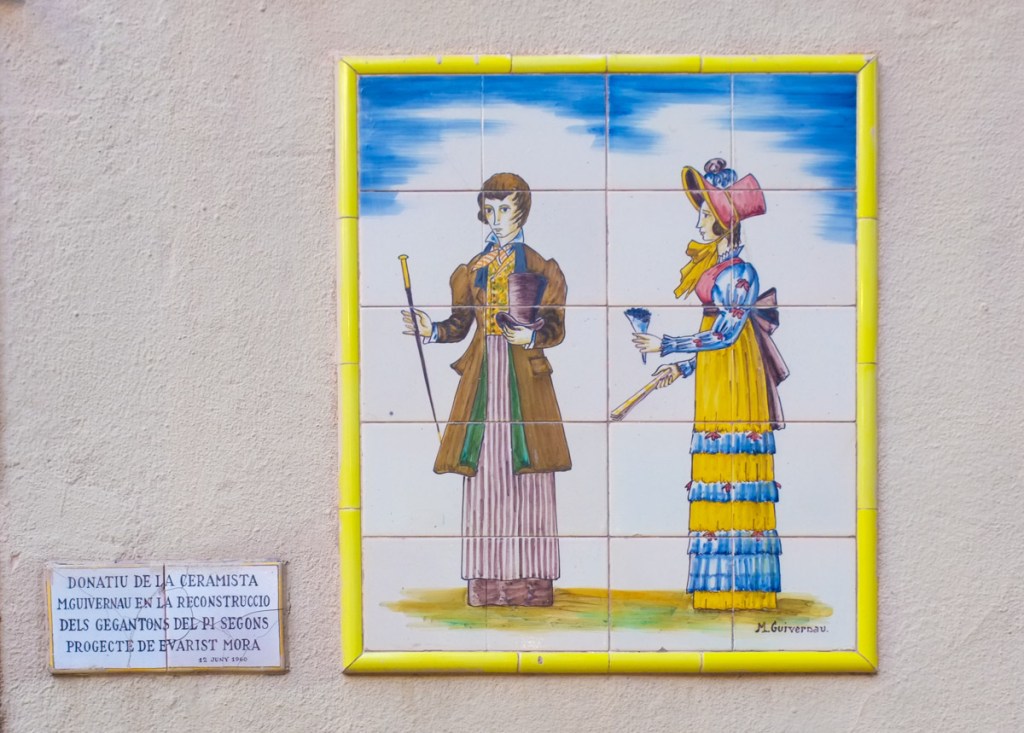
below: Catalan text: “Donatiu de la ceramista M. Guivernau en la reconstruccio dels gegantons del pi segons progecte de Evarist Mora.” Translation from Catalan: “Donation of the ceramist M. Guivernau in the reconstruction of the “Giants of Pi” according to Evarist Mora’s project. Note: The Giants of Pi – On display at the parish church of Santa Maria del Pi are two wearable puppet costumes, one male and one female, known as the Giants of Pi. They have a long history but the part most relevant to this blog post is the fact that they were restored in 1960 by the artist Evarist Mora. In 1985 they were named Mustafa and Elisenda. They are two of the many “gegants” that are brought out for special events in Barcelona such as the Corpus Christi procession and the Santa Eulalia festival.
M. Guinervau signed the above plaque but there are many other ceramic pictures on this street, all unsigned. They tell stories about the street including famous residents or visitors. What follows here are photos and a few details about some of them.
below: “Aci la mare de Déu ens diu que el temps passa lleu” , translation: “Here the mother of God tells us that time passes easily (or easily)”
below: “Amb capa i barret llue cada nit “peius” gener”, translation: “With cape and hat, shine every night “Peius” Gener”. This image shows the Spanish writer, journalist and playwright, Babot Gener Pompey (1848-1920), often known as Peius wandering the streets after dark.
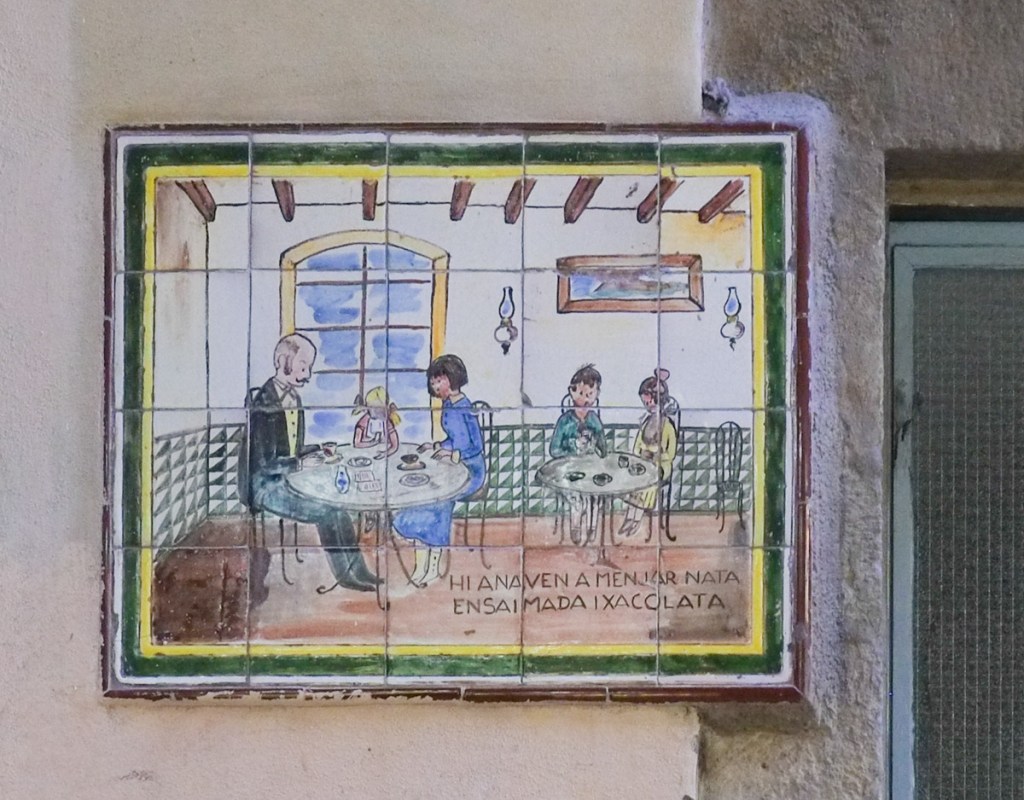
below: “Hi anaven a menjar nata ensaimada xocolata”, translation: “They were going there to eat chocolate cream” Carrer Petritxol has been a destination for chocolate for many years; there are at least 4 stores specializing in chocolate on this short street, two of which have a long history – Granja La Pallaresa and Granja Dulcinea. Granjas (Granges) were once shops specializing in dairy products.
below:Upper “De quant encara era nou i romantic el dinou”. The translation could be either “how new and romantic the nineteenth was still”, or “From when the nineteenth was still new and romantic” Lower: “De llavent ide ponent tot el da hi passa gent”, translation: “From dawn to dusk, people pass by all day”. This presumably refers to people walking along this street.
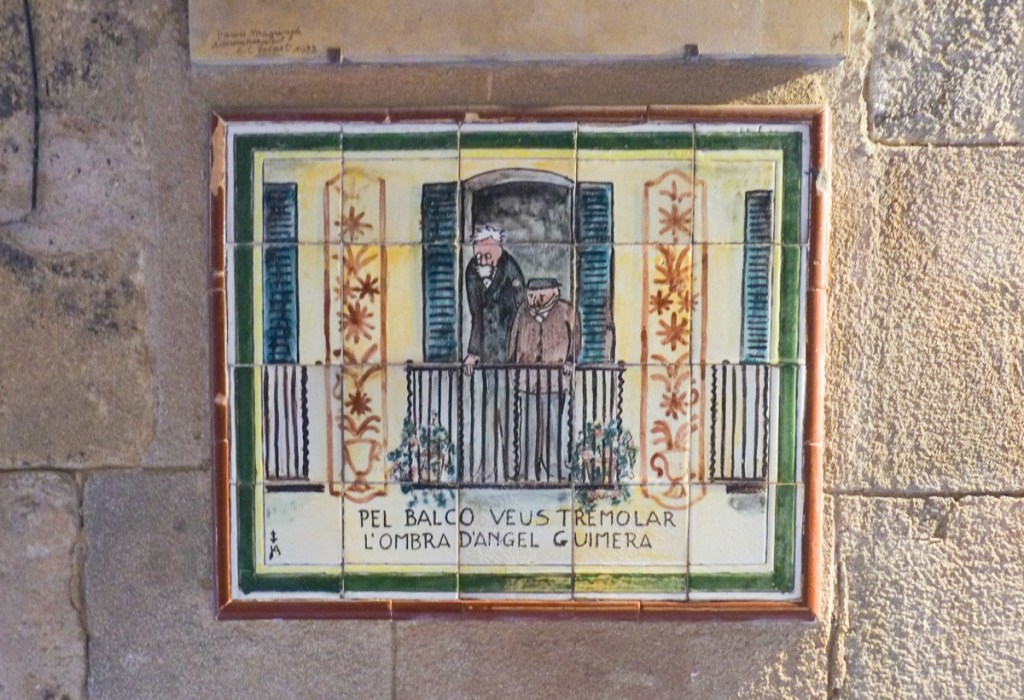
below: Catalan text: “Pel balco veus tremolar l’ombra d’angel Guimera”, translation: “On the balcony you see the shadow of Angel Guimera trembling”. Note: Angel Guimera (1847-1924) was a Catalan playwright.
below: “En un pis no sabem quin hi va viure Moratin” translation: “We don’t know which apartment Moratin lived in” . Note: Probably the writer Leandro Fernandez Moratin, (1760-1828) who lived in a hostel on this street in July 1814.
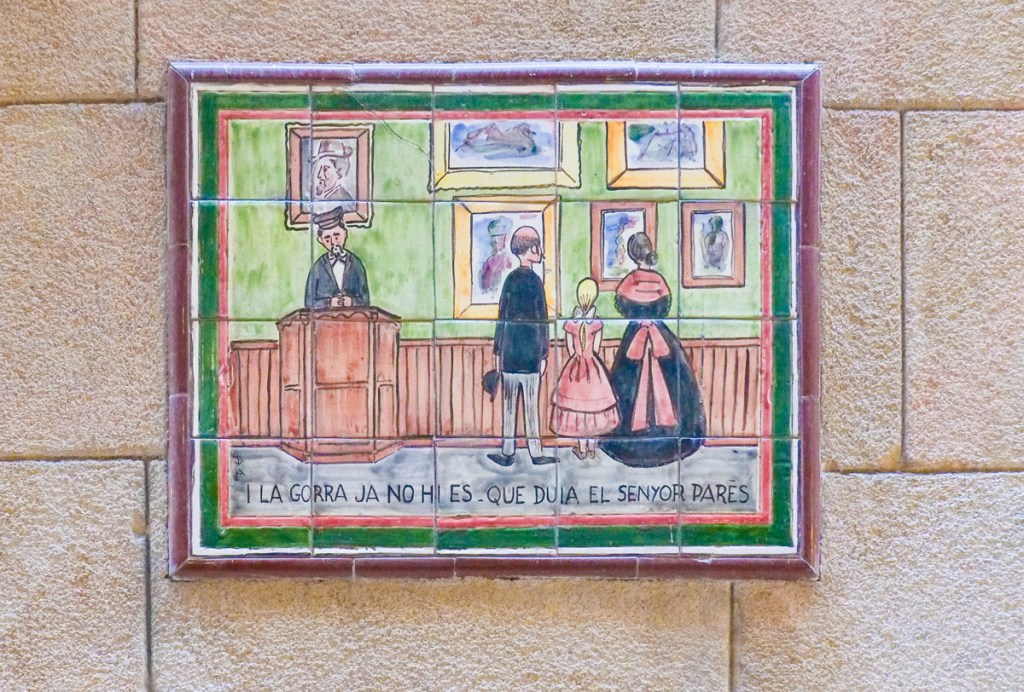
below: “I la gorra ja no hi es… que duia el Senyor Pares”. Transation: “And the cap is no longer there… that Mr. Pares wore” In other words, Sr Pares took off his hat when he and his family were at the art gallery.
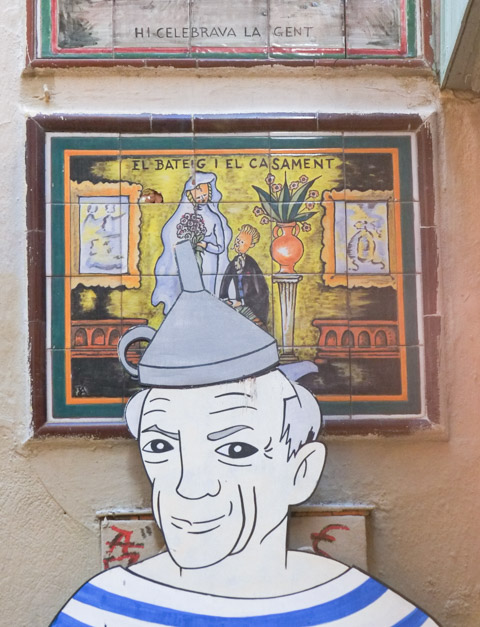
below: “El bateig i el casament”. Translation: “The baptism and the wedding.” That’s a rather short looking groom? The cutout of the man in the blue and white shirt with the funnel on his head is an added bonus!
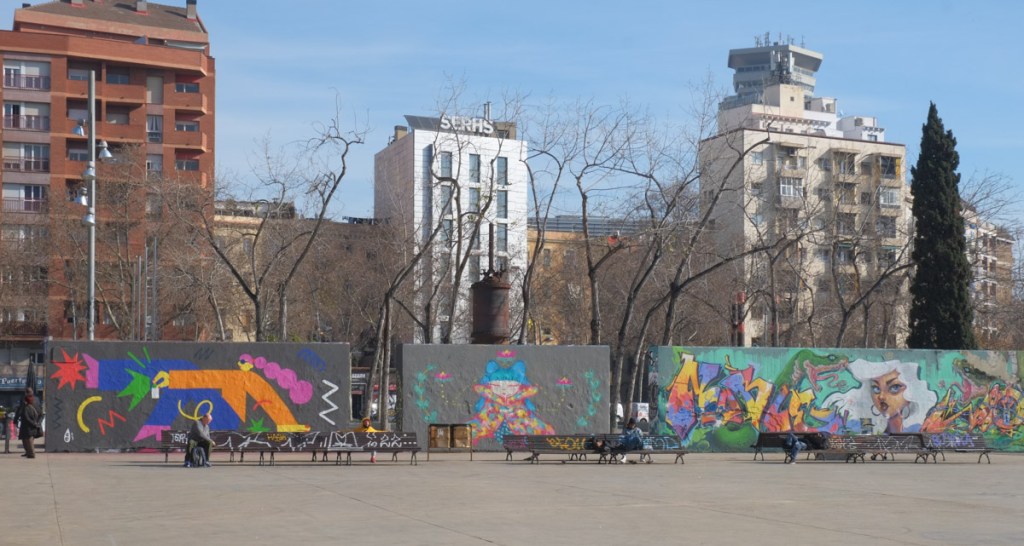
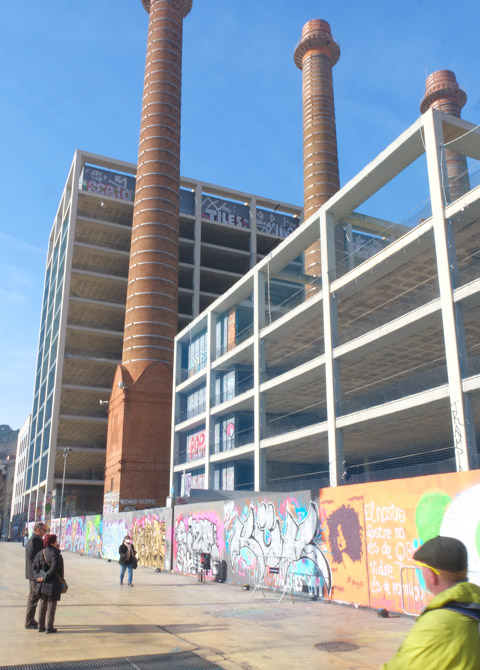
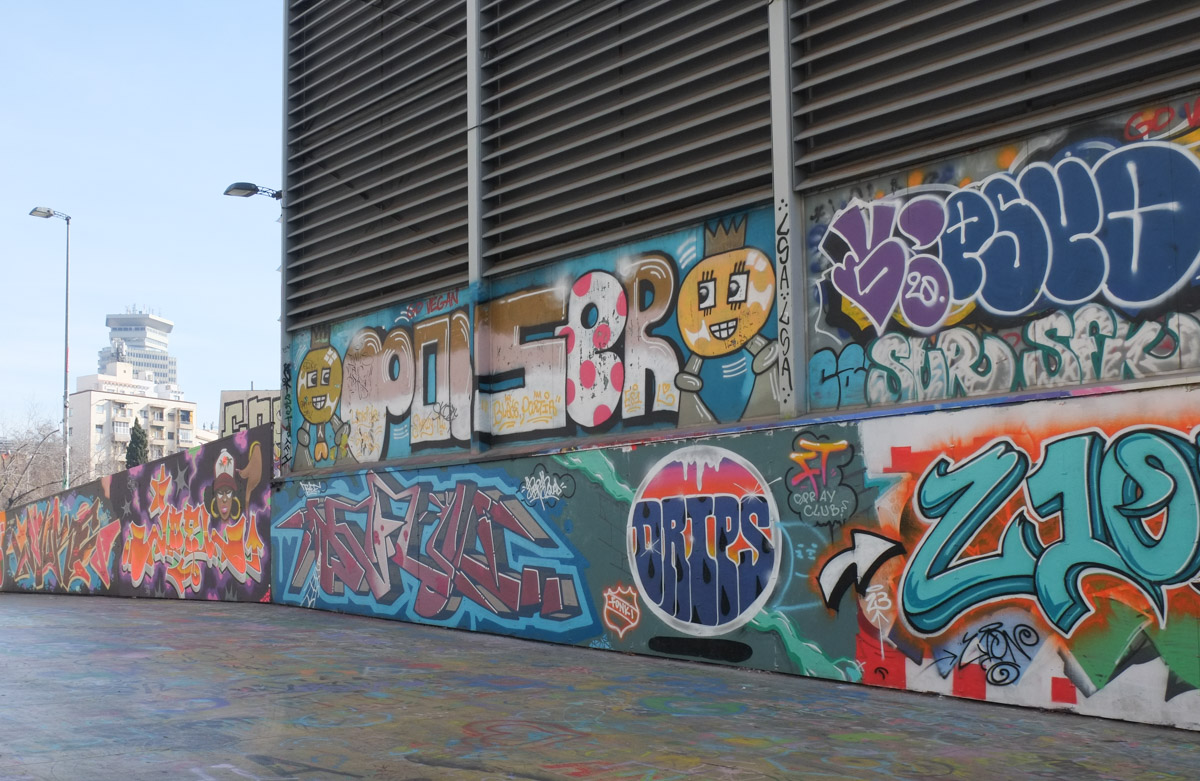
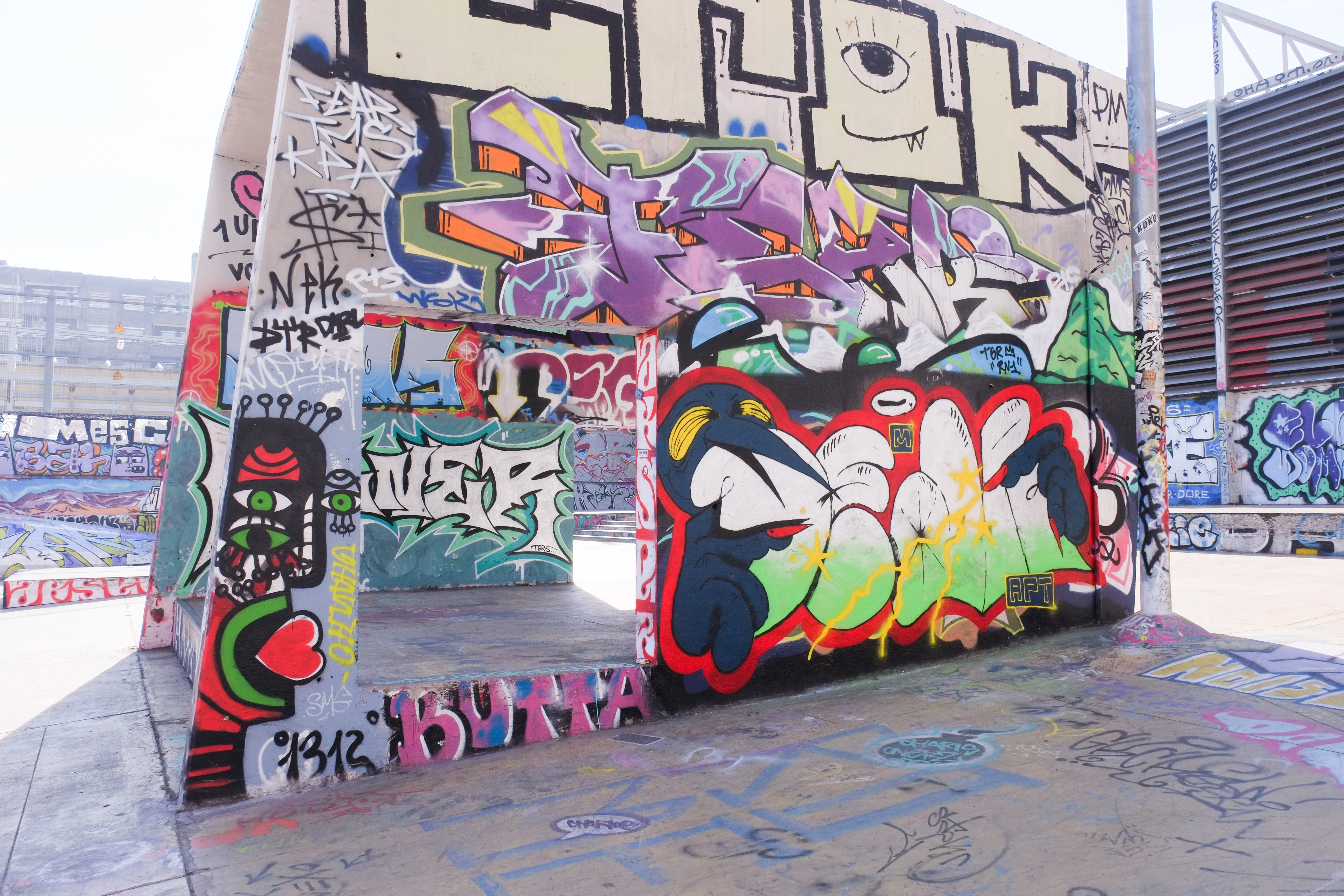
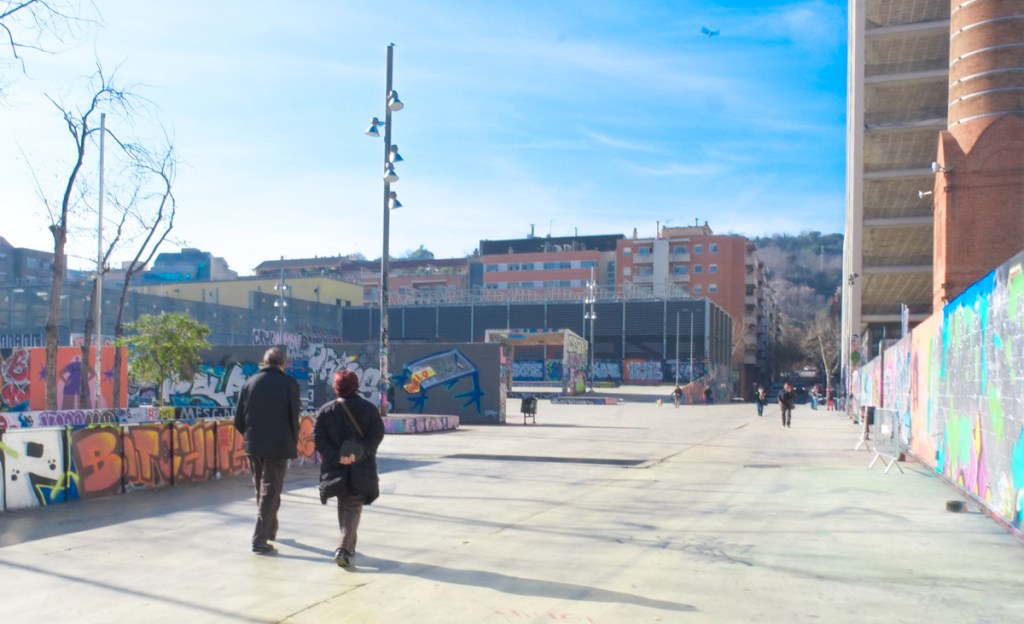
Three Chimneys is an urban park that is built on the site of an old power plant. In Catalan it’s Jardins de les Tres Xemeneies while in Spanish it is known as Jardines de las Tres Chimeneas. It is one of a few legal places for street art in Barcelona.
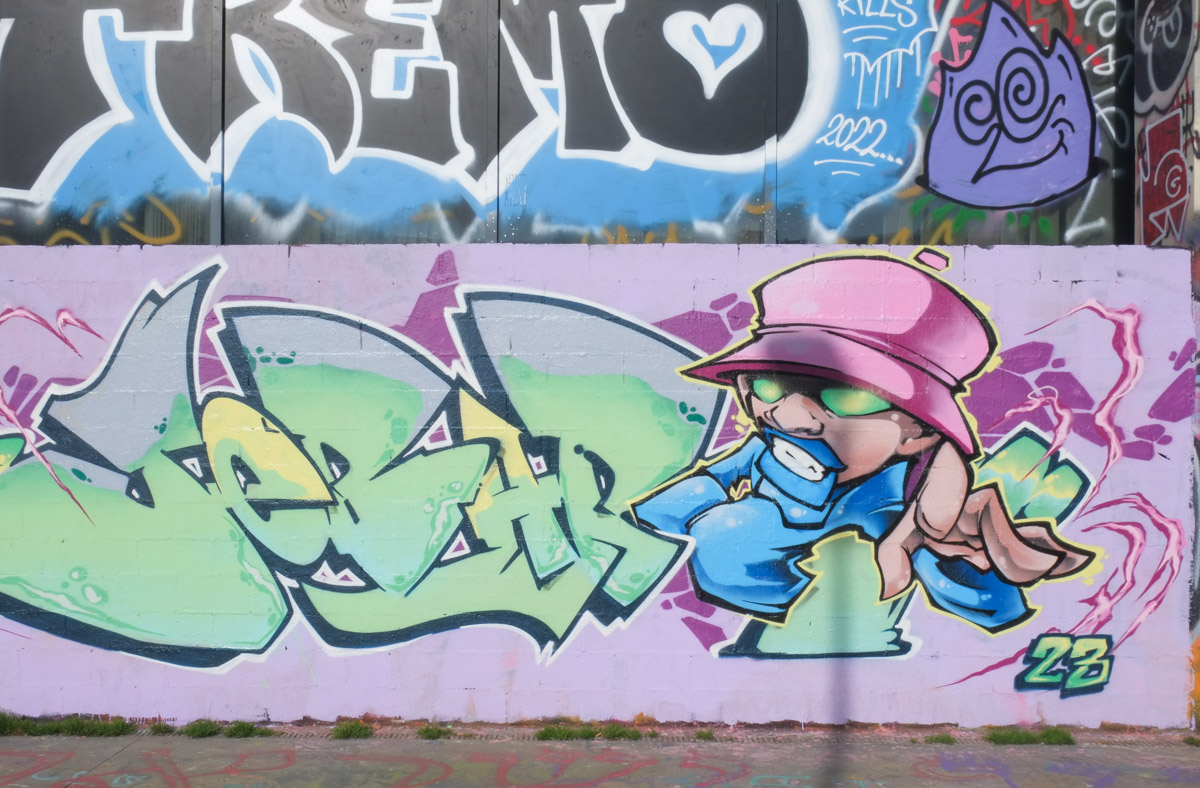
below: Long horizontal mural by a group of artists, Noble, Turkesa, KTHR, and Wios painted as part of a Mural Jam in October 2022.
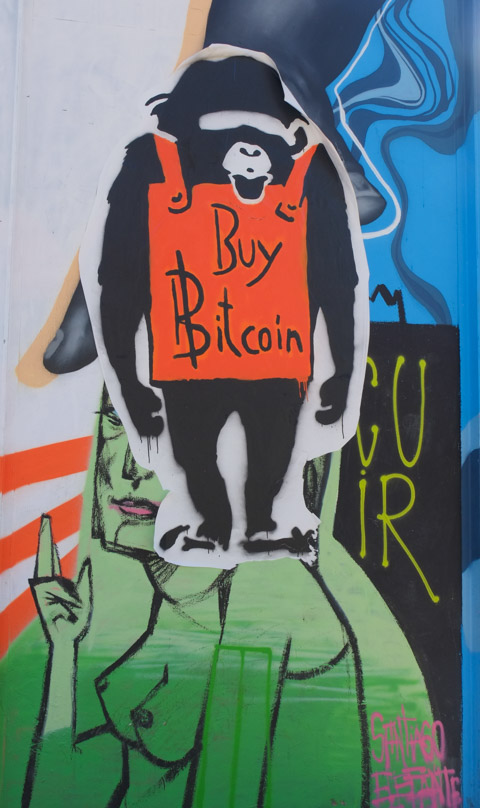
below: Monkey see, monkey do. “Buy bitcoin” says the Banksy monkey, pasted over the topless green woman whose portrait was signed in pink by Santiago [illegible surname].
below: purple duck
below: True love is pierced, tattooed, and stitched up.
below: “Relax, you’re on a floating rock”
below: Braiding green hair with snaps, crackles, and pops. Signed, dextre polo
below: Three chimneys refers to the three brick towers, or smokestacks, from an old coal burning power plant, the first one built in Spain. The first chimney was built in 1881 (or 1896 depending on the info source) by the Barcelona Traction Power and Light Company; the other two followed in 1908 and 1912. It became known as La Canadenca (in Catalan) because in 1911 one of its major shareholders became the Canadian Bank of Commerce. Each tower is 236 feet tall (72m) and up to 13 feet (4m) in diameter. Most of the facility was demolished in 1987.
below: Slaps on a metal pole.
below: poster high on a wall, #universalhumanity series of wheatpaste and collage
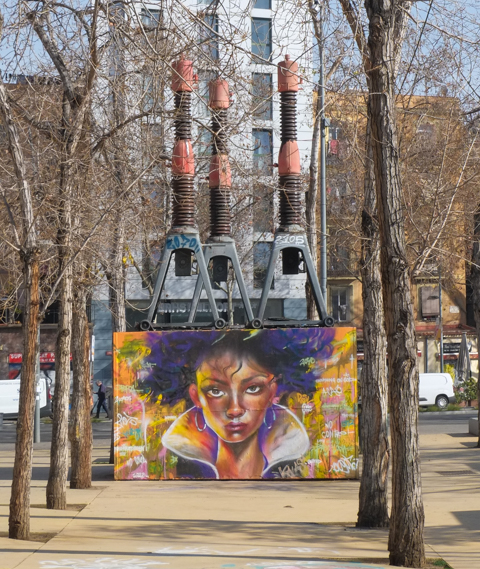
Some of the large pieces of equipment from the power plant were left scattered around the park to look like sculptures, adding interest and historical perspective to the public space.
below: Equitat is written across her chest in a painting by Vale Wilson and Popi. This is a very recent creation and was one of the murals painted for Womart Jam, and event that featured 10 female artists. It was held on International Womens Day.
Marvellously layered. Contributed to by many. Evolving over time.
below: “Please point the camera toward me” and a Salvador Dali portrait by Pat Brazil. In the middle, a large black and white object that resembles a bomb, a needlepoint bomb.
below: With hope in her eyes, by RAF Urban whose work reflects the idea that diversity is hope. Orange paint has partially hidden the bottle of pills (was there a label?) as well as the woman’s face and hands (what is she holding?).
below: Kandin ski. There are quite a few of these pictures around Barcelona – a whole series featuring different well known people. This Kandin-ski was the only one on this door. I haven’t been able to find out who the artist is – clues may lie in the top line of ‘text’ in the upper left corner but I can not figure out what it says.
below: Some wheatpaste in various conditions including a very torn and peeling Ironmould black and white drawing and a red capped Amar Garpa. Unsigned, and therefore unknown monkey, dog, little kid, and man with red beard and glasses.
below: The square in the top right corner reads, “The purpose of this festival is to use art as the attraction of the Qr code, generally used in transactions involving money, purchasing, and capitalism.” (last word in red). Then it is repeated in Spanish (where it might make more sense). “…. es utilizar el arte como atractivo del codico QR, en general utilizado en transacciones implicando dinero, compras, y el captilalism’.
Words matter! Are you graffiti? Of course not, I am more than that! I am a mural.
But what is the difference? Sometimes the difference is obvious but sometimes the line dividing graffiti from its bigger (and more important? more respected?) sibling is blurry.
It’s a question asked by an artist who left his/her mark on a concrete pillar in Girona.









































 Eyes on the Streets