In the Byward Market area of Ottawa, you can find a collection of large mural as you look across a parking lot on Dalhousie Street. They stretch along the wall of a funeral home on St. Patrick Street.
below: The darker end of the murals is signed by three. They are Juan Carlos Noria, The Laporte Brothers (Phil and Dom Laporte) and the Higher Ups.
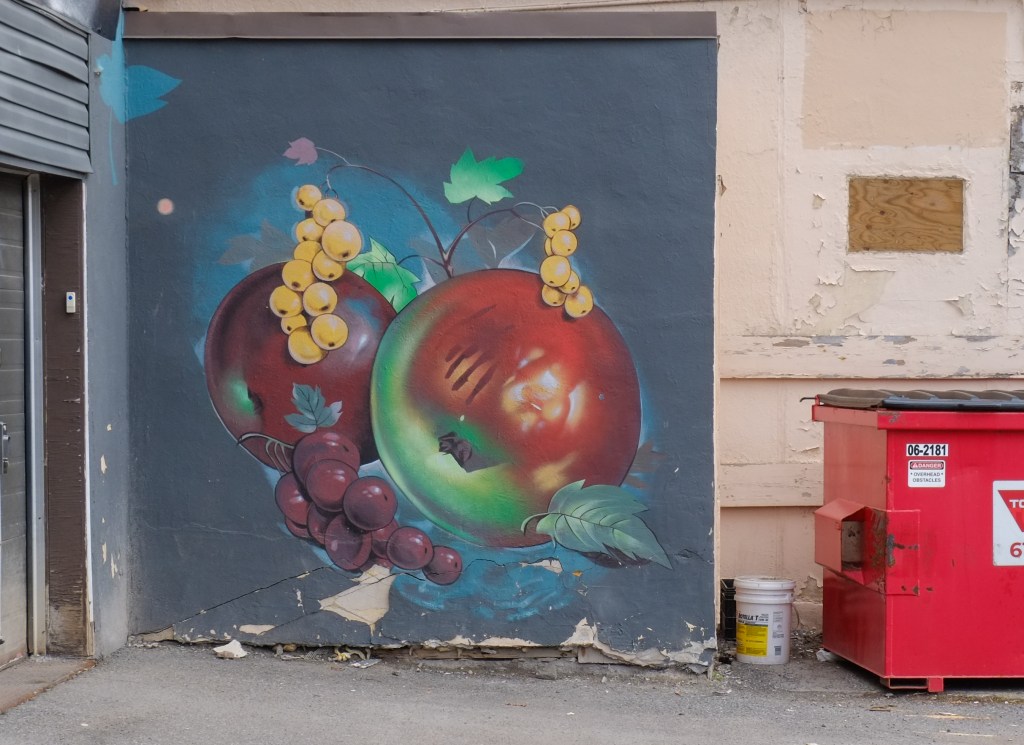
below: Apples and currants in the corner
below: The other part of the wall is for the birds so to speak. The blackbird (raven?) on the left was painted by DRPN (Drippin’ Soul).
below: This is a closer look at the head of the bird on the righthand side. It is the work of Mique Michelle, an artist who work often features feathery birds (or other animals)
below: A large mural by Dom Laporte featuring a Locomotive 2037 pulling a long freight train. The history of Smiths Falls was always closely tied to the railways. In February 1859 the first train arrived in town – on the B & O (Brockville & Ottawa) railway, pulled by a wood burning locomotive. In the 1880’s B & O was amalgamated into the CPR (Canadian Pacific Railway)network. a few years later a second rail line, the Canadian Northern, came to town.
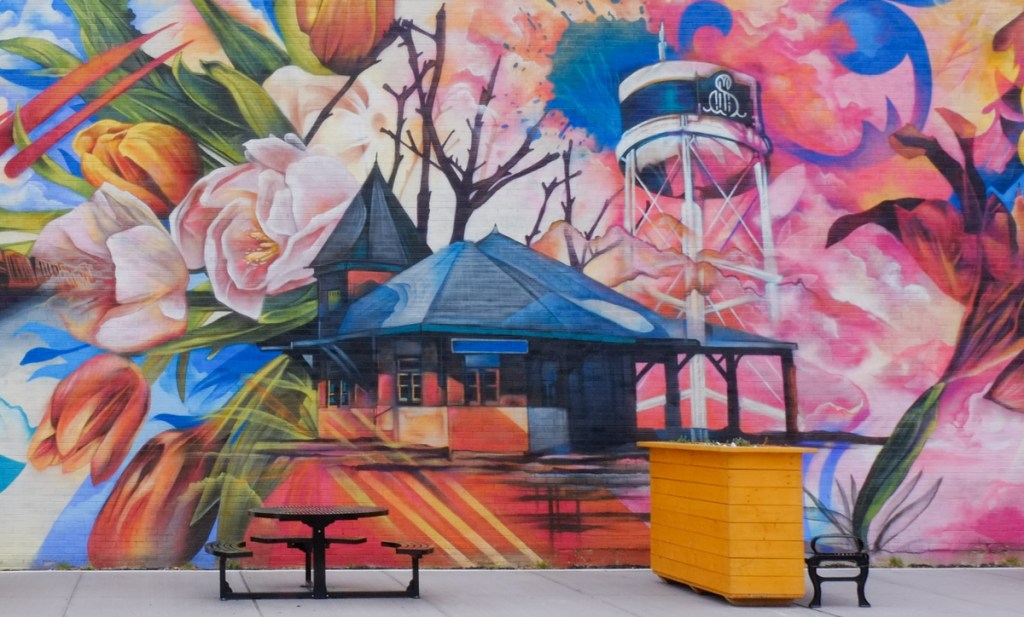
below: Smiths Falls railway station with its distinctive turret – built in 1912 for the Canadian Northern line on their Toronto to Ottawa route. It is now a National Historic site.
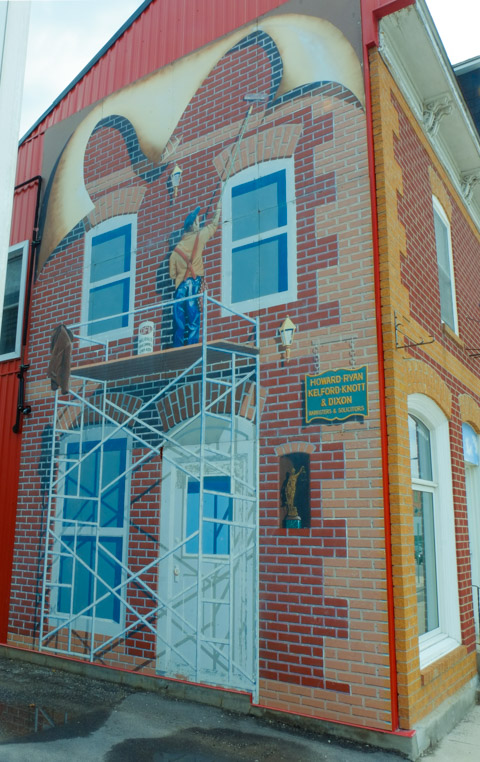
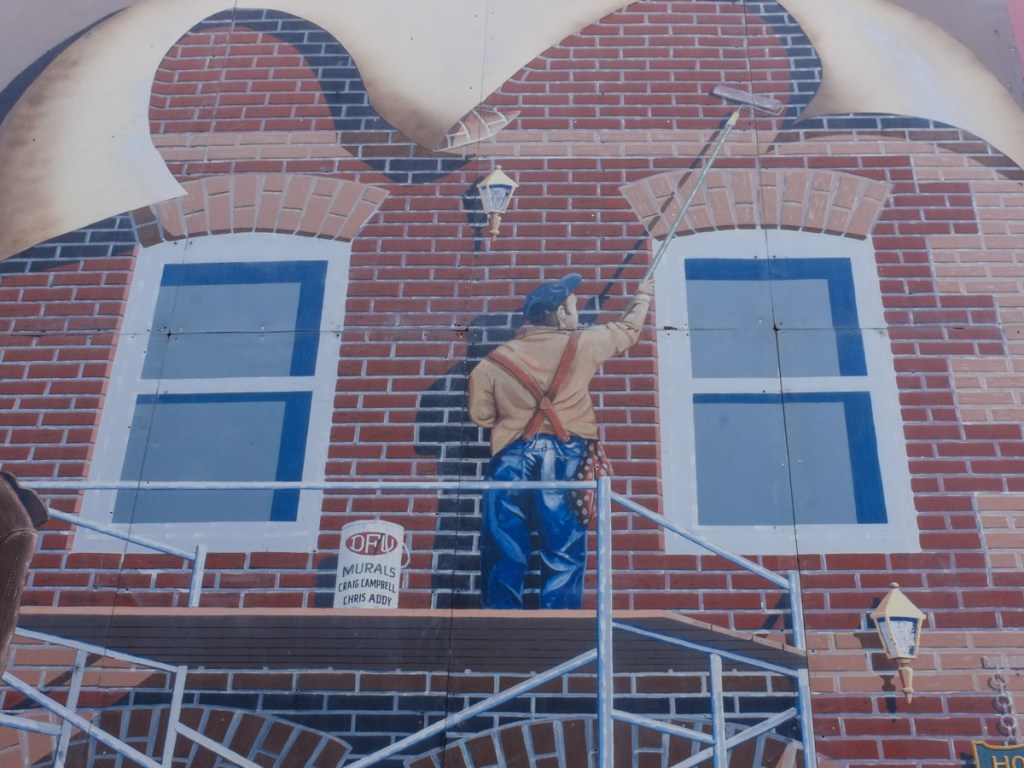
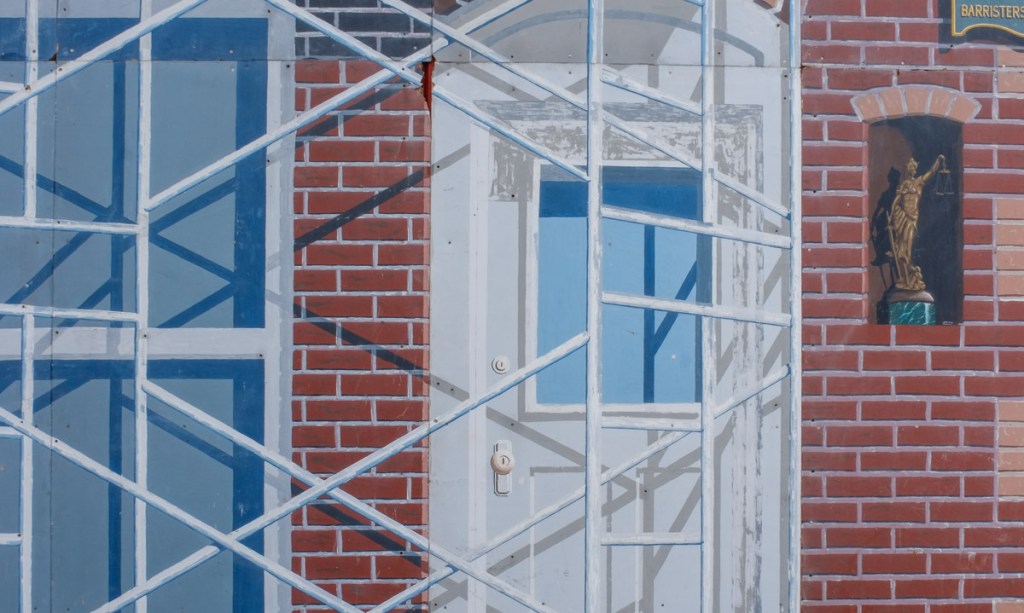
below: High above the street on scaffolding, working to “renovate” the lawyer’s office – a twist on the historic mural. Ryan, Knott & Dixon would probably be quite happy with the facelift that Craig Campbell and Chris Addy have given their brick building.
below: An older mural painted on wood and then attached to the wall. A winter scene on a downtown street.
I found myself stuck for a few minutes without an umbrella when the rain started. Luckily there was space under the arch at the entrance to Passage de la Bonne Graine
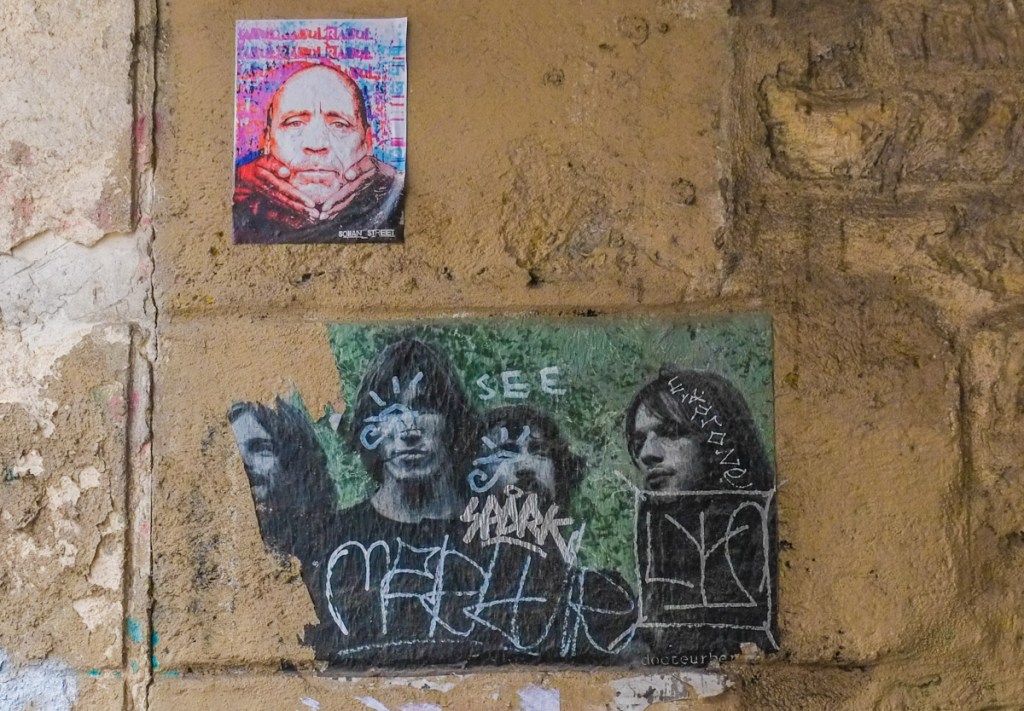
below: A little portrait by Sohan Street above a torn and defaced group photo of four men. The latter is signed in the bottom corner as Docteur something but because the paper is ripped, the rest of the name is lost.
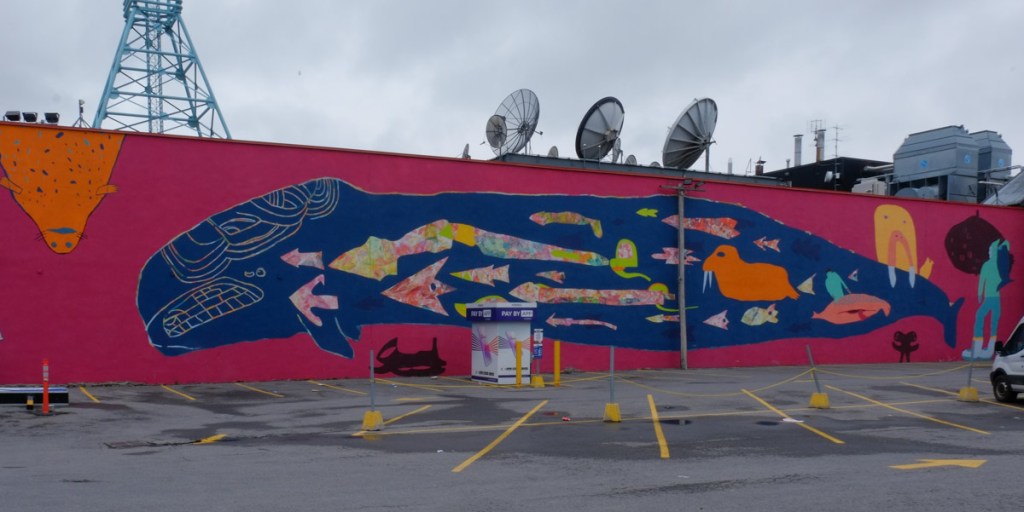
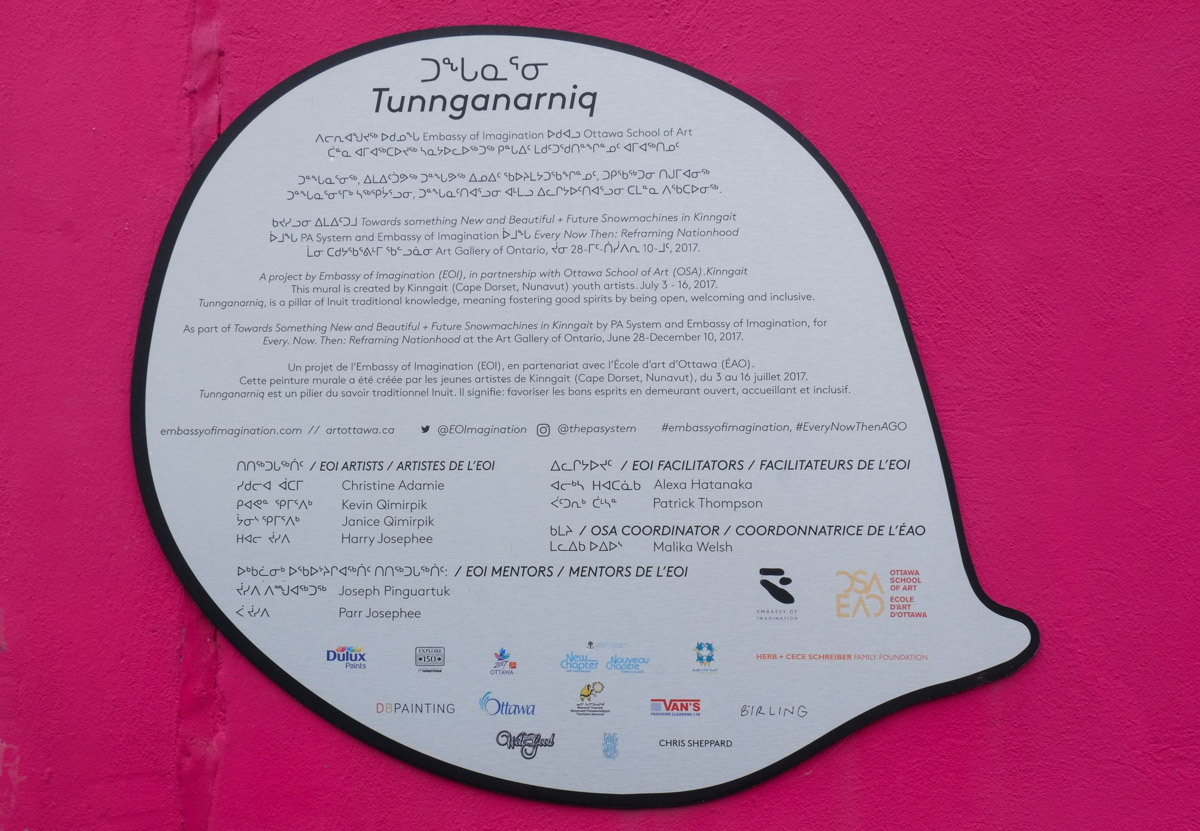
Tunnganarniq: An Inuit word that means fostering good spirits by being open, welcoming and inclusive. It is also the title of this large mural painted by Inuit youth artists from Kinngait (Cape Dorset, Nunavut) along with the Embassy of Imagination in partnership with Ottawa School of Art. It was completed in 2017.
below: At the head of the whale.
below: Tusked orange walrus
below: A tusked orange walrus swims along side.
below: At the tail end
Artists: ᕼᐊᓕ ᔫᓯᐱ- Harry Josephee, ᑭᐊᕙᓐ ᕿᒥᕐᐱᒃ- Kevin Qimirpik, ᔮᓂᔅ ᕿᒥᕐᐱᒃ – Janice Qimirpik, ᓯᑯᓕᐊ ᐋᑕᒥ – Christine Adamie,
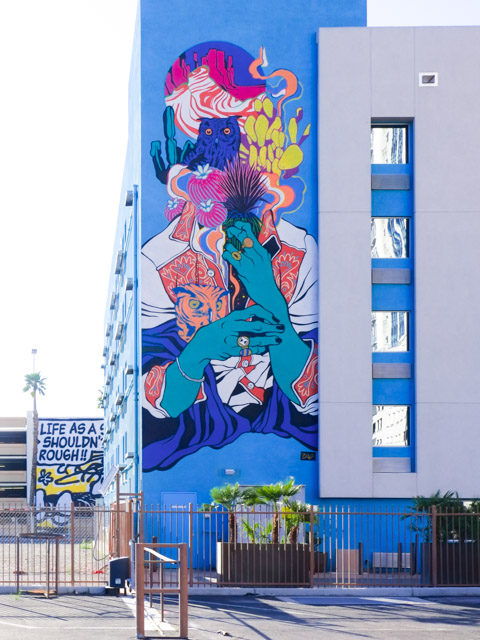
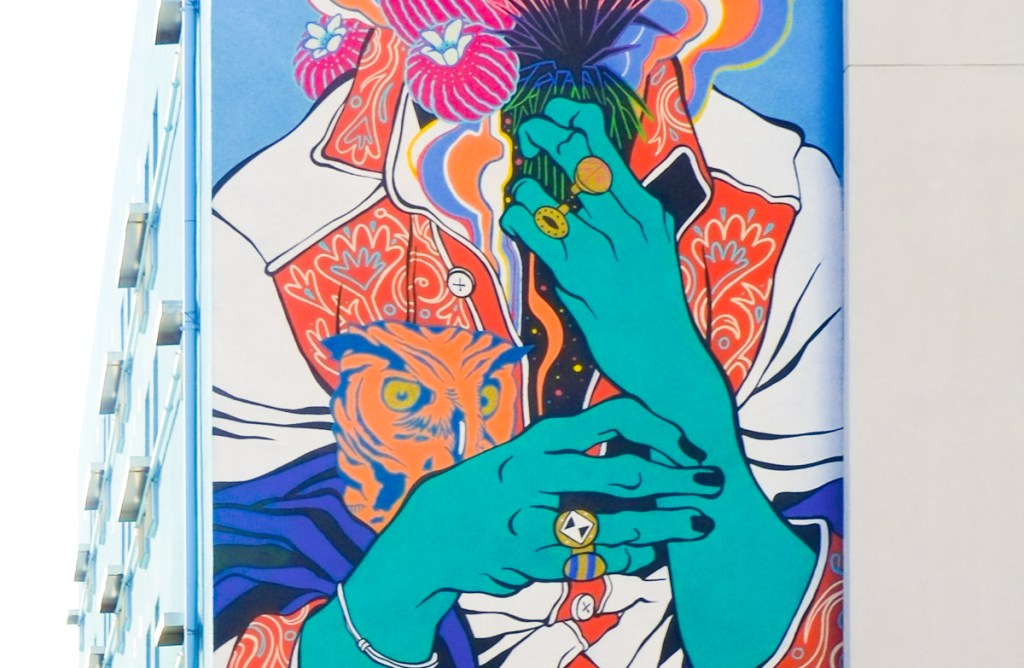
There are two large murals near the intersection of East Fremont and North 6th in Las Vegas. In the foreground is this pair of teal hands. This is one of two murals that Brazilian duo Bicicleta Sem Freio (aka Douglas de Castro and Renato Pereira) painted in Vegas during the ‘Life is Beautiful’ event of 2017.
below: Closer view of the hands with their black finger nails and oval rings.
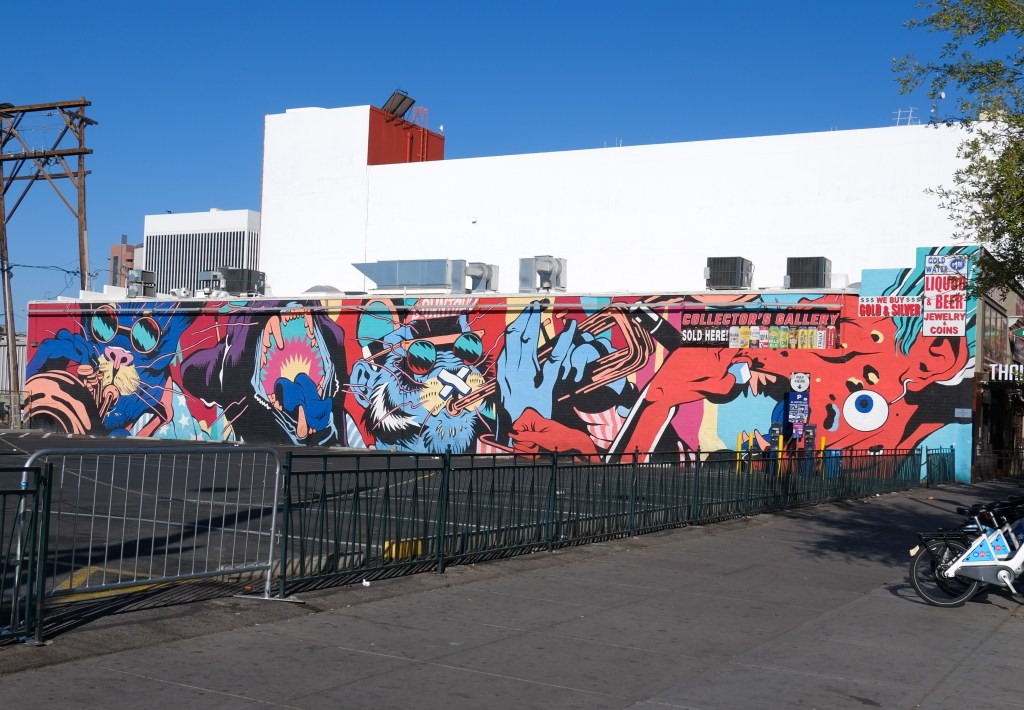
“below: Behind, Linus has a complaint writ large in a mural by Mark Drew. The text is a quote from C.R.E.A.M., a song by Wu Tang Gang. “Life as a shorty shouldn’t be so rough But as the world turned, I learned life is hell Livin’ in the world no different from a cell.”
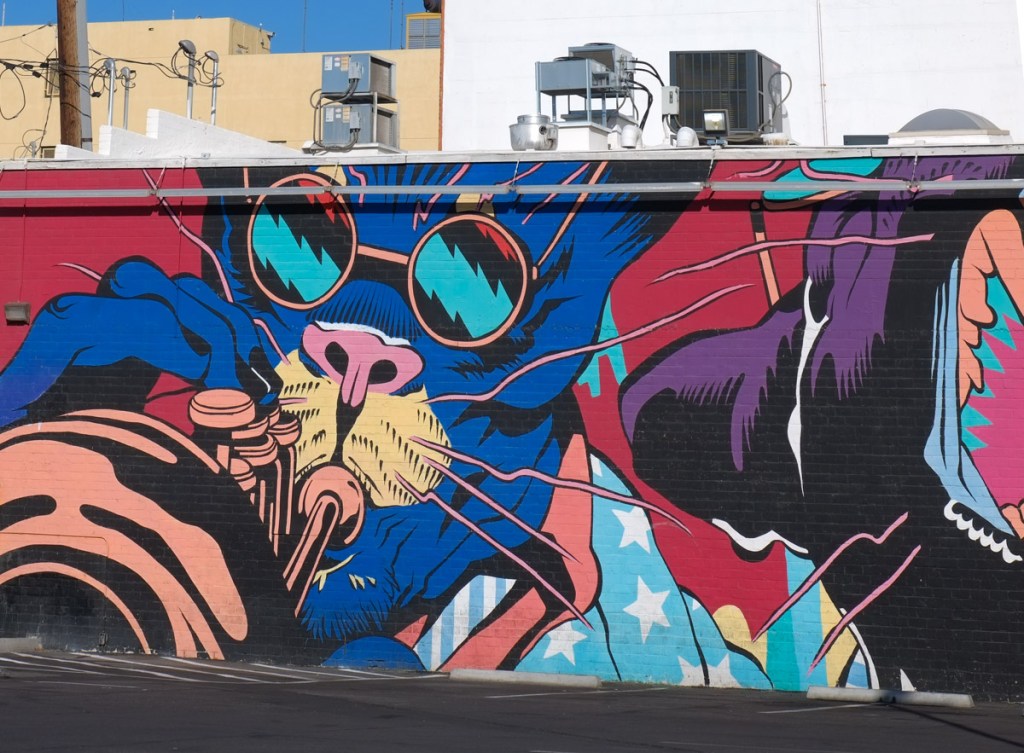
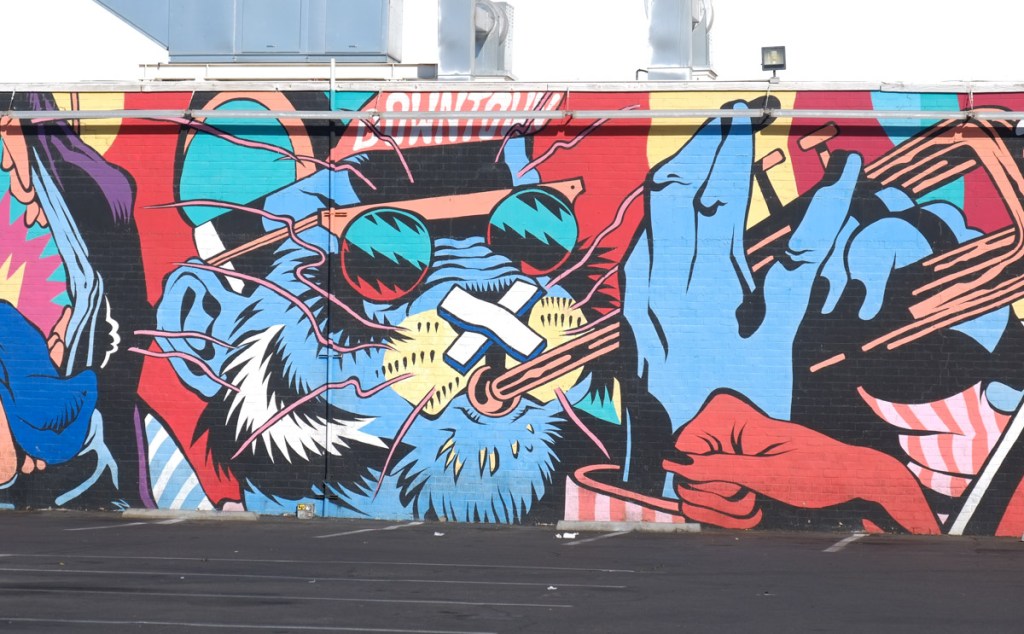
below: Another blue faced trumpet player, but a little paler. There is a strong resemblance between the hands in this mural and those in the top mural.
Back in March I kept seeing these little pictures all over Barcelona. Pasted to poles, walls, and other surfaces were images made to look similar to an instagram page. In each case the subject in the picture was a combination of two people or things with similar names. The same symbol was drawn on their faces – upside down scissors within three parallel vertical lines.
So far I haven’t been able to find any information about the artist. I suspect that the clue to his/her identity is at the top left of each graffiti piece but I can not decipher it.
below: “Franco (Battiato)” Franco Battiato is a musician whereas Franco also refers to Francisco Franco Bahamonde (1892-1975) who was the general who led the Nationalist forces to victory in the Spanish Civil War in 1939. He was then dictator of that country until his death in 1975. In the image below we see a smiling musician’s face on the body of a military leader.
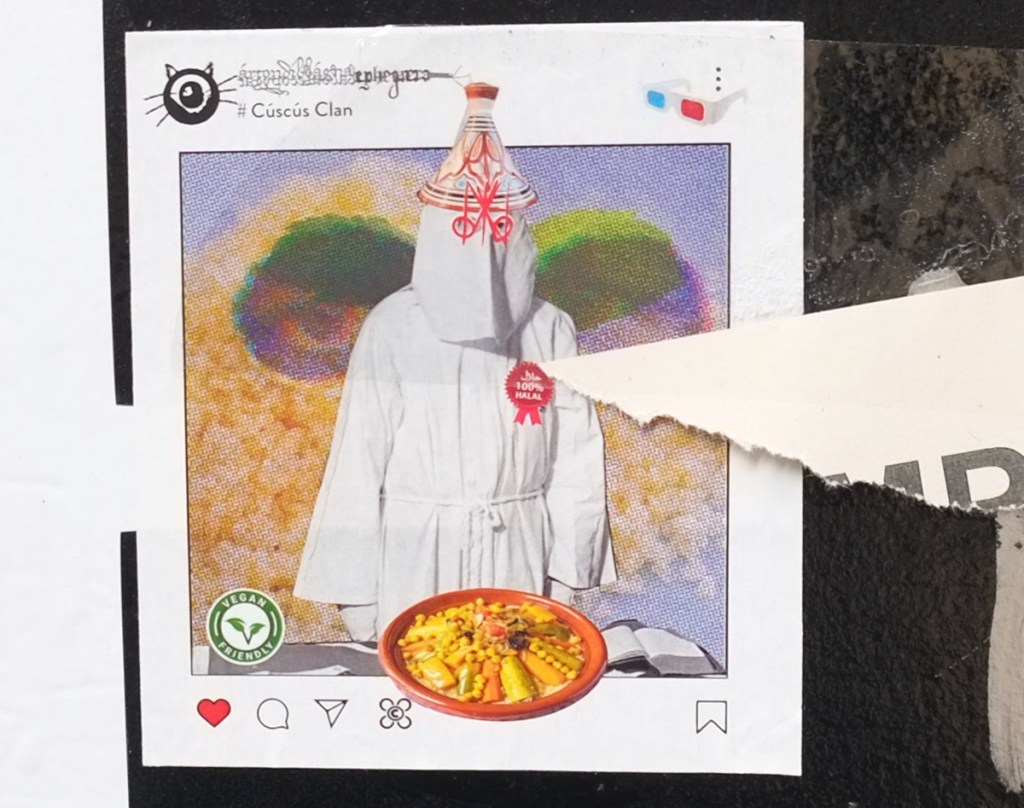
below: Couscous Clan (Cuscus Clan) is vegan friendly, 100% halal, and wears a tagine pot on its head. A mix of the American Klu Klux Klan and the mideastern food staple; Juxtoposition of white supremacy with “brown” food and Islamic ideas. Is that a bible or the Koran that he’s reading?
below: “Bjorn-Bjork” tennis playing singer. Björn Borg (b. 1956) Swedish tennis star swings his racquet at the ball. Björk (aka Björk Guðmundsdóttir b. 1965) Icelandic music star. The face and headdress in this image is taken from the cover of her album “Homogenic” which was released in 1997.
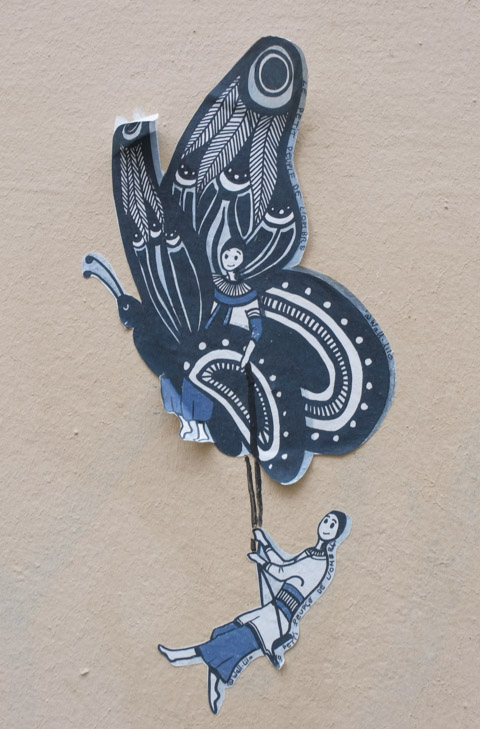
below: “Heidi Lamarr” Classic movie buffs will recognize the name (and face) of screen legend Hedi Lamarr (1914-2000). Here, she is paired with Heidi, the main character in two children’s novel published in the 1880s by Swiss author Johanna Spyri. Since then, Heidi, the most famous Swiss girl, has been retold and adapted numerous times. The image of a girl on a swing used here comes from Isao Takahata’s anime series “Heidi the Girl of the Alps,” 1974.
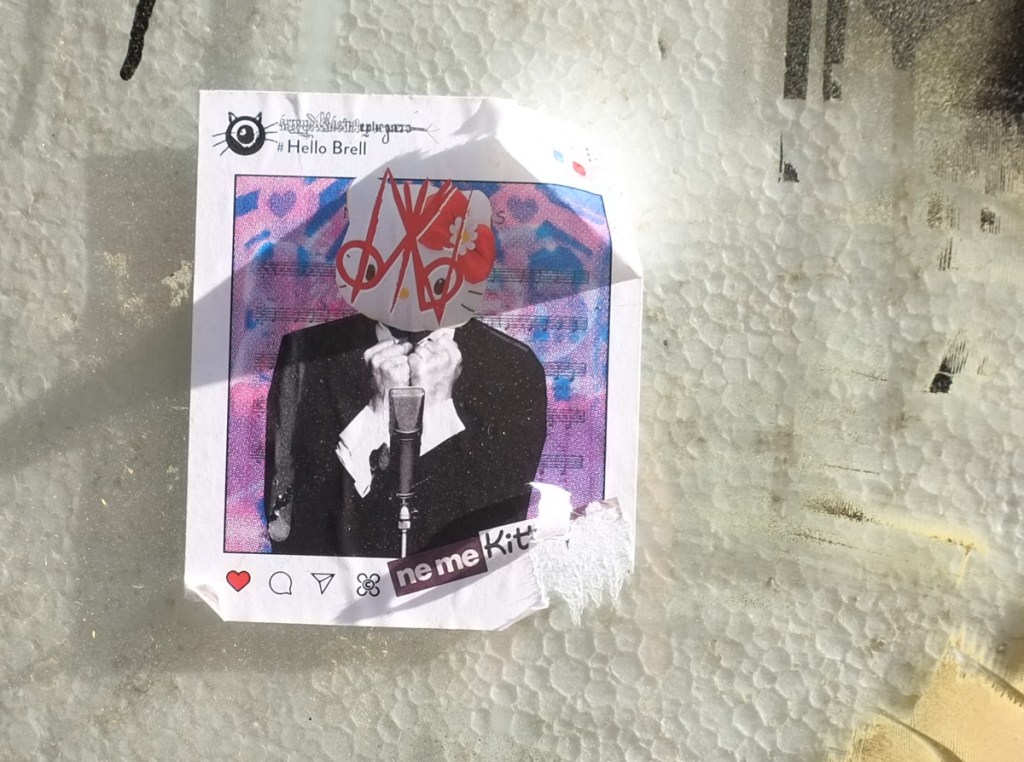
below: “Hello Brell” mash-up of Hello Kitty, the fictional anthropomorphized white cat created by Yuko Shimizu and ???. There is a music score with hearts in the background which might provide a clue but for now it remains a mystery.
below: “Knight Rider” on his horse looks like he’s delivery for UberEats or some other food delivery service. Knight Rider was a TV series in the 1980s starring David Hasselhoff. Now he’s a knight of the realm? But of which realm?
below: Juan Salvador Jeviota becomes a guitar rocking bird. It’s probably a seagull as in ‘Juan Salvador Gaviota’, the sea gull that stars in the Spanish translation of ‘Jonathan Livingston Seagull’ authored by Richard Bach back in 1970. The cats are fans! As to the reference to Jeviota, or what the second part of the idea might be, I am striking out again.
below: “Lemmy Riefenstahl” with a camera in his hand. The face here is masculine but the background blue and purple portrait is female; the mashup here is with Helene Bertha Amalie “Leni” Riefenstahl and Ian Fraser Kilmister (aka Lemmy, 1945-2015). Leni was a German film director, photographer and actress best known for her role in producing Nazi propaganda. Lemmy was a musician with rock band Motörhead.
below: “#operacionfreequini #talegoquini” Talego Quini was an album by Spanish musical group Parquesvr released in 2019. Quini (1949-2018) was a football player (and that’s his picture). In March 1981 he was kidnapped and held for 25 days before being rescued. His full name was Enrique Castro González.
below: “Pimp Ball” with pinball paddles – so obviously this is a combination of the pinball game and ??? Not just any pimp I’m sure but alas I don’t have the answer.
below: Robin in tha Hood, LA Hollywood
below: “Selfneca – say cheese!” Is the face that of Seneca or Seneca the Younger, both of whom were Roman philosophers and Stoics who believed that we waste most of our time. That’s just a guess but I rather like the idea of selfies and a waste of time in one photo.
below: “D’Urruti” The face of Buenaventura Durruti (1896-1936), a Spanish anarchist during the Spanish Civil War has been added to the body of Argentinian football player Maximiliano Urruti. A play on the surname (D)Urruti.
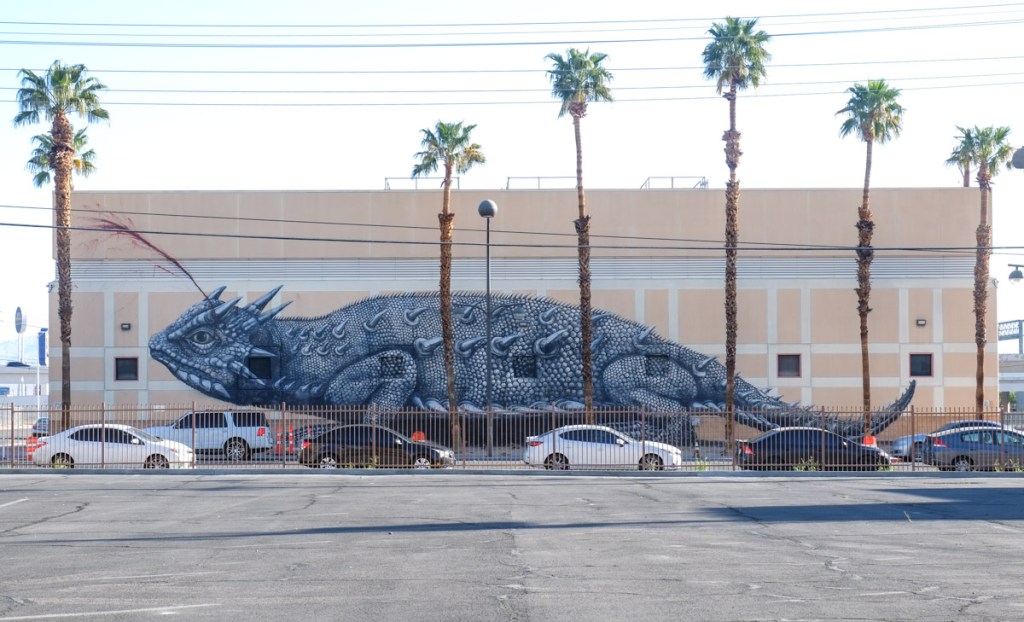
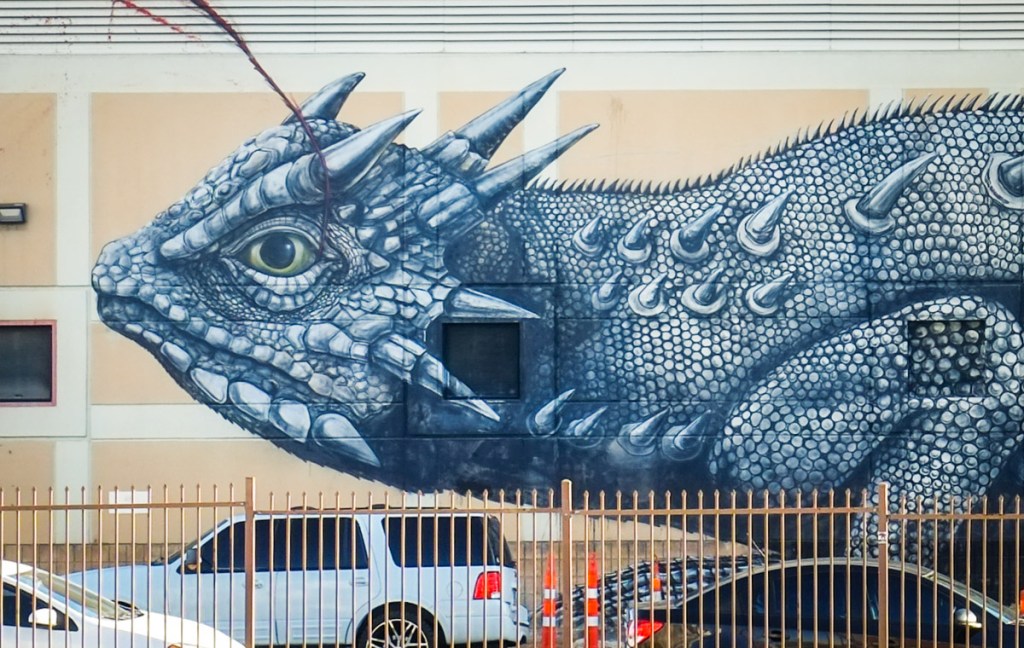
This downtown Vegas mural was painted by Belgian artist known as ROA in 2014.
It is a type of lizard known as a Horned Toad (or Horntoad, Horn Lizard). If you want to get scientific, they are of the genus Phrynosoma. These reptiles are native to western North America where they prefer desert or sandy semi-desert areas. The mural is painted in bluish grey tones but these lizards are actually brown so they are well camouflaged in sand and dirt.
If there is a predator nearby, the lizard puffs itself up to look bigger and harder to swallow. At least five species of horned toads can also squirt a stream of blood at the predator. The blood comes from tiny blood vessels near their eyes. Apparently it doesn’t taste very good and some predators have second thoughts about eating the lizard.
Carrer Petritxol is a narrow street in the Gothic Quarter (Bari Gotic) section of Barcelona. It dates from the 15th century when it was a shortcut through the backyard of a local property owner. It runs from Portaferissa to Plaça del Pi. Today it has many small unnique stores including chocolate stores.
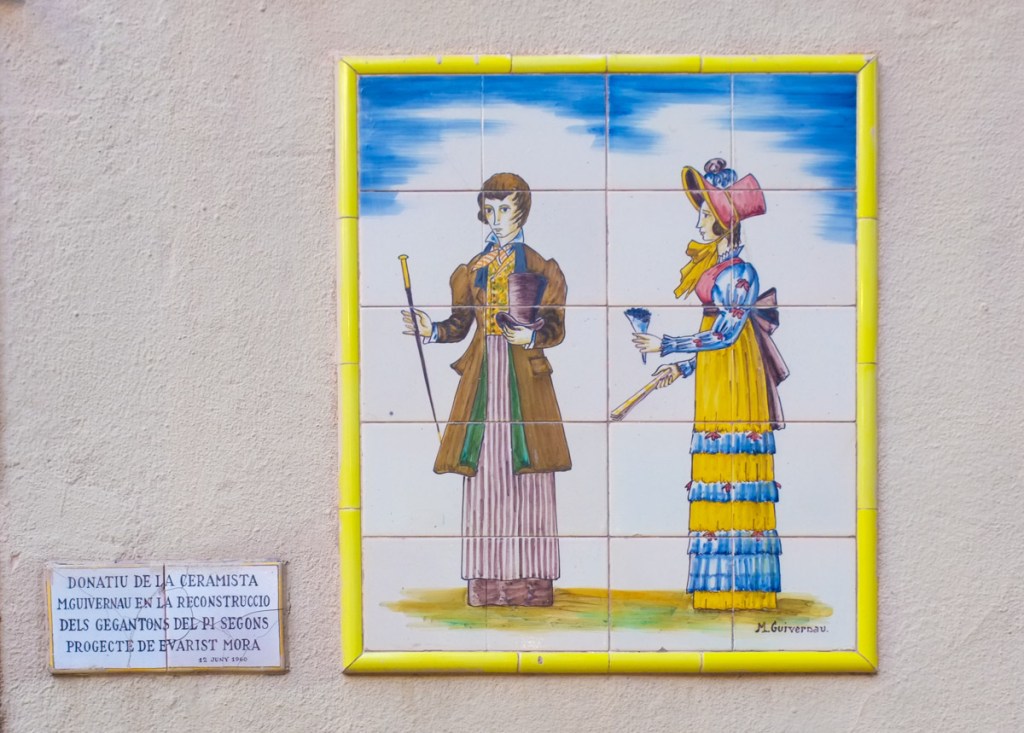
below: Catalan text: “Donatiu de la ceramista M. Guivernau en la reconstruccio dels gegantons del pi segons progecte de Evarist Mora.” Translation from Catalan: “Donation of the ceramist M. Guivernau in the reconstruction of the “Giants of Pi” according to Evarist Mora’s project. Note: The Giants of Pi – On display at the parish church of Santa Maria del Pi are two wearable puppet costumes, one male and one female, known as the Giants of Pi. They have a long history but the part most relevant to this blog post is the fact that they were restored in 1960 by the artist Evarist Mora. In 1985 they were named Mustafa and Elisenda. They are two of the many “gegants” that are brought out for special events in Barcelona such as the Corpus Christi procession and the Santa Eulalia festival.
M. Guinervau signed the above plaque but there are many other ceramic pictures on this street, all unsigned. They tell stories about the street including famous residents or visitors. What follows here are photos and a few details about some of them.
below: “Aci la mare de Déu ens diu que el temps passa lleu” , translation: “Here the mother of God tells us that time passes easily (or easily)”
below: “Amb capa i barret llue cada nit “peius” gener”, translation: “With cape and hat, shine every night “Peius” Gener”. This image shows the Spanish writer, journalist and playwright, Babot Gener Pompey (1848-1920), often known as Peius wandering the streets after dark.
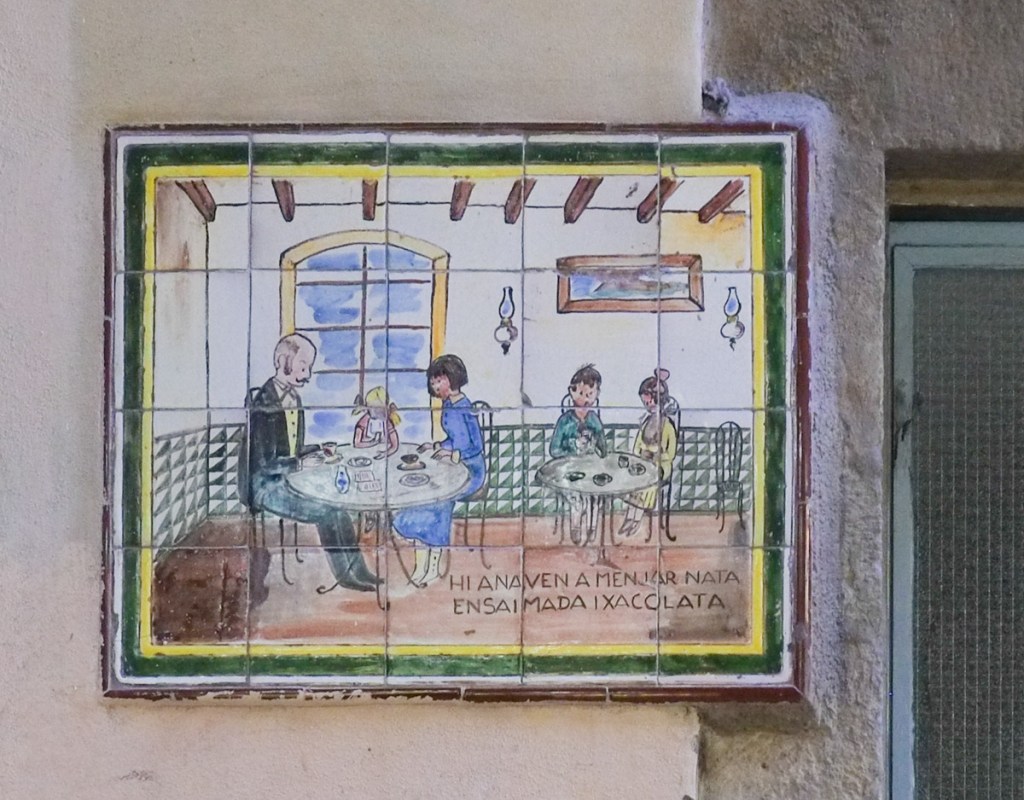
below: “Hi anaven a menjar nata ensaimada xocolata”, translation: “They were going there to eat chocolate cream” Carrer Petritxol has been a destination for chocolate for many years; there are at least 4 stores specializing in chocolate on this short street, two of which have a long history – Granja La Pallaresa and Granja Dulcinea. Granjas (Granges) were once shops specializing in dairy products.
below:Upper “De quant encara era nou i romantic el dinou”. The translation could be either “how new and romantic the nineteenth was still”, or “From when the nineteenth was still new and romantic” Lower: “De llavent ide ponent tot el da hi passa gent”, translation: “From dawn to dusk, people pass by all day”. This presumably refers to people walking along this street.
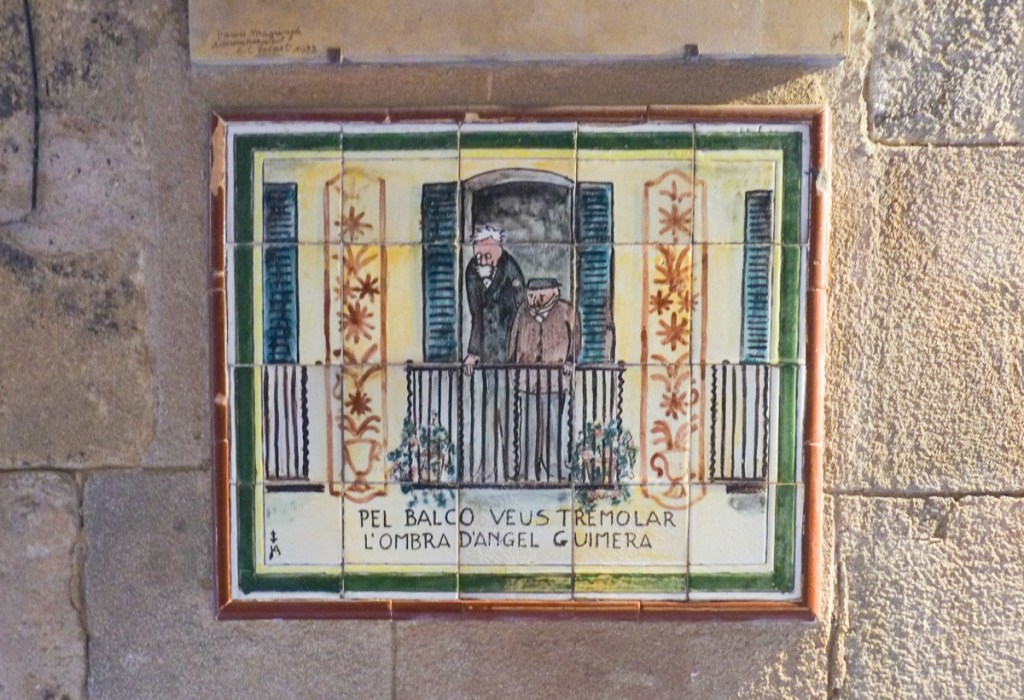
below: Catalan text: “Pel balco veus tremolar l’ombra d’angel Guimera”, translation: “On the balcony you see the shadow of Angel Guimera trembling”. Note: Angel Guimera (1847-1924) was a Catalan playwright.
below: “En un pis no sabem quin hi va viure Moratin” translation: “We don’t know which apartment Moratin lived in” . Note: Probably the writer Leandro Fernandez Moratin, (1760-1828) who lived in a hostel on this street in July 1814.
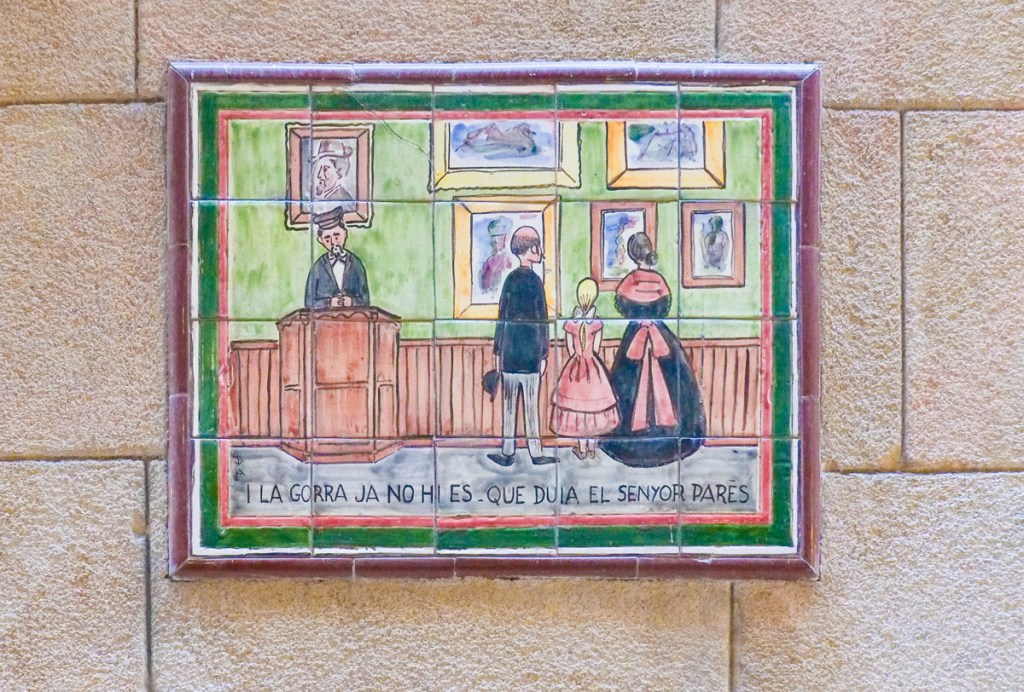
below: “I la gorra ja no hi es… que duia el Senyor Pares”. Transation: “And the cap is no longer there… that Mr. Pares wore” In other words, Sr Pares took off his hat when he and his family were at the art gallery.
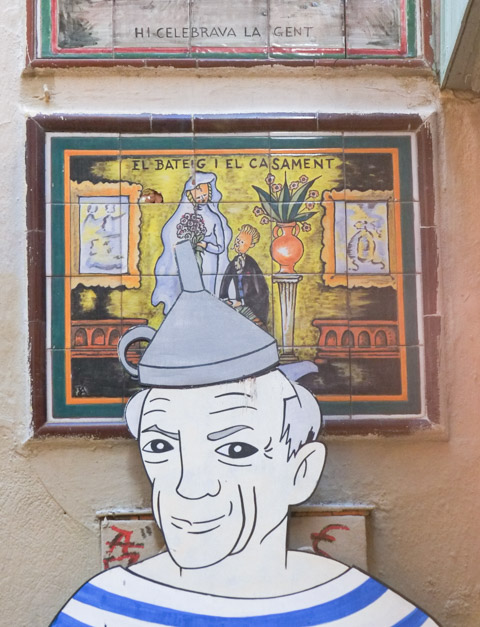
below: “El bateig i el casament”. Translation: “The baptism and the wedding.” That’s a rather short looking groom? The cutout of the man in the blue and white shirt with the funnel on his head is an added bonus!
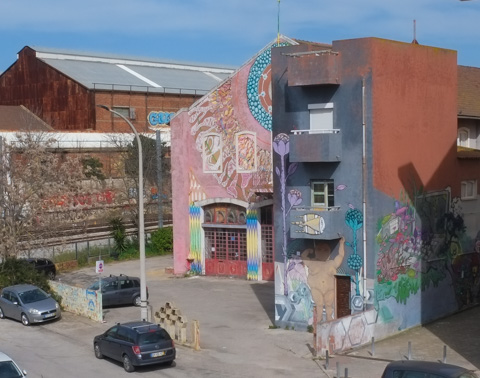
Although it is a city in its own right, Barreiro seems like a suburb of Lisbon. It is most easily accessed by a short ferry ride across the Tagus River from central Lisbon. The Barreiro train station is next to the ferry dock. There are now numerous murals in Barreiro in part because of a project called Art in Town run by the City Council and ADAO.
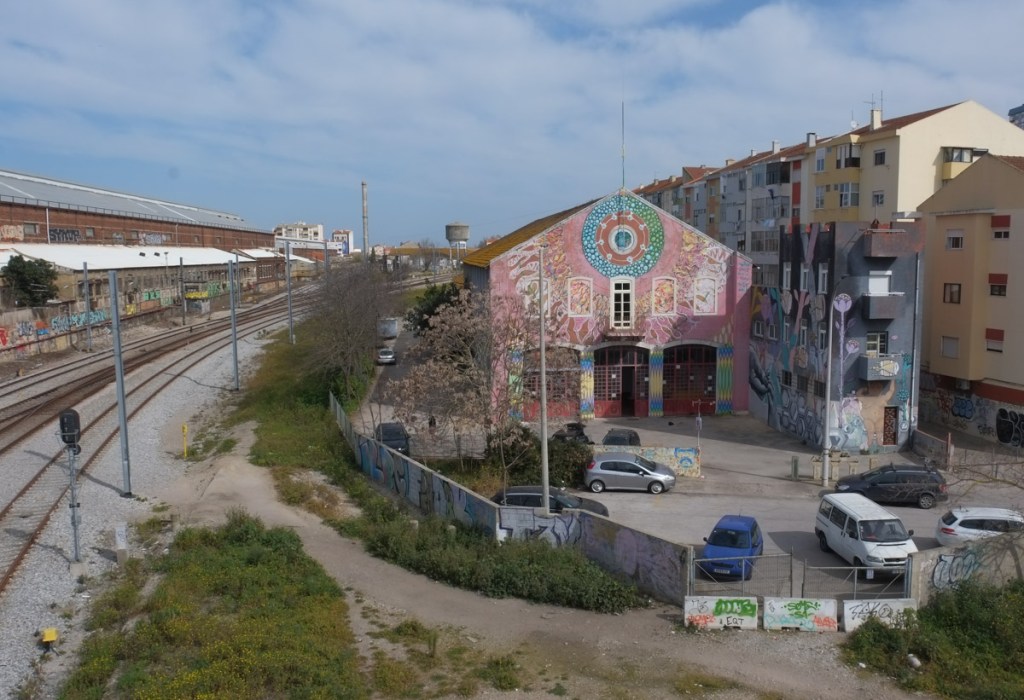
The building in the middle is ADAO Headquarters (Associação Desenvolvimento Artes e Ofícios, translation: Assoc for the Development of Arts and Crafts)
below: A hole in the concrete wall provides a short cut across the tracks as well as a different view of the murals painted by Gonçalo Mar (aka Gonçalo Ribeiro) and Odheit
below: On the fence, a owl keeps a watchful eye on passers-by
below: A closer view of the ADAO Headquarters mural . The fish-like figures swimming on the walls appear frequently in Mar’s work.
below: A head with long flowing grey and turquoise hair emerges from the hexagons.
below: Backyard view
below: Punk red feathers
below: Two street art portraits; the woman on the right was painted by Pedro Pinhal
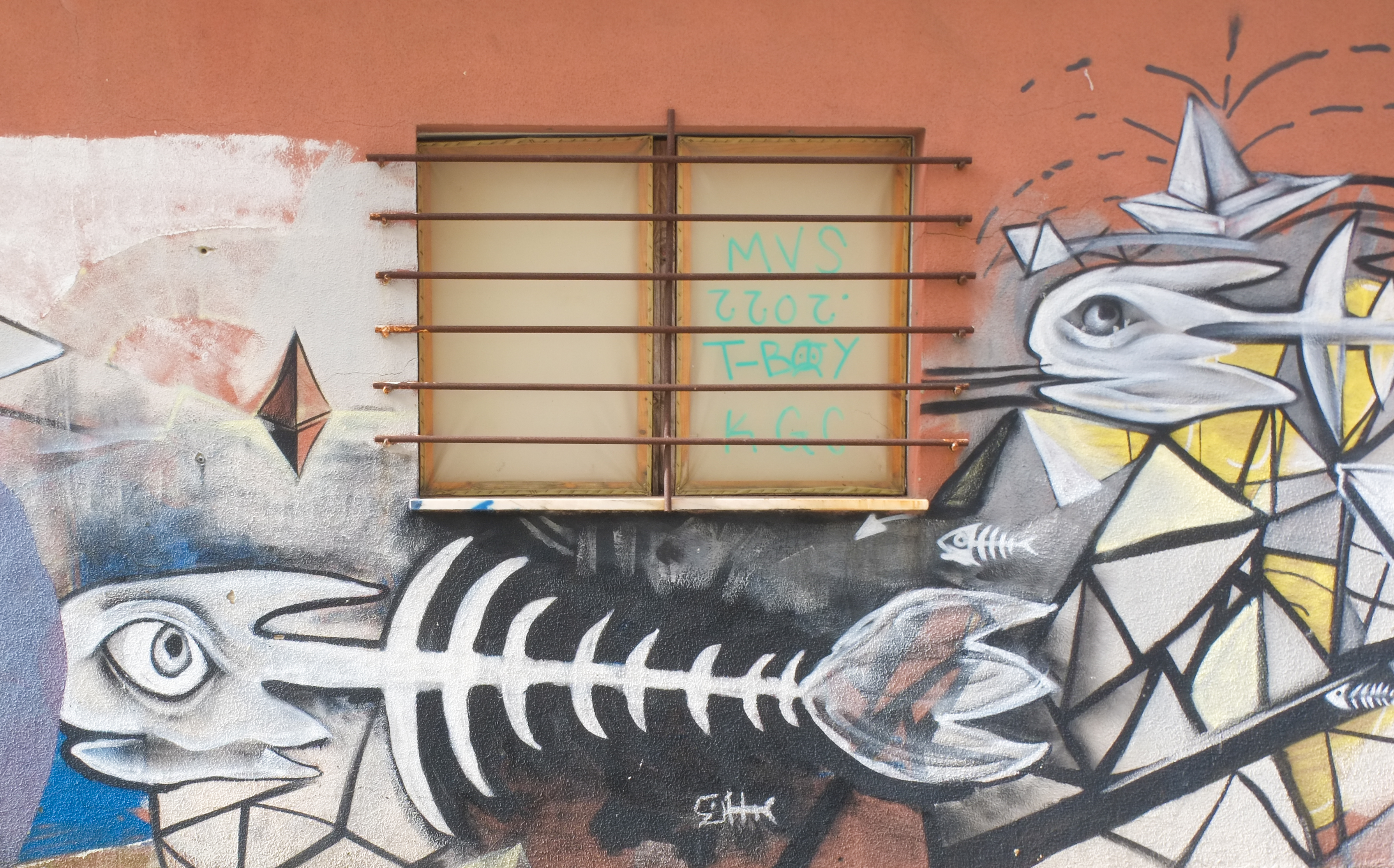
below: A mermaid, octopus, paper sailboat, and fish bones
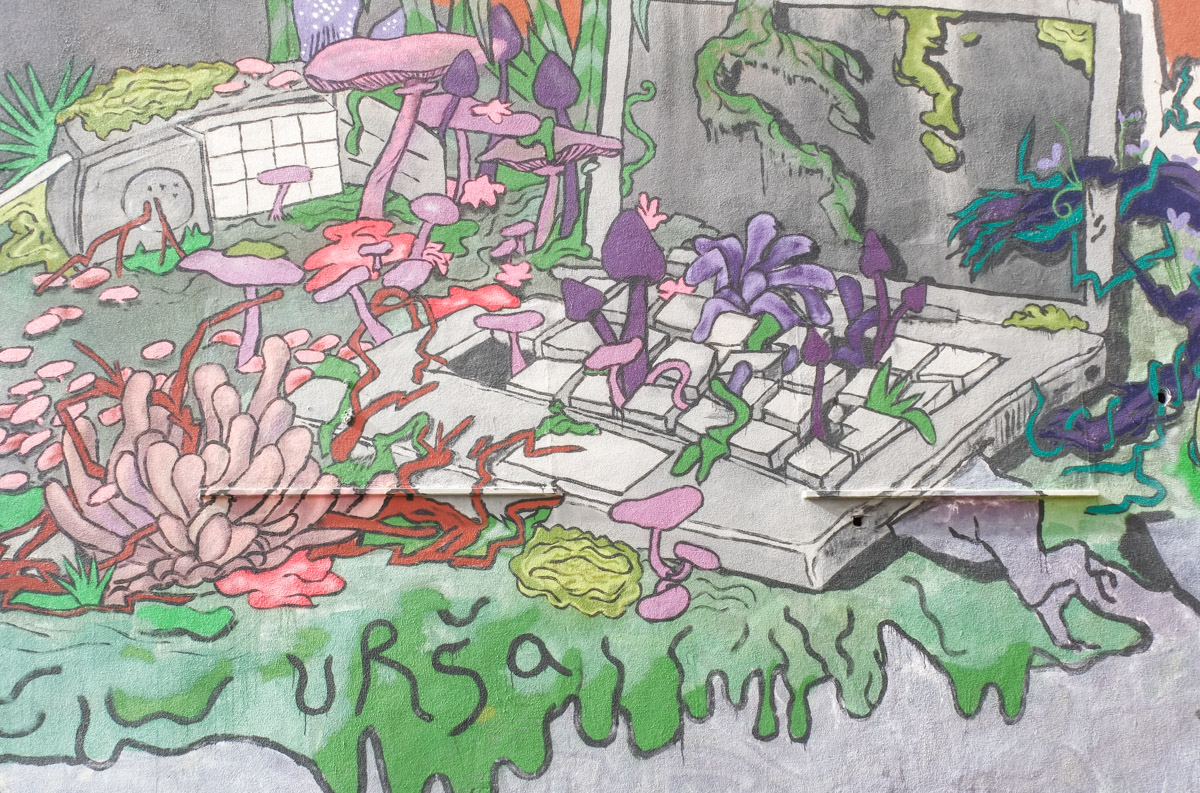
below: Ursa’s laptop and old flip phone has begun to sprout.
below: Old School Futuristes
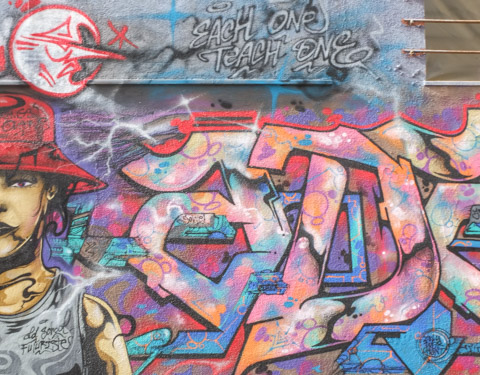
below: Each one teach one
below: Rays of sunshine above with sharp angles of concrete below.
below: Back to the front of the ADAO Headquarters ….
below: …. where this beauty stands by the entrance.






























 Eyes on the Streets