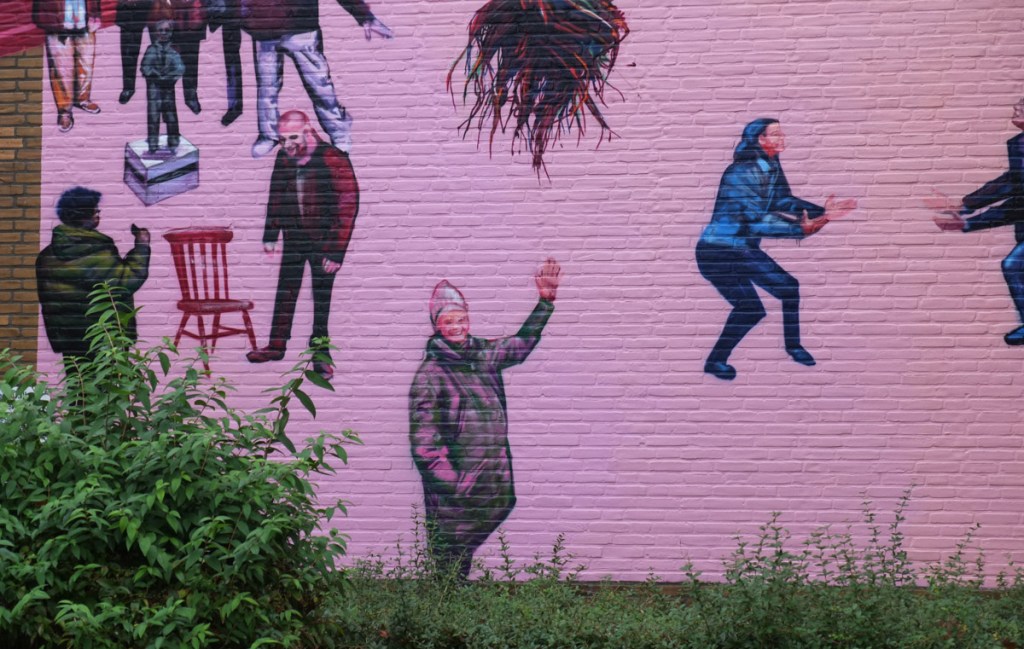
On all four corners of an intersection in a residential area of Heerlen (Netherlands) there is a mural on the side of one of the buildings. They were all painted by the same artist and they all feature some aspect of Dutch culture or history. A pink and purple theme also runs through them all.
below: On Oude Kerkstraat is “Operation Heartbeat” by American artist Gaia – A heart surrounded by different flowers from the Dutch “Empire”
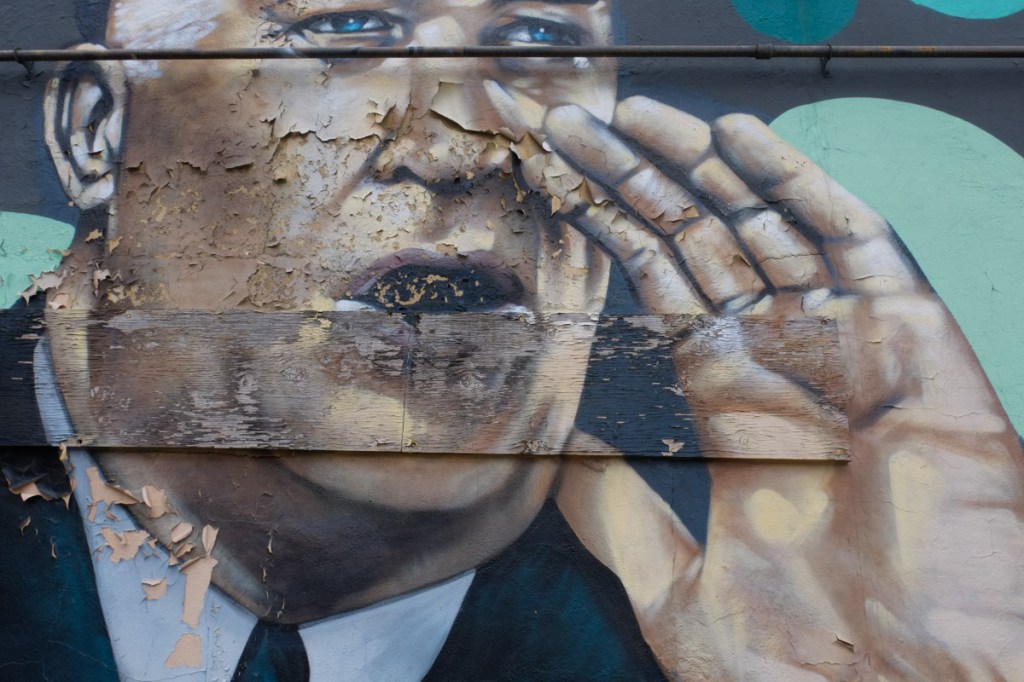
below: Another Gaia mural across the street from his hearts and flowers is this bit of local history – Former Prime Minister of the Netherlands, Joop den Uyl, announces the end of the coal mining in Limburg, December 1, 1965.
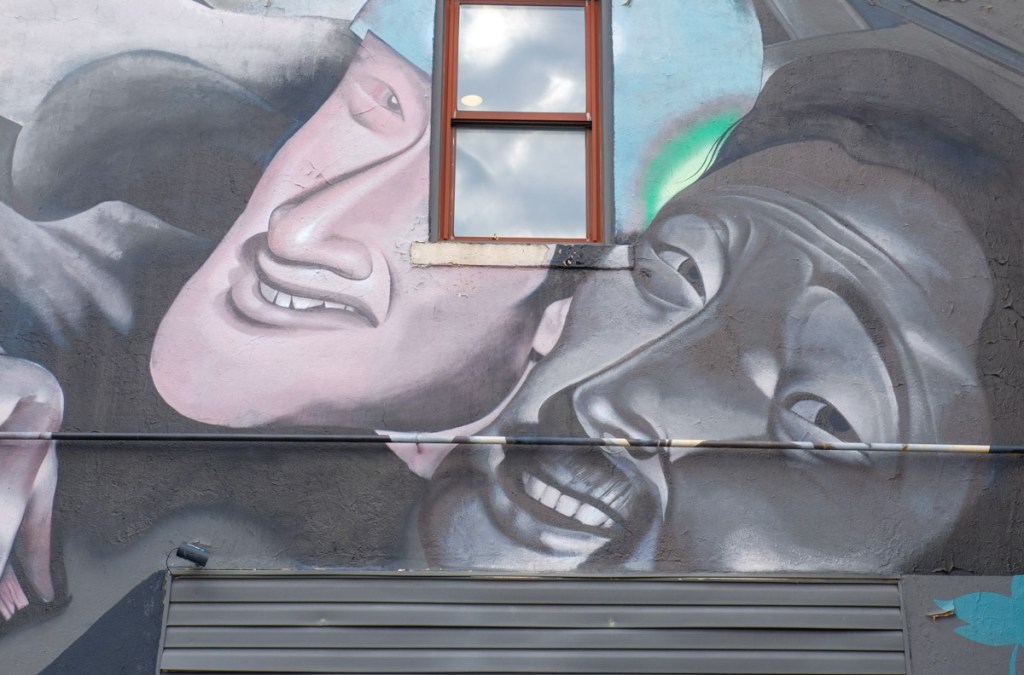
below: ‘Tulipmania’. The face is that of Frederik Hendrik (1584-1647) who was a Statdtholder of the Dutch Republic, as well as a sovereign Prince of Orange during the Dutch Golden Age, i.e. in the time of Tulipmania. I doubt that he’s a recognizable face these days but it’s an interesting detail just the same.
below: ‘Resilience’ was influenced by the painter Pieter Bruegel the Elder (d. 1569) who painted scenes of everyday peasant life. Here is a contemporary scene of everyday urban life.
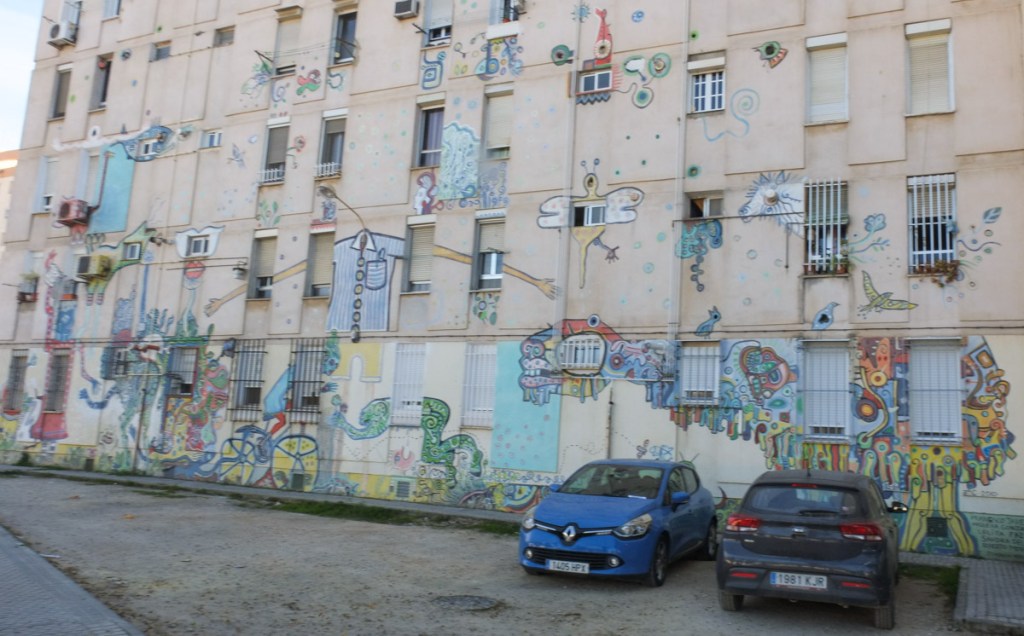
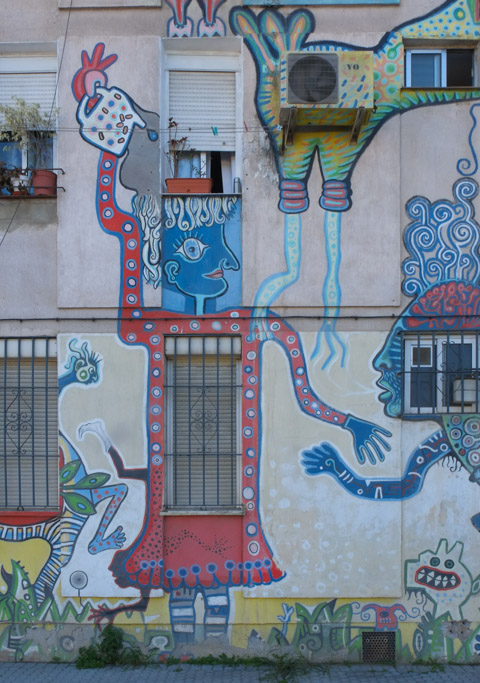
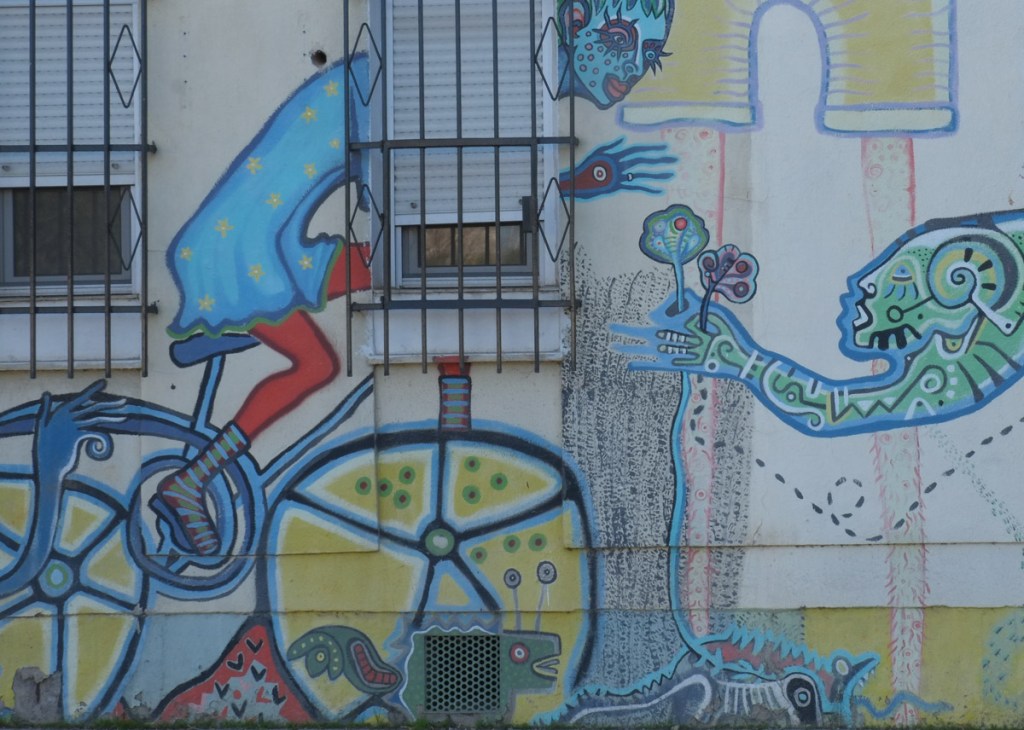
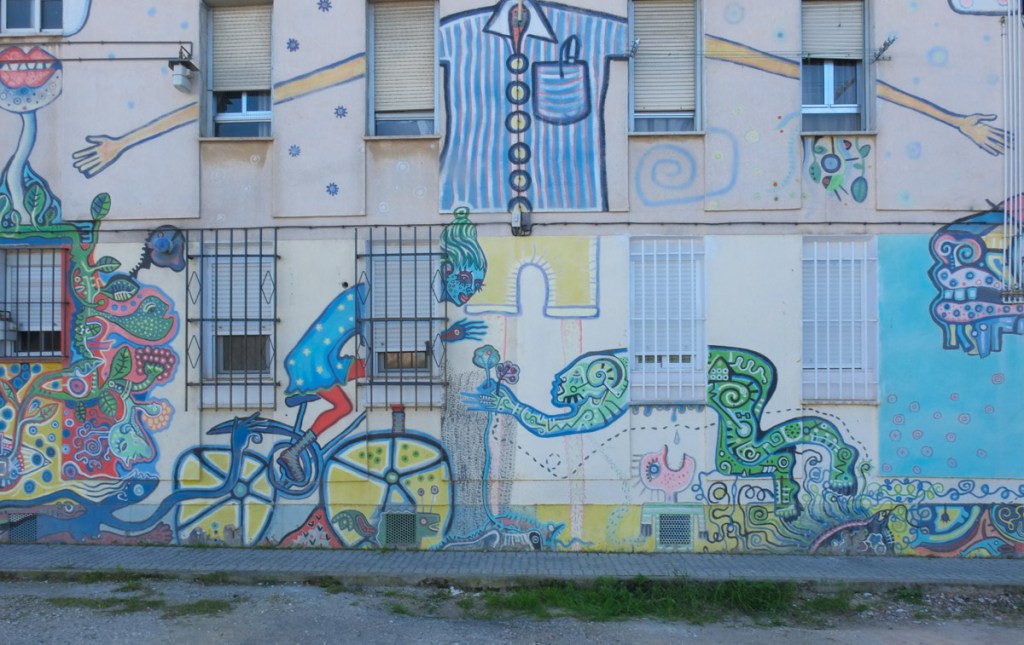
On the back of an apartment building in Seville (Sevilla) Spain there is a mural that is a collection of scenes involving fantasy animals and characters.
below: Long and flexible arms make it possible for her to water the flowers and reach out to others at the same time. … even if she’s got wet hair.
Six artists were involved: Francisco Javier, Hiquera Gonzales, Lolita Paz, Sandra Del Gado, Roberto Moreno and Joaquin Heredia.
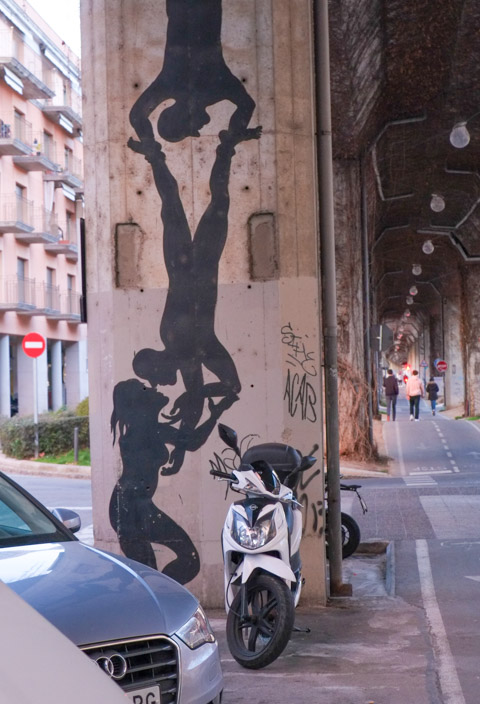
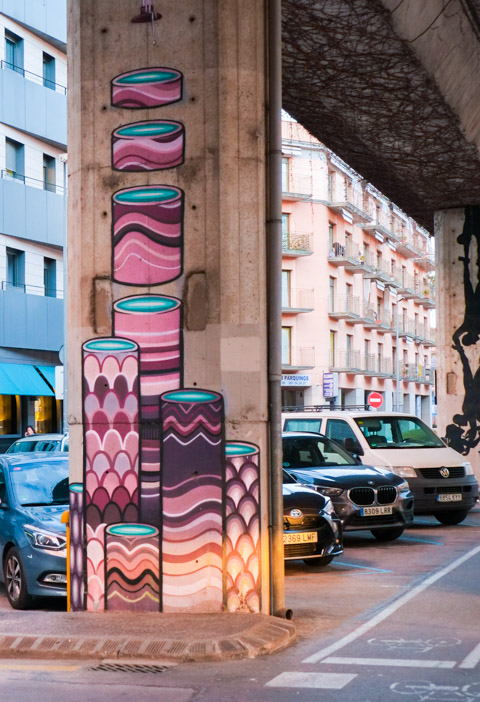
A long stretch of railway is elevated as it passes through the city of Girona, Spain. A bicycle and pedestrian path runs underneath. Some of the pillars supporting the railroad have been decorated by street artists.
below: Birds in flight
below: Cyop & Kaf have painted a few of the pillars with their black silhouette-like people such as this stolen kiss.
or this very tall man – He’s all tied up with his feet in the mud? in concrete?
below: KRAM is responsible for two pillars including this blue character on a swing.
below: The other KRAM pillar is this one – quite different from the first.
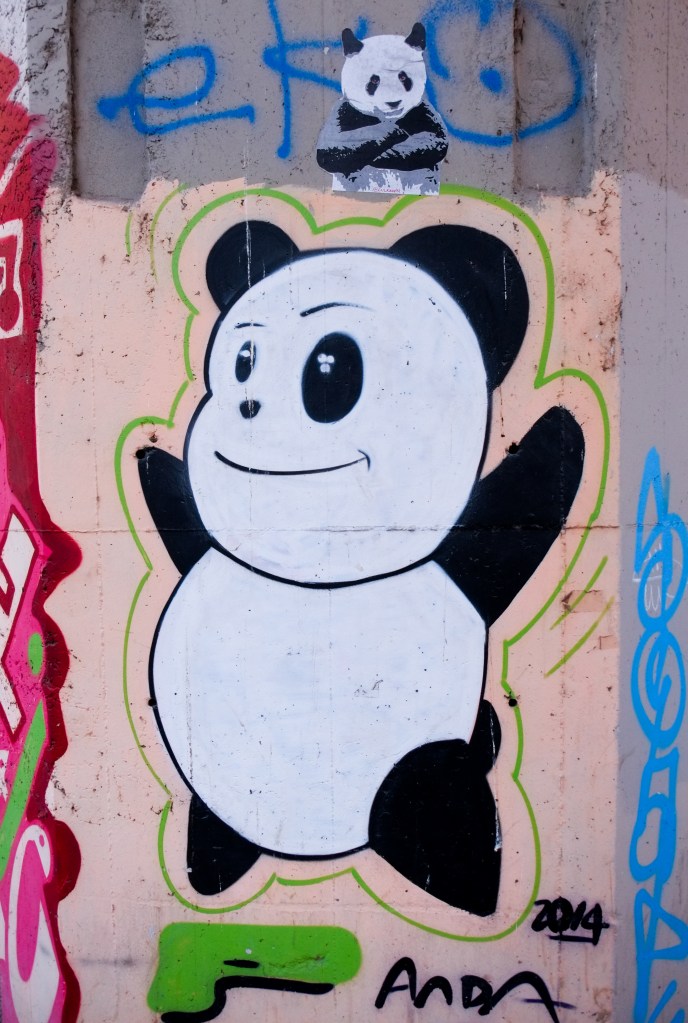
below: Two pandas
below: A brush to clean the toilet bowl. Not your average painting subject matter.
below: A few pillars are decorated with these red and blue guys – stylized yet anatomically correct – painted by Boris Hoppek
As part of the town’s Bicenntenial (200 years!) celebration, a large mural was created for the side of a building in downtown Prescott Ontario.
The Prescott People’s Place Commissioned by the Prescott Bicentennial Committee and dedicated December 18th, 2010 The Prescott People’s Place is composed of over 3000 pictures from Prescott people. This mural was created by Chuck Street and made in Prescott at MD Signs. Made possible by federal Canadian Heritage funding and the generous Prescott People. Victoria Hall and St. John’s Market The cornerstone for the Old Town Hall was laid on August 13th 1874 and the Market Building built in 1876. Both were demolished in 1960. The clock tower was added to the Town Hall in 1927. The orginal clock works were restored in 1980 and housed in the Rotary Clock Tower which still marks time today on the same corner. The building pictured on the left of the Town Hall is still standing and is home to the Forwarders Museum and Visitor Centre.
below: A white happy three eyed fish swimming among the scribbles.
below: A curly haired woman, or an old lady with a cane, and a monkey face. It looks like someone has a roller ready to paint over this section of wall…
below: Too cool dragon wearing blue shades and a jacket with the Montreal Expos logo on it. It’s been almost 20 years since the Expos played in Montreal.
In the Byward Market area of Ottawa, you can find a collection of large mural as you look across a parking lot on Dalhousie Street. They stretch along the wall of a funeral home on St. Patrick Street.
below: The darker end of the murals is signed by three. They are Juan Carlos Noria, The Laporte Brothers (Phil and Dom Laporte) and the Higher Ups.
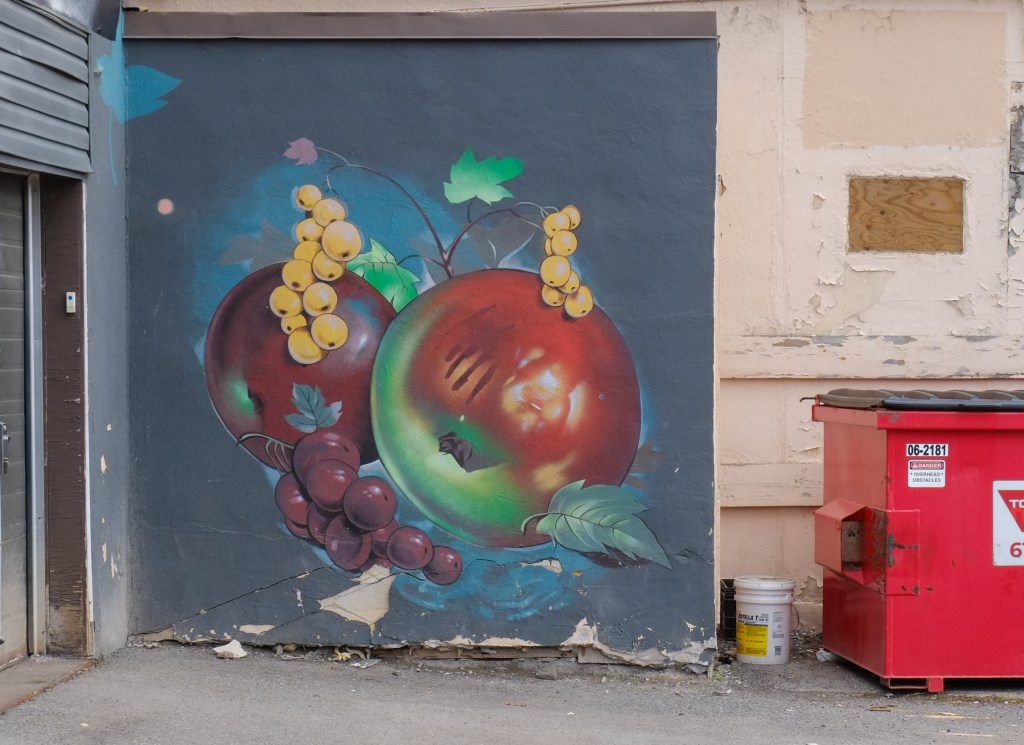
below: Apples and currants in the corner
below: The other part of the wall is for the birds so to speak. The blackbird (raven?) on the left was painted by DRPN (Drippin’ Soul).
below: This is a closer look at the head of the bird on the righthand side. It is the work of Mique Michelle, an artist who work often features feathery birds (or other animals)
Carrer Petritxol is a narrow street in the Gothic Quarter (Bari Gotic) section of Barcelona. It dates from the 15th century when it was a shortcut through the backyard of a local property owner. It runs from Portaferissa to Plaça del Pi. Today it has many small unnique stores including chocolate stores.
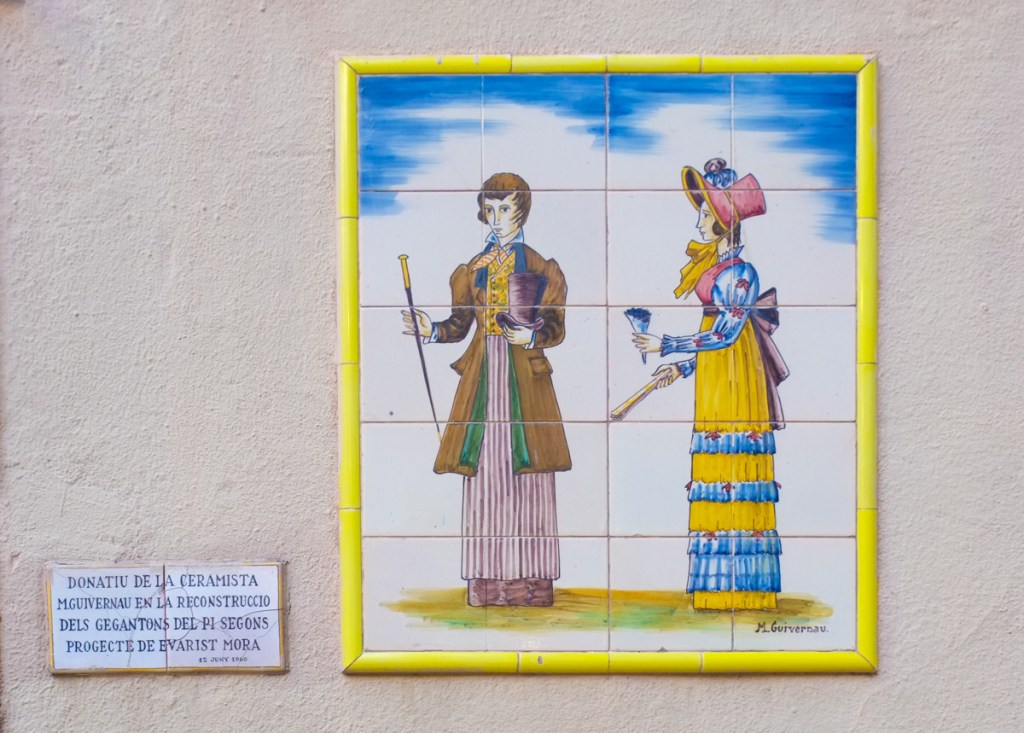
below: Catalan text: “Donatiu de la ceramista M. Guivernau en la reconstruccio dels gegantons del pi segons progecte de Evarist Mora.” Translation from Catalan: “Donation of the ceramist M. Guivernau in the reconstruction of the “Giants of Pi” according to Evarist Mora’s project. Note: The Giants of Pi – On display at the parish church of Santa Maria del Pi are two wearable puppet costumes, one male and one female, known as the Giants of Pi. They have a long history but the part most relevant to this blog post is the fact that they were restored in 1960 by the artist Evarist Mora. In 1985 they were named Mustafa and Elisenda. They are two of the many “gegants” that are brought out for special events in Barcelona such as the Corpus Christi procession and the Santa Eulalia festival.
M. Guinervau signed the above plaque but there are many other ceramic pictures on this street, all unsigned. They tell stories about the street including famous residents or visitors. What follows here are photos and a few details about some of them.
below: “Aci la mare de Déu ens diu que el temps passa lleu” , translation: “Here the mother of God tells us that time passes easily (or easily)”
below: “Amb capa i barret llue cada nit “peius” gener”, translation: “With cape and hat, shine every night “Peius” Gener”. This image shows the Spanish writer, journalist and playwright, Babot Gener Pompey (1848-1920), often known as Peius wandering the streets after dark.
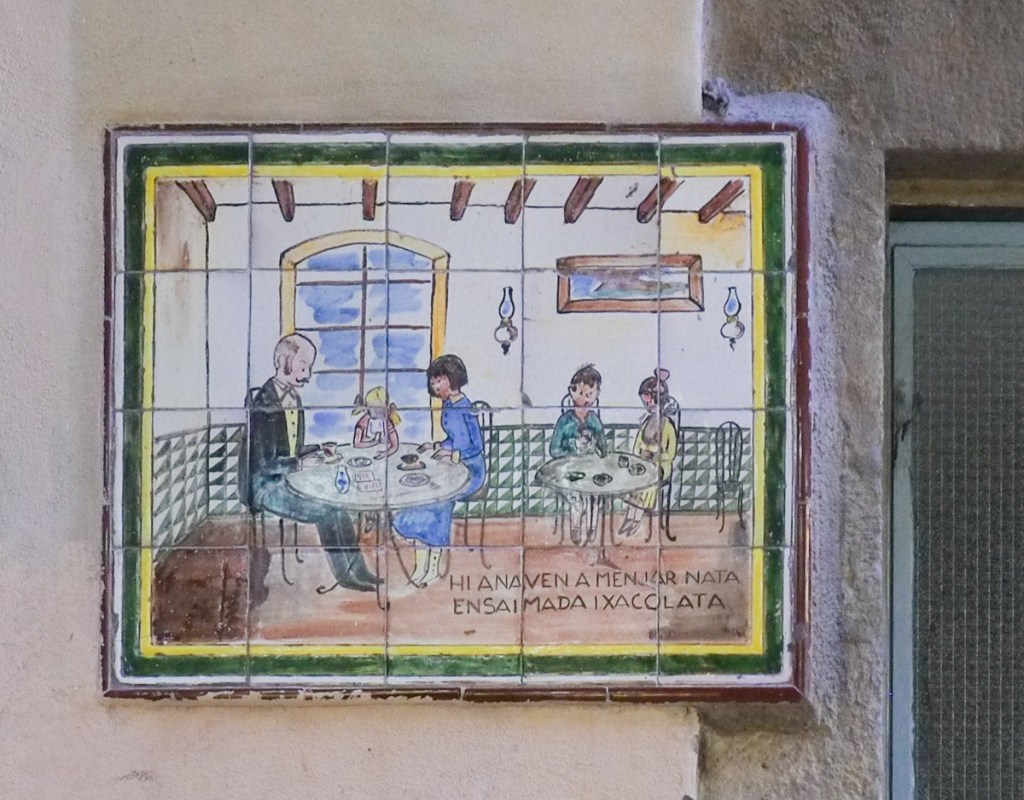
below: “Hi anaven a menjar nata ensaimada xocolata”, translation: “They were going there to eat chocolate cream” Carrer Petritxol has been a destination for chocolate for many years; there are at least 4 stores specializing in chocolate on this short street, two of which have a long history – Granja La Pallaresa and Granja Dulcinea. Granjas (Granges) were once shops specializing in dairy products.
below:Upper “De quant encara era nou i romantic el dinou”. The translation could be either “how new and romantic the nineteenth was still”, or “From when the nineteenth was still new and romantic” Lower: “De llavent ide ponent tot el da hi passa gent”, translation: “From dawn to dusk, people pass by all day”. This presumably refers to people walking along this street.
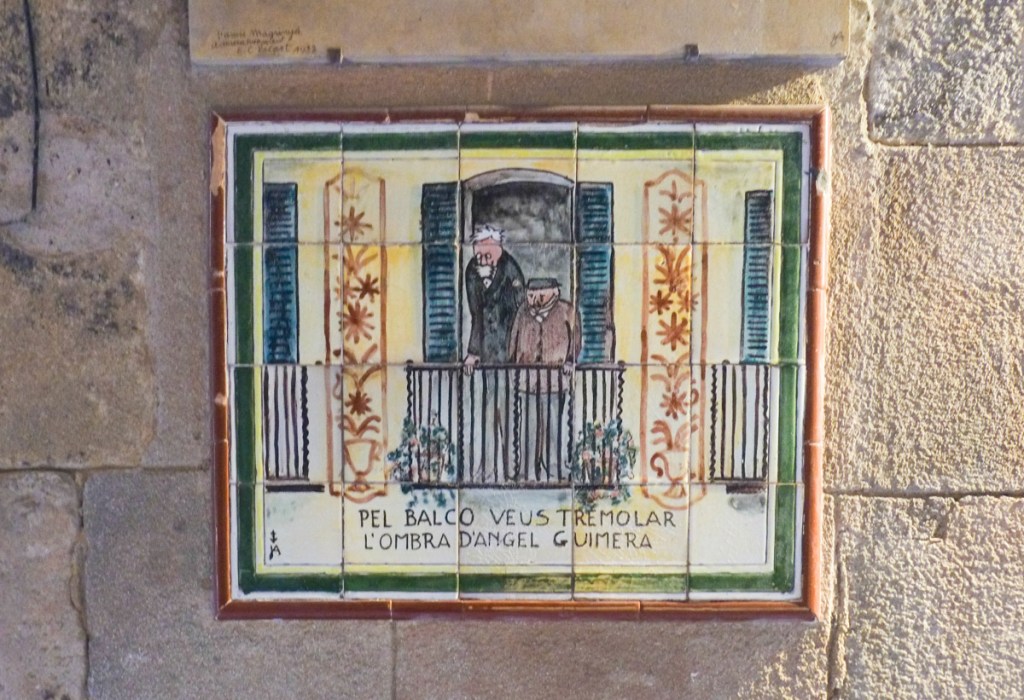
below: Catalan text: “Pel balco veus tremolar l’ombra d’angel Guimera”, translation: “On the balcony you see the shadow of Angel Guimera trembling”. Note: Angel Guimera (1847-1924) was a Catalan playwright.
below: “En un pis no sabem quin hi va viure Moratin” translation: “We don’t know which apartment Moratin lived in” . Note: Probably the writer Leandro Fernandez Moratin, (1760-1828) who lived in a hostel on this street in July 1814.
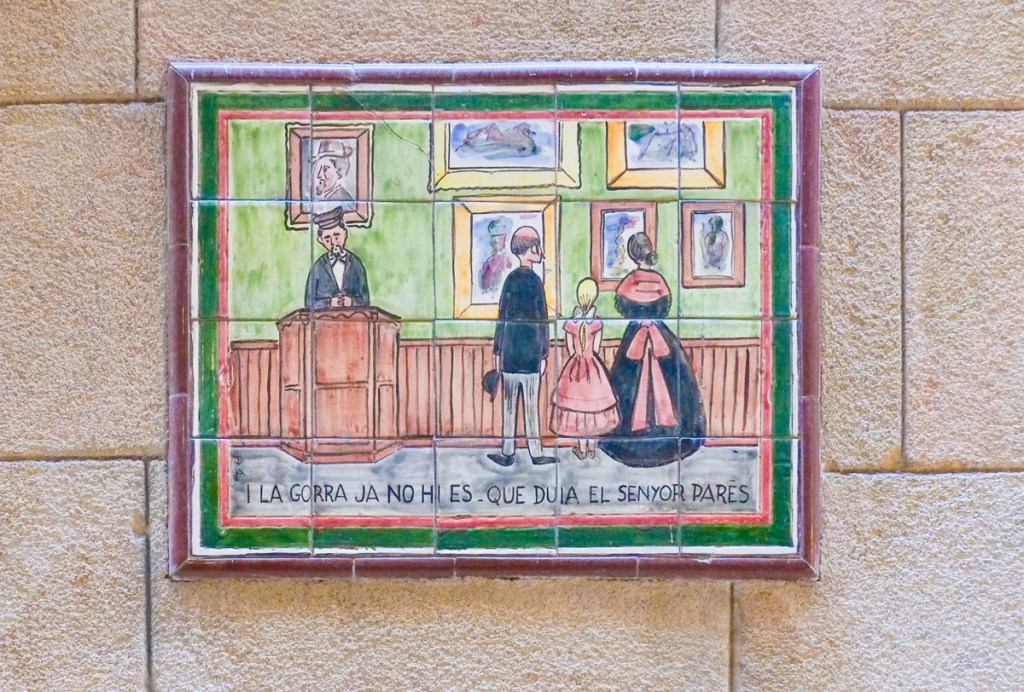
below: “I la gorra ja no hi es… que duia el Senyor Pares”. Transation: “And the cap is no longer there… that Mr. Pares wore” In other words, Sr Pares took off his hat when he and his family were at the art gallery.
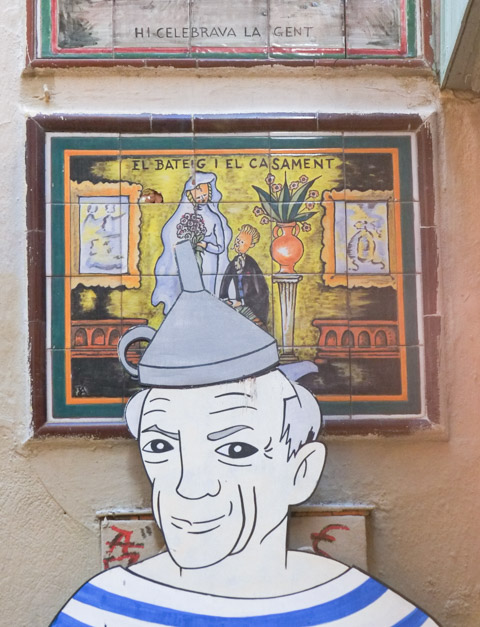
below: “El bateig i el casament”. Translation: “The baptism and the wedding.” That’s a rather short looking groom? The cutout of the man in the blue and white shirt with the funnel on his head is an added bonus!





 Photos taken August 2023