Sandwich history murals

I’m not talking about an edible sandwich [insert silly emoji here], but rather this post is about the Ontario town of Sandwich and some of the murals that they have.

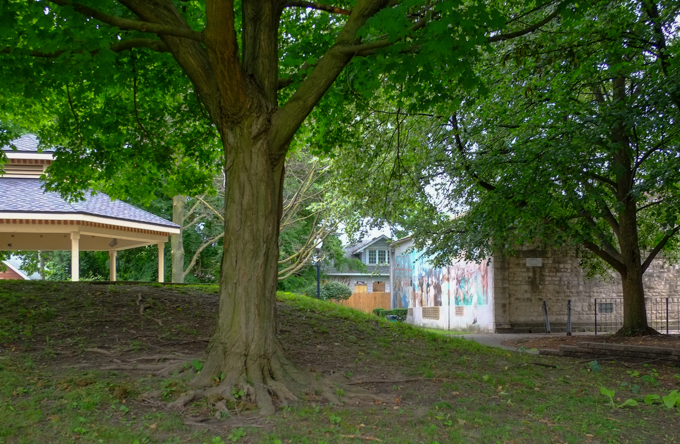
In a park setting – the story of a day in the life of a town, 24 May 1855.
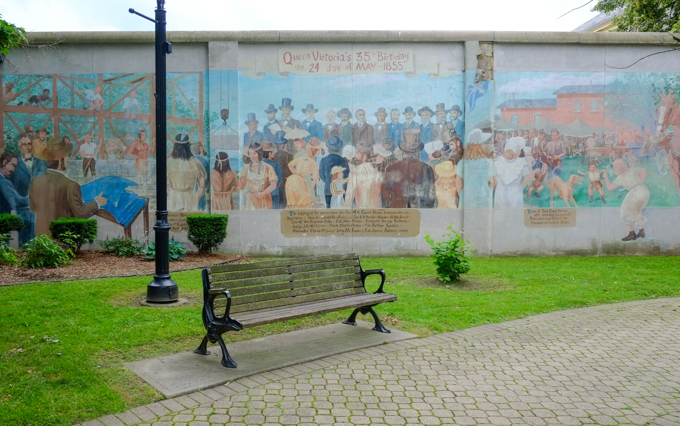
On the left, the construction of a new Court House is well underway.
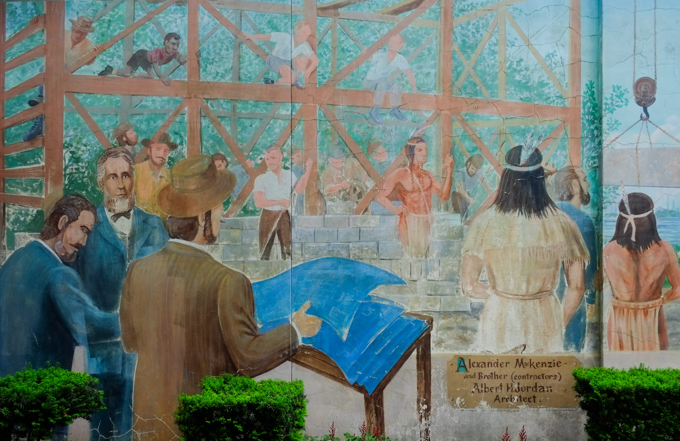
“Alexander Mackenzie and Brother (contractors), Albert H. Jordan – Architect”

In the middle the banner across the top of the panel says it all – “Queen Victoria’s 35th birthday, the 24th day of May, 1855” [note: Her 35th birthday was actually in 1854]. I suspect that the line of men is supposed to be all the dignitaries and local bigwigs (some of whom were named at the bottom of the image) who have come to celebrate a queen’s birthday and witness the laying of the cornerstone.
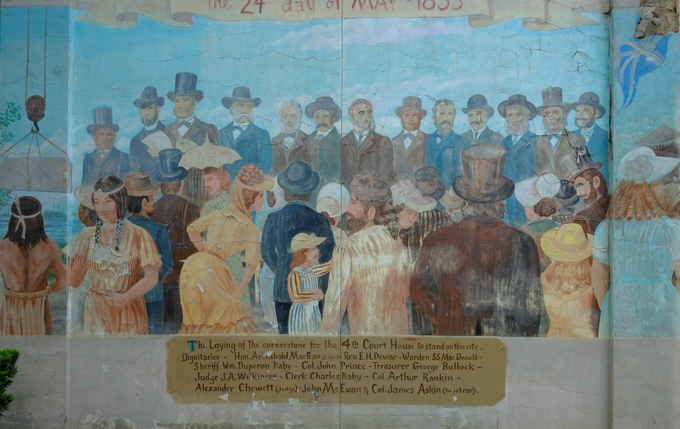
“The Laying of the corner stone for the 4th Court House to stand on this site. Dignitaries – Hon. Archibald Maclean (Judge), Rev. E. H. Dewar, Warden S.S. MacDonell, Sheriff Wm Duperon Baby, Col. John Prince, Treasurer George Bullock, Judge J.A. Wilkinson, Clerk Charles Baby, Col. Arthur Rankin, Alexander Chewett (Judge), John McEwan, and Col. James Askin (Registrar).”

below: Meanwhile, on the right, there was a party going on.
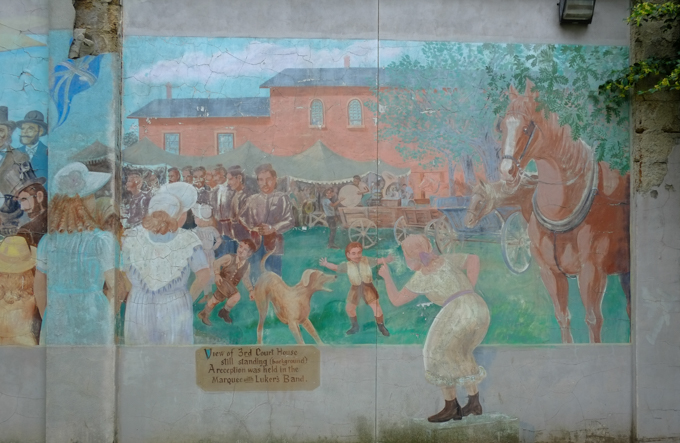
“View of 3rd Court House still standing (background). A reception was held in the Marquee with Luker’s Band.”

below: This is the Court House that was built in 1854/5 by the Mackenzie brothers (Alexander Mackenzie (1822-1892) then served as the federal Member of Parliament for the area between 1867 and 1892. He was the second Prime Minister of Canada (1873-1878)) . The building was used as a Court House until 1963. It is now known as Mackenzie Hall.
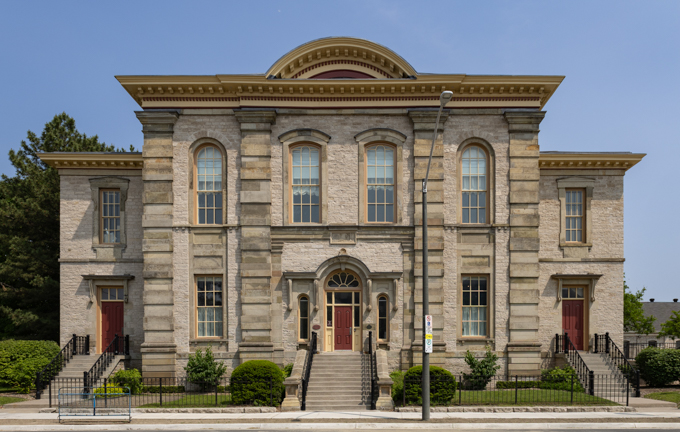
picture of the modern day Mackenzie Hall
Picture source: Wikipedia

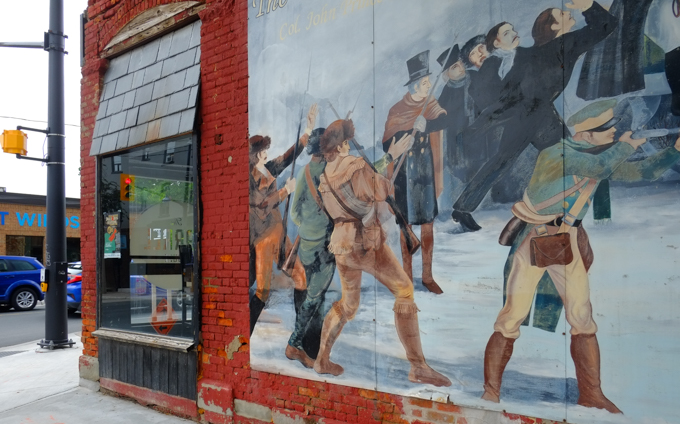
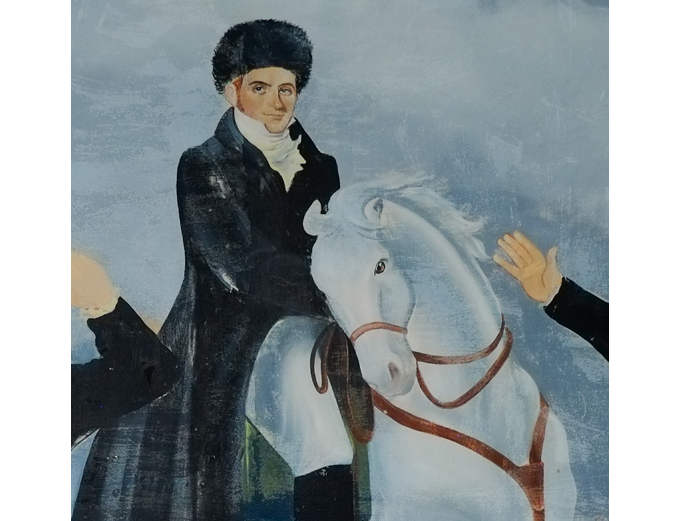
below: “The Battle of Windsor” is another mural.
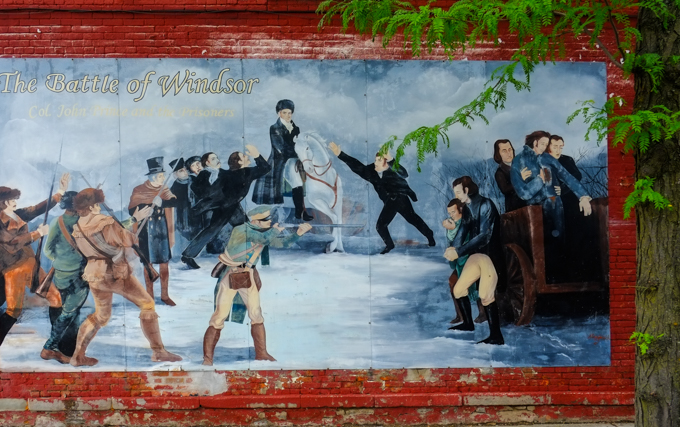
There is a panel in this mural (not shown) that tells the story of the Battle of Windsor. The first paragraph gives an account from the perspective of the man in charge, Col. John Prince (the one sitting on the white horse). … “In his diary for December 4 1838 Col. John Prince wrote: ‘A cold day. Awoke at 6 am by an alarm gun at Sandwich. Rose and saw a fire at Windsor. Proceeded there with the militia and found it in possession of Brigands and Pirates. We attacked them and killed 27 and took about 20 prisoners. I ordered the first 5 taken to be shot. We lost 4 men, and poor Dr. Hum Asst. Staff Surgeon who was cruelly Murdered by them!’ “
below: Another piece of local history…..
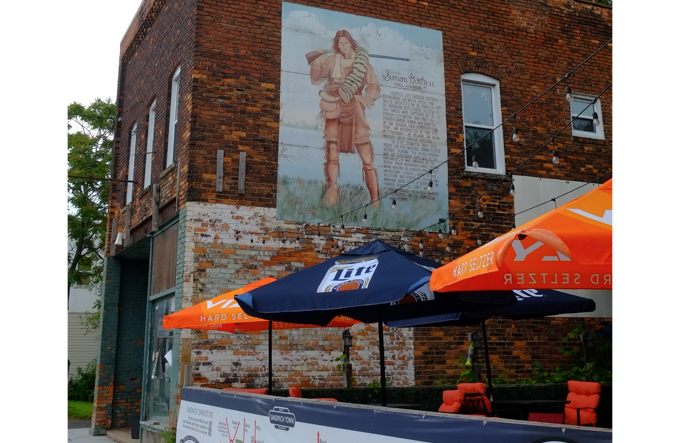
mural about Simon Ginty, picture of him along with many words describing his life on the side of a brick building, above a restaurant patio with blue and orange umbrellas

“Simon Girty U.E. 1741 – 1818 Girty’s life crossed cultural boundaries between Native and White societies on the frontier of American settlement. In 1756 his family was captured by a French-led Native war party in Pennsylvania. Simon was adopted by the Seneca, then repatriated in 1764. An interpreter at Fort Pitt (Pittsburgh). He became an intermediary with Native Nations.

In 1778, dismayed over rebel policy on the Natives, Simon fled to Detroit. During the Revolutionary War and subsequent conflicts in the Ohio Valley, he was employed by the British Indian Department while serving Native Nations as a negotiator, scout, and military leader. Anger at his defection and fearful of his influence Americans made Ginty a scapegoat for frontier atrocities. Girty was actively involved with old Sandwich. He is buried on his homestead in Amherstburg. “

The above paragraphs are a transcription of the text in the mural. There is a plaque in Pennsylvania that honours him and one part of it says, “… he became an interpreter for the American army; deserted in 1778. Afterwards, led British and Native American war parties against frontier settlements. Hostile to the US in the War of 1812. Regard as a loyalist by some and as a “White Savage” by others.”
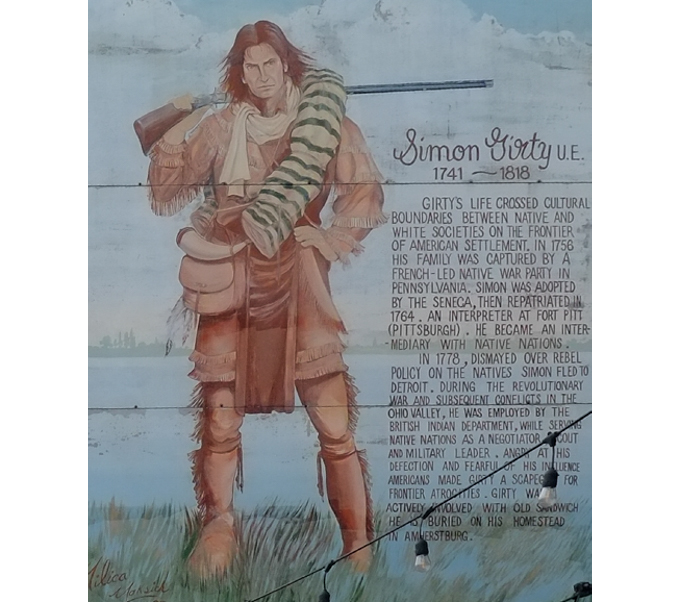
mural about Simon Ginty, picture of him along with many words describing his life

below: “Healthy Communities”, a mural about doctors, nurses, hospitals, and pharmacists both past and present.
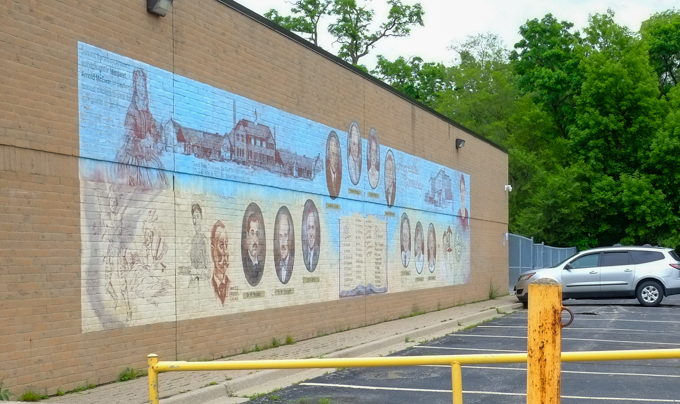
mural called healthy communities, about famous doctors and nurses in sandwich

below: In the top corner, “General Benedict Arnold’s granddaughter, Margaret Arnold McEwan of Sandwich, braved cholera to care for immigrants in 1854”. Also in blue and across the top of this part of the mural is a drawing of the Braid Building. It was a Sanitorium that was built in 1923 to house tuberculosis patients. Cholera and TB, two diseases that are much rarer nowadays.
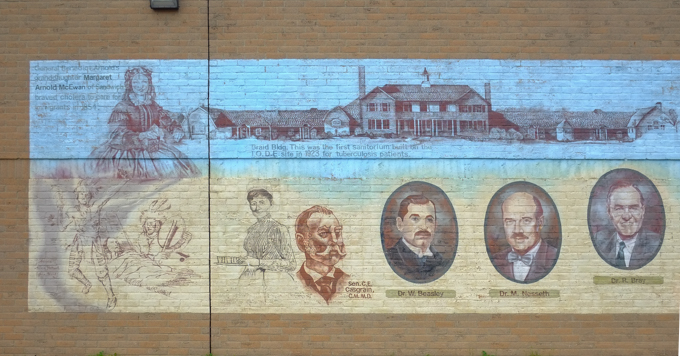
part of Healthy Communities mural with drawing of General Benedict Arnold's granddaughter, Margaret Arnold McEwan as well as Braid Building which was a Sanitorium that was built in 1923 to house tuberculosis patients
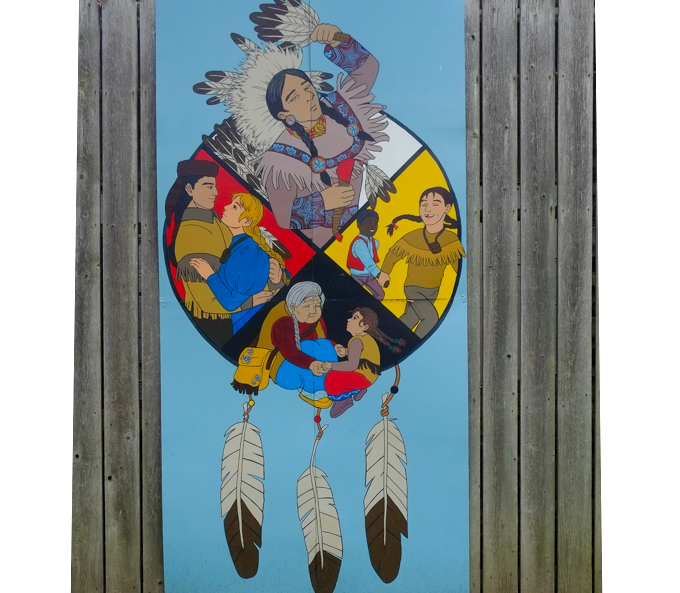
street art painting of dreamcatcher but in circle part are four pictures, each in a quadrant of the circle

In case you are unsure where Sandwich is, it is on the Detroit River just outside of Windsor (or is a suburb of Windsor)
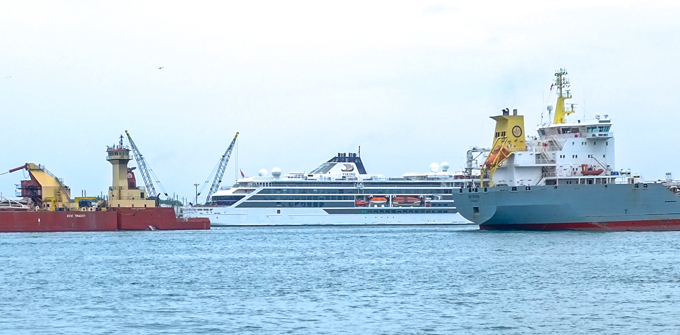
boats on the Detroit River, a rusty red and yellow boat, a cruise ship, and a navy boat

It is where you will find the Gordie Howe Bridge – which is now opened (finally!)
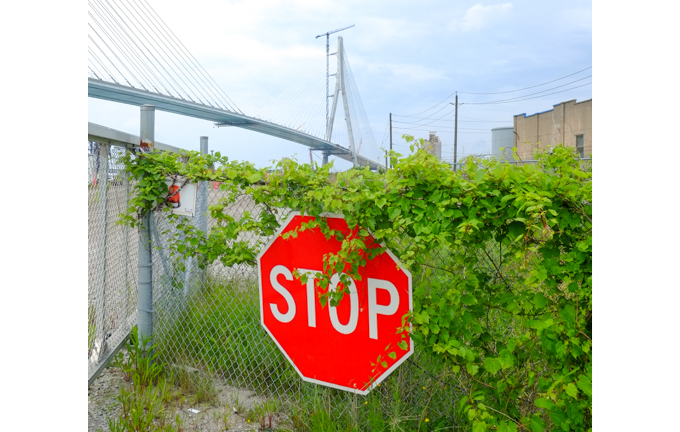
Stop sign on a fence overgrown with greenery, at the end of a road by a construction site for the Gordie Howe bridge

Photos taken June 2025

Eastside Gallery, Berlin

On 12 August 1961, the Soviets began building a wall around West Berlin to separate it from East Berlin and East Germany.  By the next morning, the wall was complete.  More than 90 miles of wall made an island out of West Germany.

people and parked bikes in front of part of a mural on Berlin Wall, Eastside gallery

Eastside Gallery – This outdoor “gallery” is a section of the Berlin Wall that has been left standing along Muhlenstrasse.   It is just over 1300 metres long and has been covered with 105 paintings and murals on the side that faced East Berlin.  It was first painted in 1990 just after the wall fell.  Some sections were repainted in 2009.

below: “Diagonale Lösung des Problems” by Michail Serebrjakow 1990. Diagonal solutions.

part of a mural on Berlin Wall, Eastside gallery, thumbs up sign, with a string tied to the thumb pulling it backwards and holding it up

below: A Trabant (the only East German make of car) comes through the wall, painted by Birgit Kinder, 2009. The date on the licence plate, 9 November 1989, is when the wall was opened and East and West Germans were allowed to cross freely.  Demolition of the wall began in June of 1990.

 a mural on Berlin Wall, Eastside gallery

below: The orange bridge in the picture is Oberbaumbrucke (Oberbaum Bridge) that crosses the River Spree near this wall section. This wall runs parallel to the River Spree as the river was part of the ‘border’ here.

a woman walks her bike past part of a mural on Berlin Wall, Eastside gallery

below: Part of “Doin it cool for the East Side” by Jim Avignon, Miriam Butterfly, and Tomas Fey (similar to above).

below:  actors Jean Reno and Juliette Binoche

part of a mural on Berlin Wall, Eastside gallery - faces of two people,

below: Jumping over the wall (He looks a bit too relaxed?)

part of a mural on Berlin Wall, Eastside gallery, a man in a red jacket jumps over the Berlin wall

below: ‘Tolerance’ by Mary Mackey of Denver

part of a mural on Berlin Wall, Eastside gallery, Tolerance by Mary Mackey of Denver Colorado

below: A small part of ‘Joint Venture’ by Margaret Hunter.

part of a mural on Berlin Wall, Eastside gallery

part of a mural on Berlin Wall, Eastside gallery - lots of graffiti, a pasteup of a couple kissing under an umbrella


below: Es gilt viele mauren abzu bauen = There are many walls to build.  There are lots of walls we need to break down.  Painted by Ines Bayer and Raik Hönemann

part of a mural on Berlin Wall, Eastside gallery - es gilt viele mauern

below: By Schamil Gimajev (or Gamil Gimajew), a very large mural with the words Freedom and Perestroika incorporated into it.

part of a mural on Berlin Wall, Eastside gallery

below: A gate in the wall, now with locks on it.

people hanging out in front of part of a mural on Berlin Wall, Eastside gallery

below: Some of the locks

Some locks attached the bars of a metal gate in the old Berlin Wall on Muhlenstrasse, Eastside gallery

below: by Christine Fuchs

writeen words, brown on white, large letters, How's God she's black

below: Batman and The Joker.

part of a mural on Berlin Wall, Eastside gallery - Batman and Joker

a young man playing a guitar in front of part of a mural on Berlin Wall, Eastside gallery

part of a mural on Berlin Wall, Eastside gallery

below: No mans land barbed wire. “Niemandsland” by Carmen Leidner.

part of a mural on Berlin Wall, Eastside gallery - barbed wire

below: Theodor Cheslav Tezhik – The Big Kremlins Wind.  The winds of change.

part of a mural on Berlin Wall, Eastside gallery

a young muslim woman in a head scarf walks past part of a mural on Berlin Wall, Eastside gallery

 below: I painted over the wall of shame so freedom is ashamed no more.  Inferno ruled too many years until the people chose the light.  I put my faith in you, Berlin, and give to you my colours bright.” Fulvio Pinma.  The text is also written in Italian (larger letters above) and in German (at the bottom).

words in a mural by Fulvio Pinma, in Italian, German, and English, on part of the Berlin wall, Eastside Gallery

below: Not in the picture, the other end of the chain is in the mouth of a white dove.  This mural is by Andrej Smolák

part of a mural on Berlin Wall, Eastside gallery with a lot of pink and black graffiti scrawled on top of it

below:  A comment on censorship in art by Willi Berger –  “Der Maler Hans Meissel (1888-1969) sowohl im Dritten Reich als auch in der DDR mit Ausstellungsverbot belegt wegen seiner expressiven Malweise setzte mit ‘GOTT ALLEIN DIE EHRE’, J.S. Bachs letzter Komposition der Kunst der Fuge ein Denkmal. [blue] Mit der Kopie des nun erstverottenthaten Bildes mochte ich meinem Lehrer Donk abstatten.”   It’s a copy of a painting by (and tribute to) Hans Meissel whose artwork was banned by the Third Reich.  The title of the painting is “Soli Deo Gloria” and was a tribute to the last composition by J.S. Bach, ‘The Art of the Fugue’.

a man stops to look at part of a mural on Berlin Wall, Eastside gallery, tribute to painter Hans Meissel by Willi Berger

below: Thierry Noir

part of a mural on Berlin Wall, Eastside gallery, large faces by Thierry Noir

below: Mikhail Gorbachev drives a car with a hammer and sickle steering wheel.

part of a mural on Berlin Wall, Eastside gallery, picture of Mikhail Gorbechev driving a car with a hammer and sickle shaped steering wheel.

below: Selling black and white portraits in front of an untitled work by Ana Leonor Madeira Rodrigues.  Floating ghostly figures in black and white.

a man sells black and white drawn portraits in front of part of a mural on Berlin Wall, Eastside gallery

below: Spacemagik, by Gabor Simon

people in front of part of a mural on Berlin Wall, Eastside gallery

below: A line of wanted posters.  Bloody Vladimir.  Putin of course.

part of a mural on Berlin Wall, Eastside gallery - posters with the face of Putin, Russin leader, with words, Bloody Vladimir, wanted poster

below: A painting of Leonid Brezhnev and Erich Honecker kissing as painted by Dmitri Vrubel.  It was first painted in 1990 and re painted in 2009.  Honecker was the East German leader in 1989 whose rise to power was aided by Soviet leader Leonid Brezhnev.  By 1989, Brezhnev was dead and the more liberal Mikhail Gorbachev was the Soviet leader.

two women stand in front of part of a mural on Berlin Wall, Eastside gallery

people reaching up high to write things on the wall, part of a mural on Berlin Wall, Eastside gallery

part of a mural on Berlin Wall, Eastside gallery

part of a mural on Berlin Wall, Eastside gallery

people walking past part of a mural on Berlin Wall, Eastside gallery

A full list of the original artists can be found on Wikipedia.

part of a mural on Berlin Wall, Eastside gallery