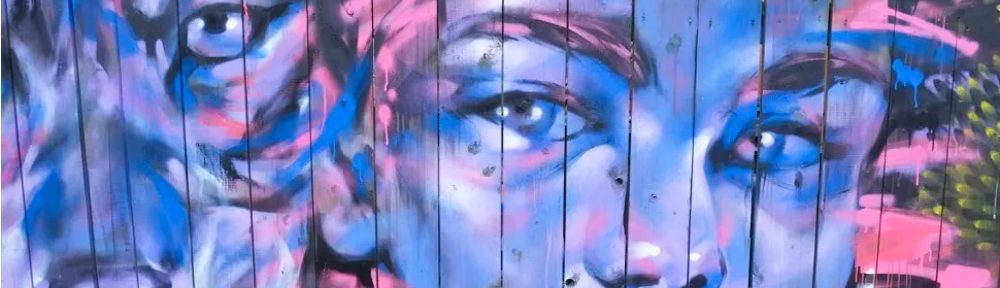
I’m not talking about an edible sandwich [insert silly emoji here], but rather this post is about the Ontario town of Sandwich and some of the murals that they have.
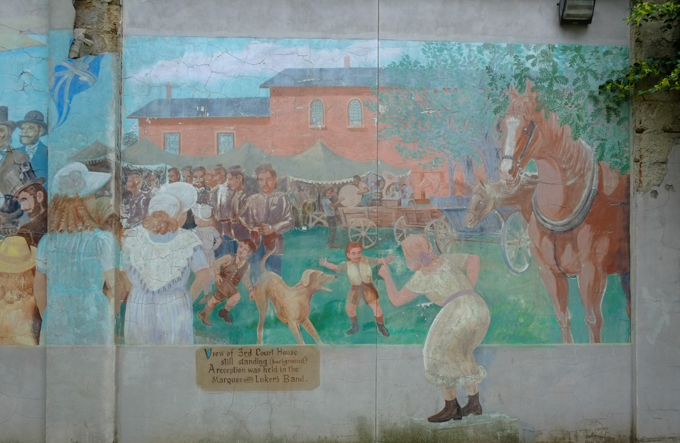
In a park setting – the story of a day in the life of a town, 24 May 1855.
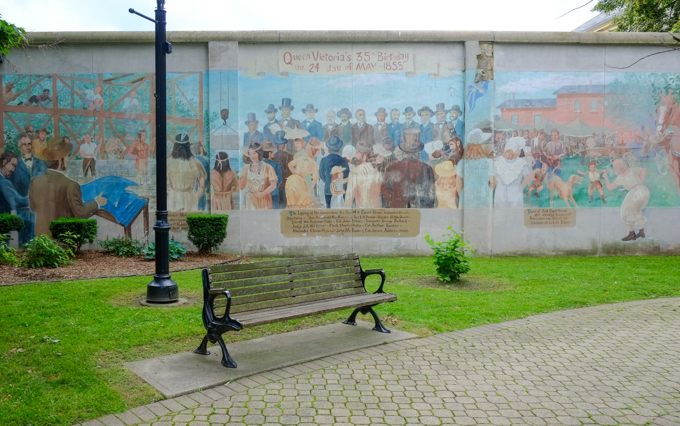
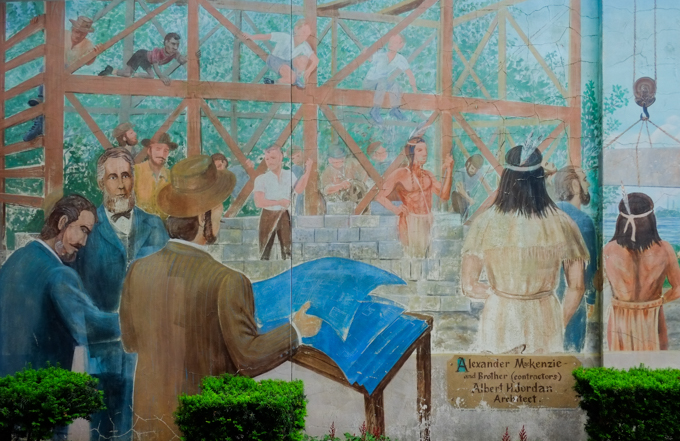
On the left, the construction of a new Court House is well underway.
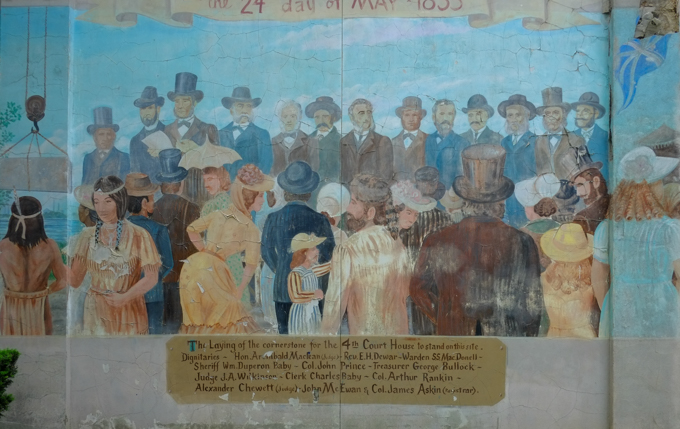
In the middle the banner across the top of the panel says it all – “Queen Victoria’s 35th birthday, the 24th day of May, 1855” [note: Her 35th birthday was actually in 1854]. I suspect that the line of men is supposed to be all the dignitaries and local bigwigs (some of whom were named at the bottom of the image) who have come to celebrate a queen’s birthday and witness the laying of the cornerstone.
below: Meanwhile, on the right, there was a party going on.
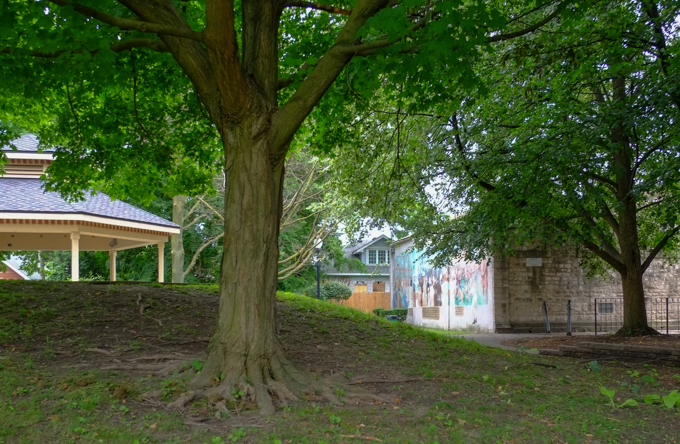
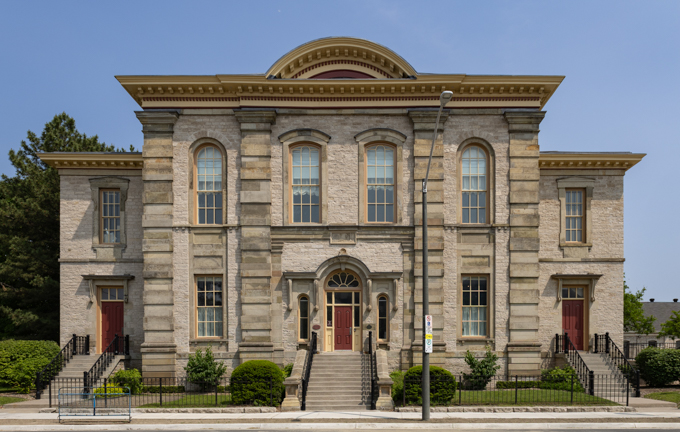
below: This is the Court House that was built in 1854/5 by the Mackenzie brothers (Alexander Mackenzie (1822-1892) then served as the federal Member of Parliament for the area between 1867 and 1892. He was the second Prime Minister of Canada (1873-1878)) . The building was used as a Court House until 1963. It is now known as Mackenzie Hall.
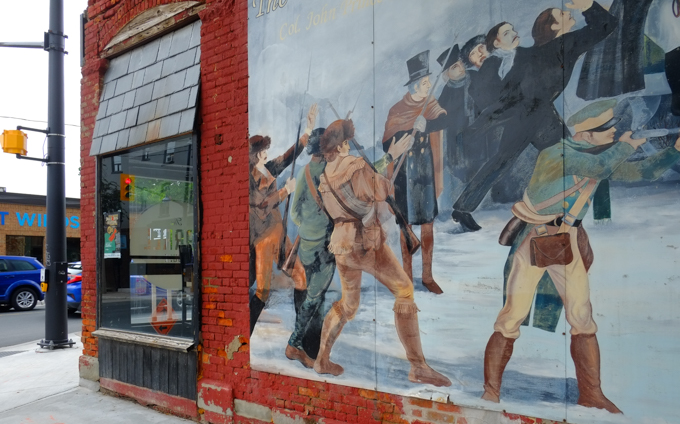
below: “The Battle of Windsor” is another mural.
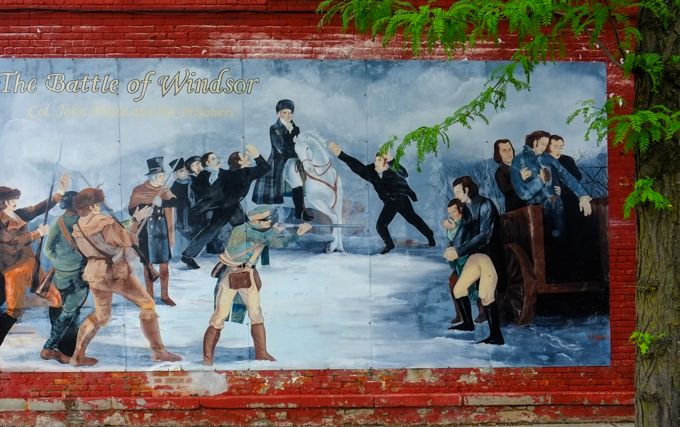
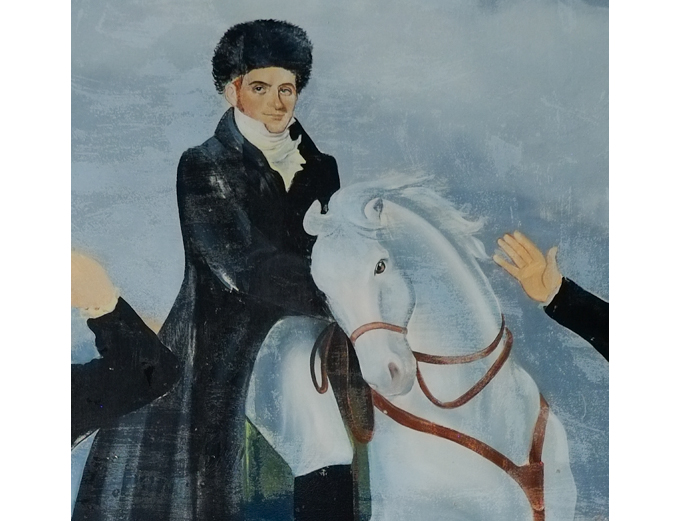
There is a panel in this mural (not shown) that tells the story of the Battle of Windsor. The first paragraph gives an account from the perspective of the man in charge, Col. John Prince (the one sitting on the white horse). … “In his diary for December 4 1838 Col. John Prince wrote: ‘A cold day. Awoke at 6 am by an alarm gun at Sandwich. Rose and saw a fire at Windsor. Proceeded there with the militia and found it in possession of Brigands and Pirates. We attacked them and killed 27 and took about 20 prisoners. I ordered the first 5 taken to be shot. We lost 4 men, and poor Dr. Hum Asst. Staff Surgeon who was cruelly Murdered by them!’ “
below: Another piece of local history…..
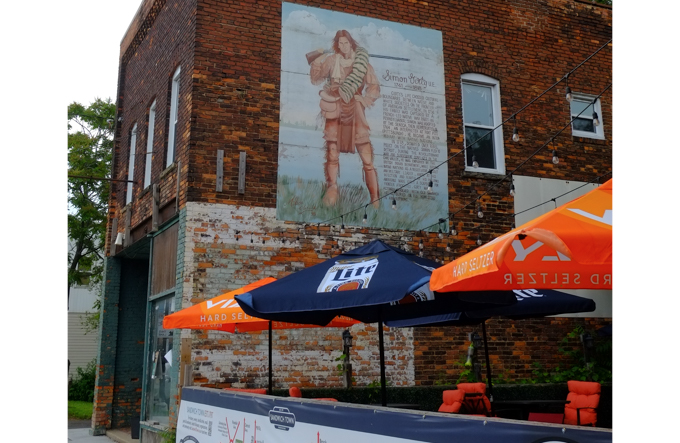
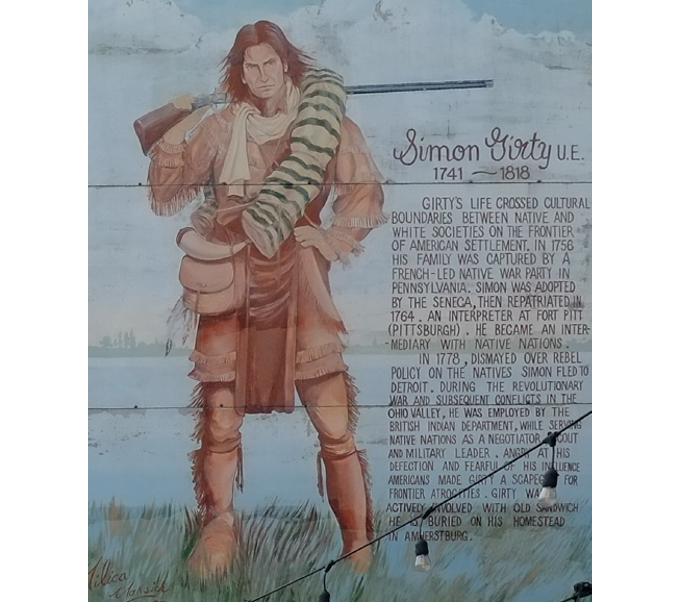
“Simon Girty U.E. 1741 – 1818 Girty’s life crossed cultural boundaries between Native and White societies on the frontier of American settlement. In 1756 his family was captured by a French-led Native war party in Pennsylvania. Simon was adopted by the Seneca, then repatriated in 1764. An interpreter at Fort Pitt (Pittsburgh). He became an intermediary with Native Nations.
In 1778, dismayed over rebel policy on the Natives, Simon fled to Detroit. During the Revolutionary War and subsequent conflicts in the Ohio Valley, he was employed by the British Indian Department while serving Native Nations as a negotiator, scout, and military leader. Anger at his defection and fearful of his influence Americans made Ginty a scapegoat for frontier atrocities. Girty was actively involved with old Sandwich. He is buried on his homestead in Amherstburg. “
The above paragraphs are a transcription of the text in the mural. There is a plaque in Pennsylvania that honours him and one part of it says, “… he became an interpreter for the American army; deserted in 1778. Afterwards, led British and Native American war parties against frontier settlements. Hostile to the US in the War of 1812. Regard as a loyalist by some and as a “White Savage” by others.”
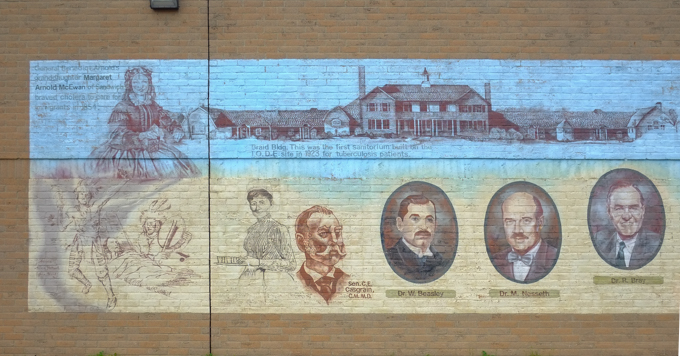
below: “Healthy Communities”, a mural about doctors, nurses, hospitals, and pharmacists both past and present.
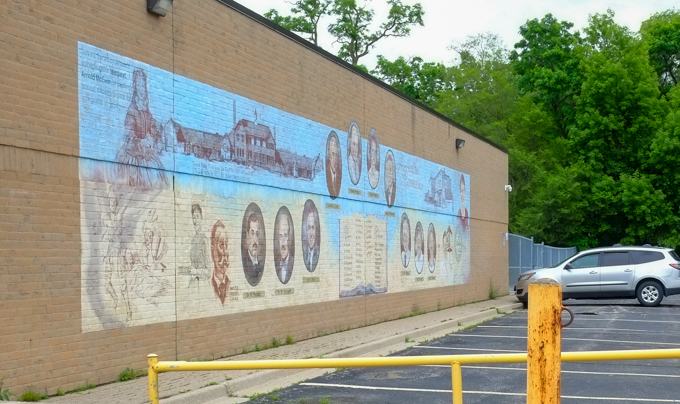
below: In the top corner, “General Benedict Arnold’s granddaughter, Margaret Arnold McEwan of Sandwich, braved cholera to care for immigrants in 1854”. Also in blue and across the top of this part of the mural is a drawing of the Braid Building. It was a Sanitorium that was built in 1923 to house tuberculosis patients. Cholera and TB, two diseases that are much rarer nowadays.
In case you are unsure where Sandwich is, it is on the Detroit River just outside of Windsor (or is a suburb of Windsor)
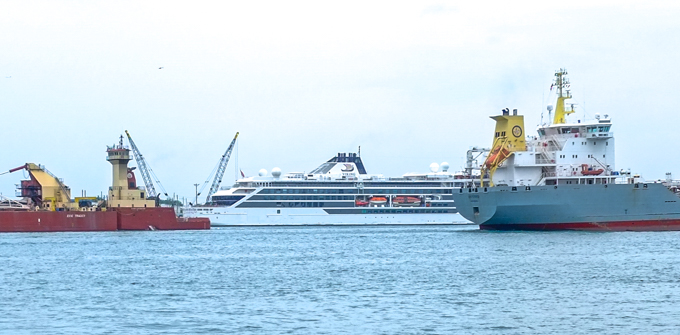
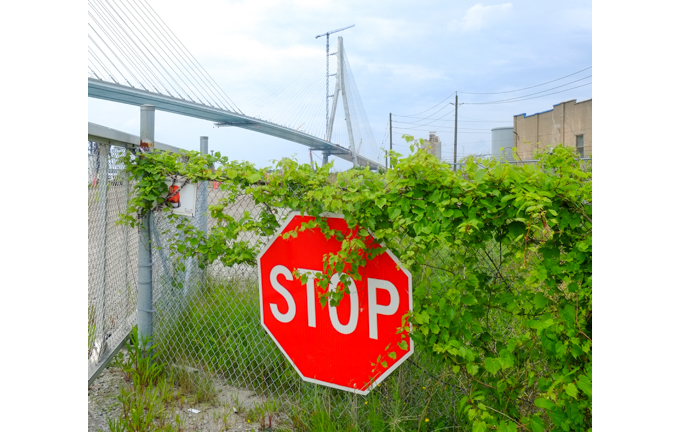
It is where you will find the Gordie Howe Bridge – which is now opened (finally!)
Photos taken June 2025

