small town Ontario murals

As I find more, I will add them here in alphabetical order by town name.

Burnt River: Two halves of the same mural. Rural life – cows, horses, and the old CN train that no longer runs here. The land where the railway tracks ran has been repurposed into a walking trail in summer and a snow mobile trail in winter.
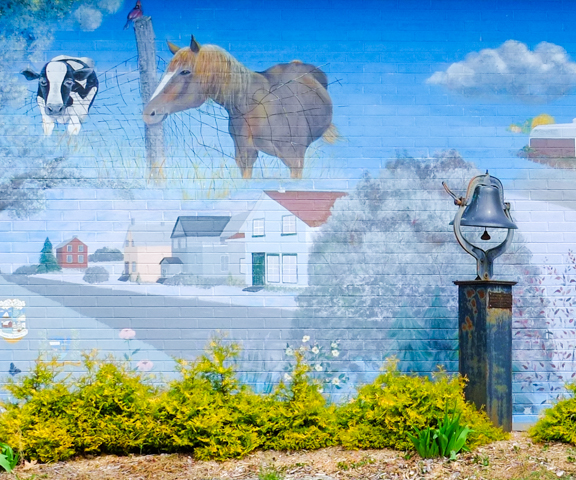
part of a mural on exterior wall of Burnt River post office, some houses, a cow, and a horse

part of a mural on exterior wall of Burnt River post office, a train stopped at a station, a snow mobile.

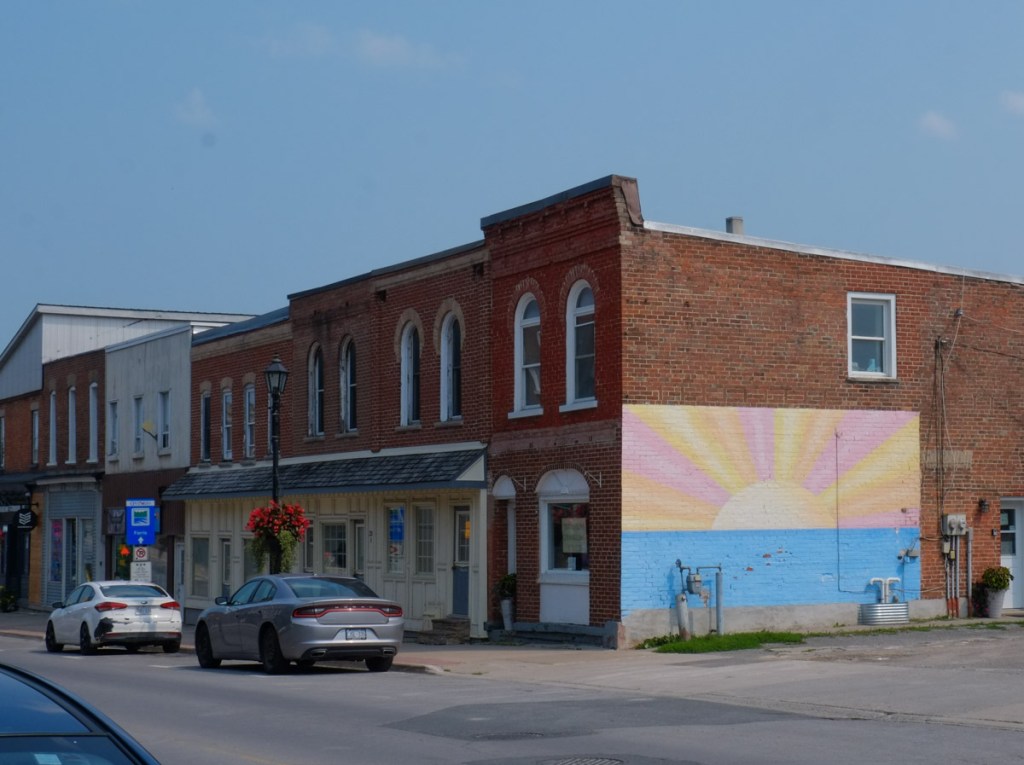
Campbellford: Sunrise over the water. Campbellford is on the Trent River.
Goderich: Butterflies and rainbows on the corner of Courthouse Square and Montreal Street, downtown.

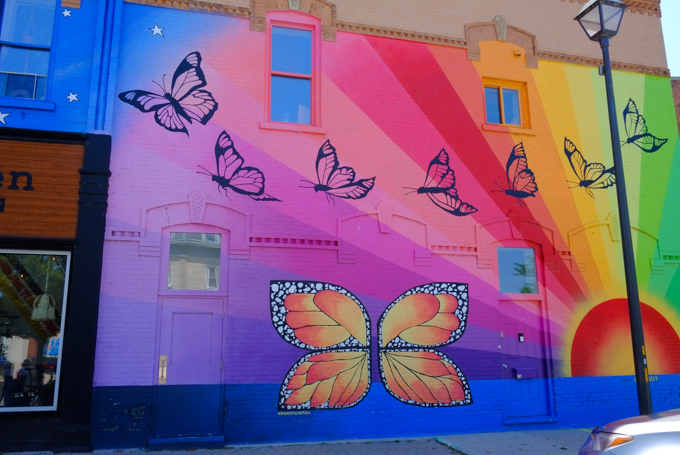
butterflies and a rainbow in a large mural on the side of a brick building in downtown Goderich

Lafontaine: Profile of a wolf… Legend of Loup Lafontaine – part legend and part true story, written by Thomas Marchildon, a parish priest, in 1955. Since 2002 the town has held an annual Festival du Loup.

mural, wolf head in profile, leaves, berries, nature scene

Parham: “59th Annual Exhibition of the Parham Agricultural … A glimpse into the past – just some of the people who made the 1950 Parham Fair another memorable event.”
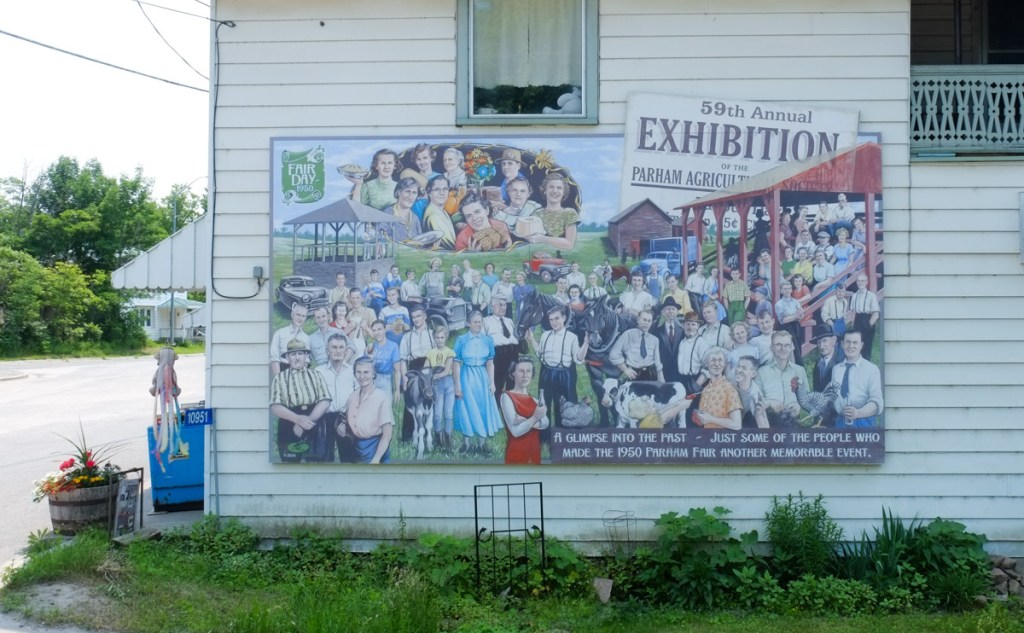
large mural on the side of general store in Parham Ontario, image of a group of people at the 59th annual Exhibition and Parham agricultural fair, early 1900sm

Sharbot Lake: “The Final Journey”, On June 6, 1891, Sir John A. Macdonald died at his residence in Ottawa. After a state funeral, his body was taken by train to Kingston from the mainline to the K&P at Sharbot Lake.

mural on wall in sharbot lake, portrait of Sir John A Macdonald as well as a train, tells story of Macdonald's trip in the train after he died

Sharbot Lake: Kingston and Pembroke Iron Mining Company. Incorporated 1887. The Railway’s Influence: with the arrival of the railway in 1876 came new prosperity. Sawmills and mines now had easy access to markets. Sharbot Lake soon had several stores, hotels and 3 doctors. This building, built in 1901, was originally the Farmers Bank of Canada.

mural about Kingston and Pembroke iron mining company incorporated in 1887, and the railway's influence in the area, saw mills and mines and easy access to markets.  On the side of building from 1901, the Farmers Bank of Canada

Tiverton: The Watchman – this was the name of the local newspaper. At the top of the oval, “Incorporated in 1879” and at the bottom, a portrait of John Patterson, one of the first settlers. Also shown, the Masonic Lodge, local church, an old car and pickup truck at the B A gas station, horses pulling a plow, and an old fire wagon on the main street. It was originally painted by Allen Hilgendorf in August 2001 then restored by Ruth Hurdle in 2010, and by the looks of it perhaps it is being restored again (photo taken June 2025). Other notes: Although the town was incorporated in 1879, it took the name Tiverton in 1860 when the post office opened there. “The Watchman” newspaper was founded in 1874.
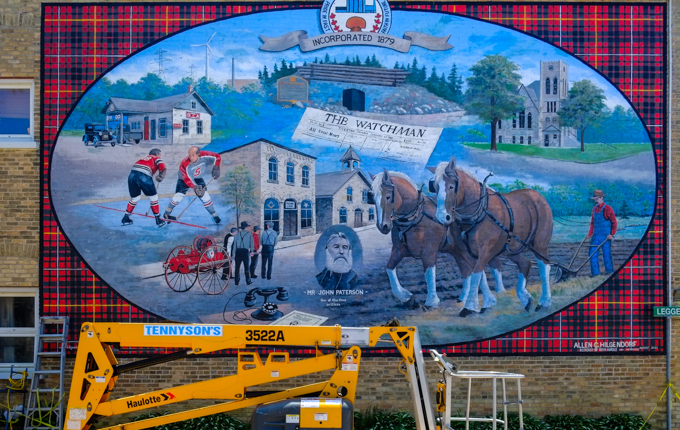
large mural, outdoors, black watchman plaid background with large interior oval containing many images of pioneer life, horses pulling a plow in a field, men playing hockey outside, a church, a wagon on a street with a couple of stores,

Tiverton: Tiverton Platoon 1917, group picture

large photograph of men in uniform, 1917, group shot, about 50 men, title is Tiverton Platoon 1917, on brick wall, outside

Wallaceburg: The S.S. Superior, a large boat. “1889-1960, Typical of the Great Lake Steamers that visited Canada’s Inland Deep Water Port, this 250 ft package freighter, a familiar sight loading local products, made it’s last call in 1958 thus ending an important chapter in local heritage. “
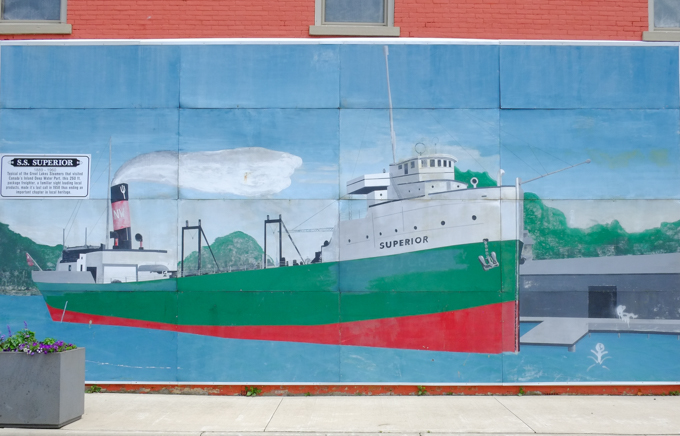
painting on an exterior wall in Wallaceburg, a large image of the S.S. Supperior, a package freighter built in the 1880s.

Along the Riverbank

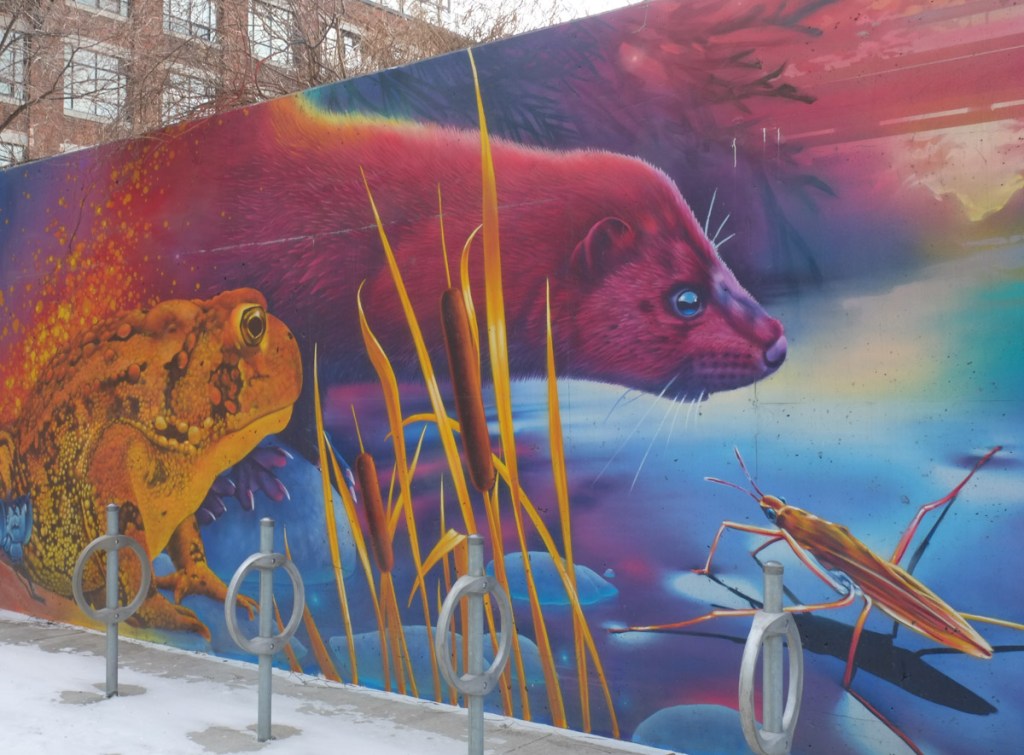
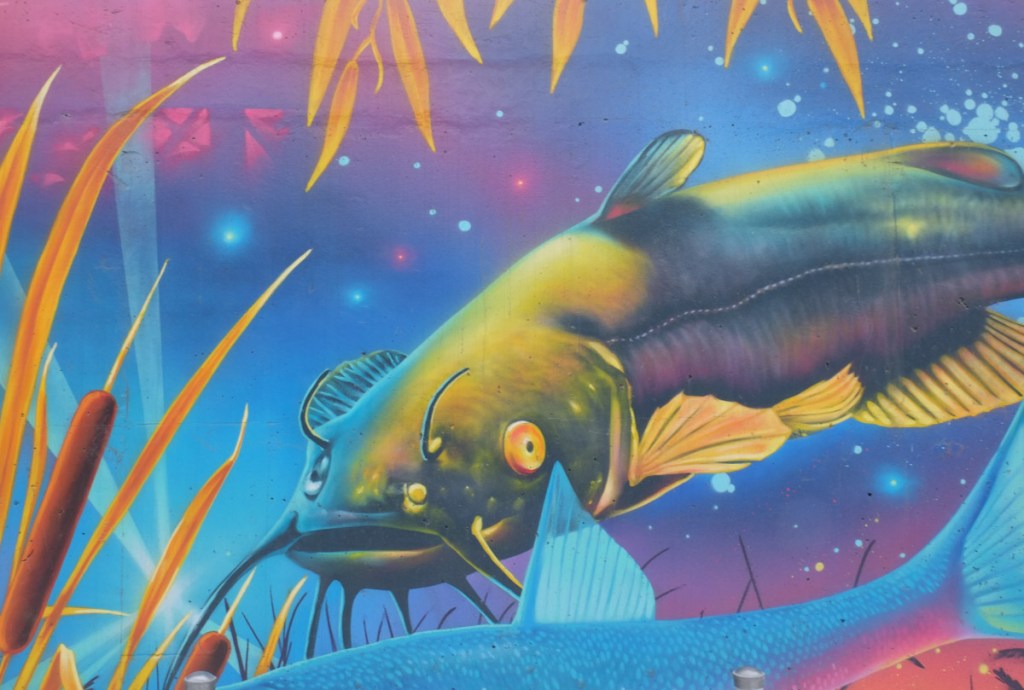
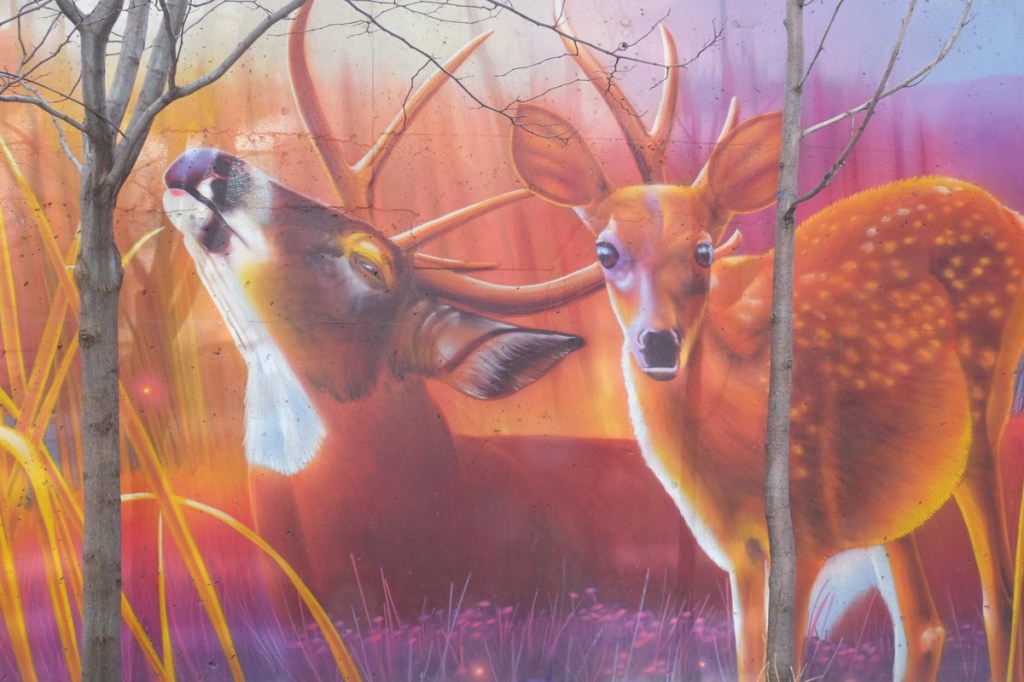
There is a new mural (2022) in Toronto by Nick Sweetman featuring animals and plant life commonly found along Ontario’s rivers, especially the Don River that flows nearby.  It adorns a wall/fence that runs the length of a new park, Riverside Square, which is southeast of Queen and the Don Valley Parkway.

below: The east end of the mural

part of mural by Nick Sweetman, Along the Riverbank

below: A blue-fronted dancer damselfly (A very long name for a very small creature!)

below: Mink, toad, and a water insect called a water strider.

part of mural by Nick Sweetman, Along the Riverbank

below: Catfish

part of mural by Nick Sweetman, Along the Riverbank

below: A raccoon eyes the fish swimming past

part of mural by Nick Sweetman, Along the Riverbank

below: A happy dog among friends, a raccoon and a cotton tail rabbit. If you look closely, there is a bridge in the background by the fox – Torontonians might recognize this bridge as one of the many that cross the Don River.

part of mural by Nick Sweetman, Along the Riverbank

below: Red fox, coyote

part of mural by Nick Sweetman, Along the Riverbank

below: In the middle

part of mural by Nick Sweetman, Along the Riverbank

below: Egret diving for fish

part of mural by Nick Sweetman, Along the Riverbank

below: White-tailed Deer

part of mural by Nick Sweetman, Along the Riverbank

below: North American beaver

below: Painted turtle

part of mural by Nick Sweetman, Along the Riverbank

below: Northern Leopard Frog

part of mural by Nick Sweetman, Along the Riverbank

Tensoe2 and Moises (Luvs) also contributed to ‘Along the Riverbank’

Photos taken January 2024

Spirit Stories under Old Mill

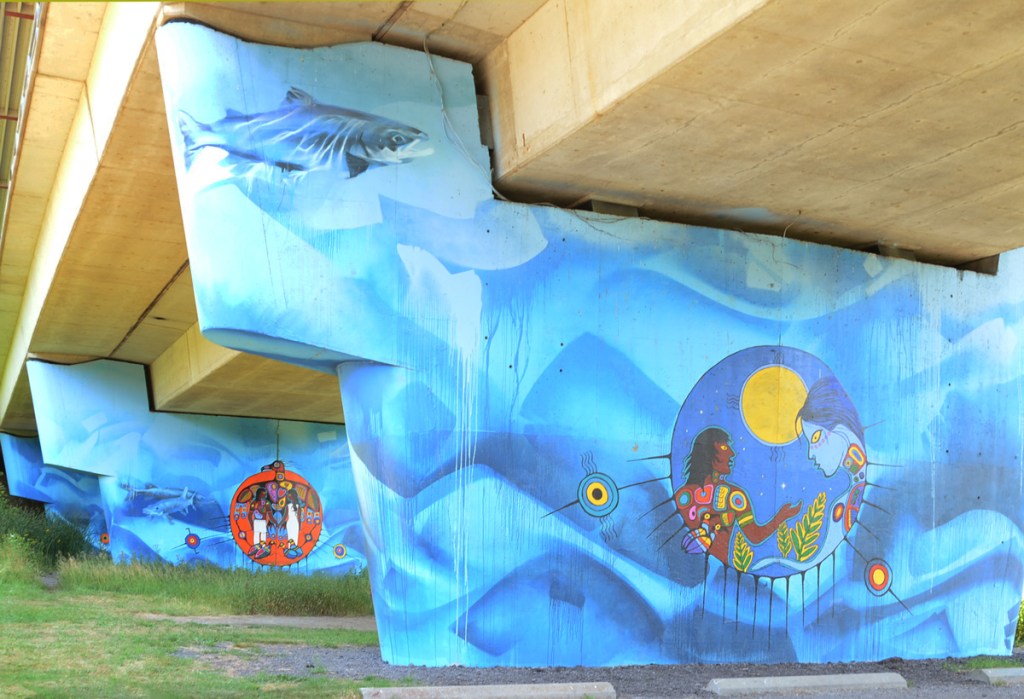
In Toronto, subway tracks cross above the Humber River at Old Mill station. The concrete pillars that support the subway bridge have been covered with many watery blue First Nations themed murals.

Philip Cote Anishinaabe mural of water and spirits on concrete pillar

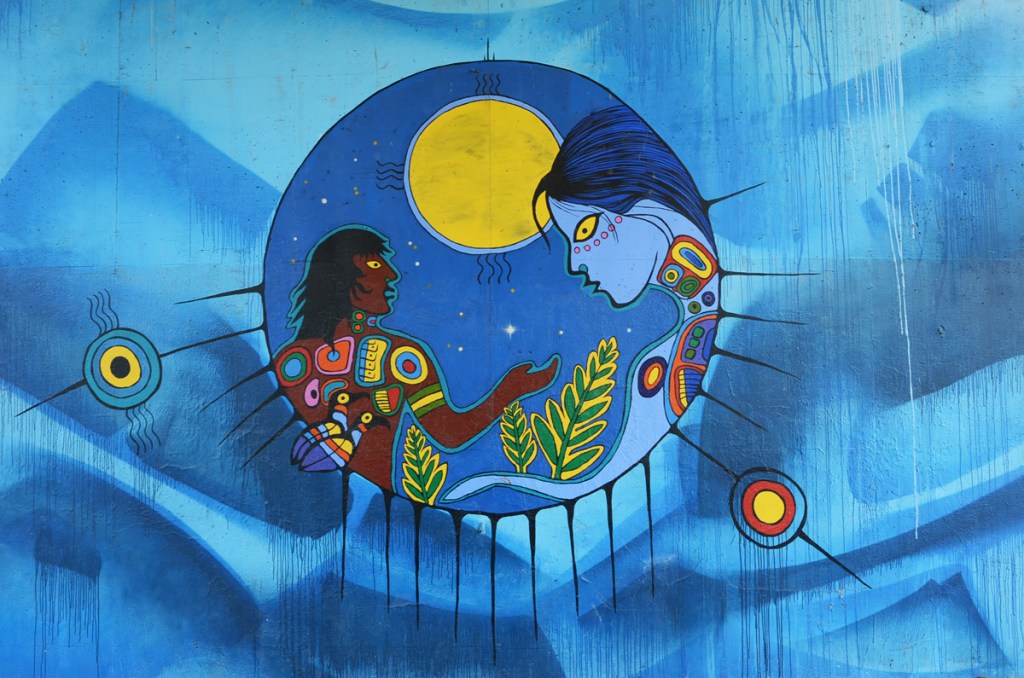
below: The artist, Philip Cote, described the story behind this image on the ArtworxTO website (see link); like all cultures, the Anishinaabe have an origin story.  In the beginning there was just Spirit. “And that spirit decided to send signals out into the universe and waited for a response. And when no response happened that spirit called the signals back and said, “As you come back to me, create light in the universe”. And at that moment they had light and dark in the universe. And that is the beginning of the Anishinaabe cosmology. Everything for Anishinaabe is made of light and dark. Everything we look at has a spirit, everything, the ground, the rocks, the sand, the trees, the birds, the plants, everything is… and even our sun and our Mother Earth and the moon, they all have a spirit.”     

Philip Cote Anishinaabe mural of water and spirits on concrete pillar
connecting with the thousands of galaxies of the universe

The blues of the water, the Humber River, were painted by Kwest. Water is the Underworld in Ahishinaabe cosmology and the Guardians of this Underworld are the fish. Another artist, Jarus aka (Emmanuel Jarus), painted the fish.

Philip Cote Anishinaabe mural of water and spirits on concrete pillar, large grouper fish in the water surrounding the central medallion

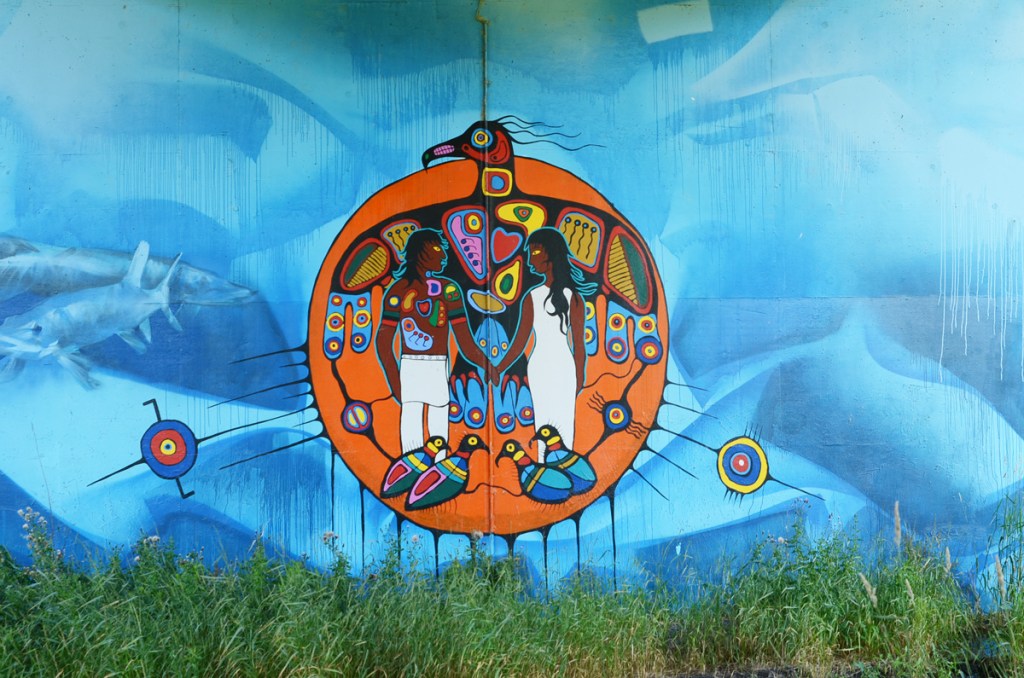
Most of the paintings have a well defined circle. This is the boundary between water and earth, between the spirit world and the physical world. But there are connections between the two worlds – all living things are connected and we are all connected to the Spirit World.

Philip Cote Anishinaabe mural of water and spirits on concrete pillar, a mountain of ice in the background
Philip Cote Anishinaabe mural of water and spirits on concrete pillar, a male and a female figure
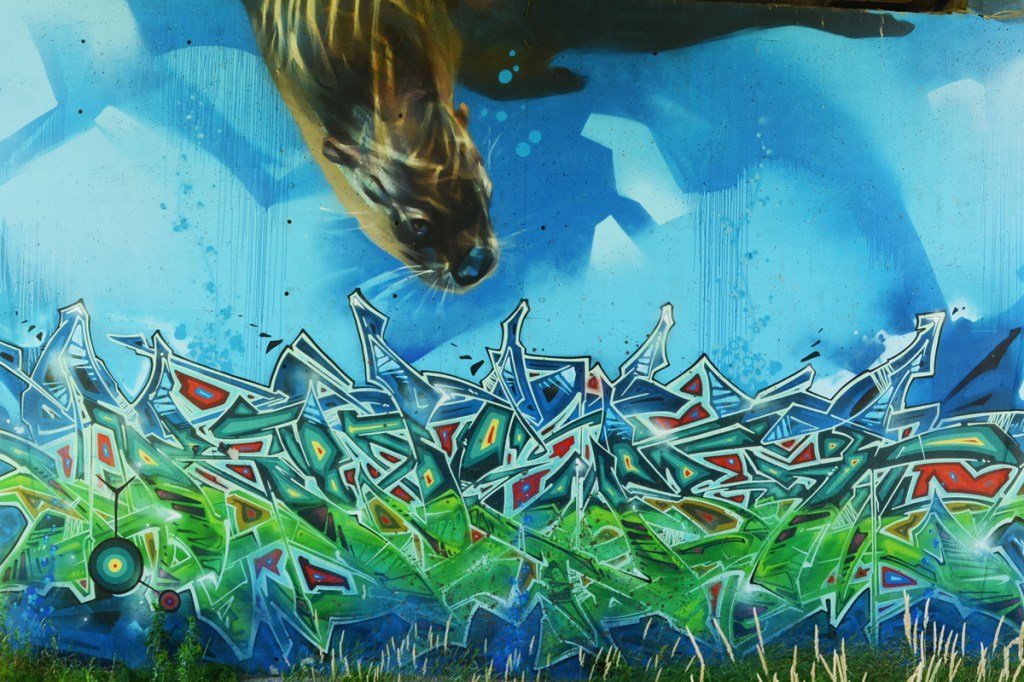
Philip Cote Anishinaabe mural of water and spirits on concrete pillar, an otter swimming in the water, looking below the surface
Philip Cote Anishinaabe mural of water and spirits on concrete pillar, a turtle shaped animal with a bear head with open mouth trying to catch fish