The historic Casa Blanca Citrus Fruit Crate Label is the center focus of this mural recently painted by Juan Navarro in Riverside California. It is located on Madison Street by the small “Welcome to Casa Blanca” sign that marks the start of this neighborhood (see bottom right in photo).
Images of three old Casa Blanca landmarks were provided by the local historical group – the original adobe Saint Anthony’s Church (1923-1975), the old elementary school, and the railway depot. The depot was built in 1897 and serviced the Santa Fe railway that ran between San Bernardino and Los Angeles; the building was demolished in the late 1960s.
The soldier in the mural represents Medal of Honor (WWII) recipient Ysmael Villegas who was from the neighborhood. There is also a park named in his honor.
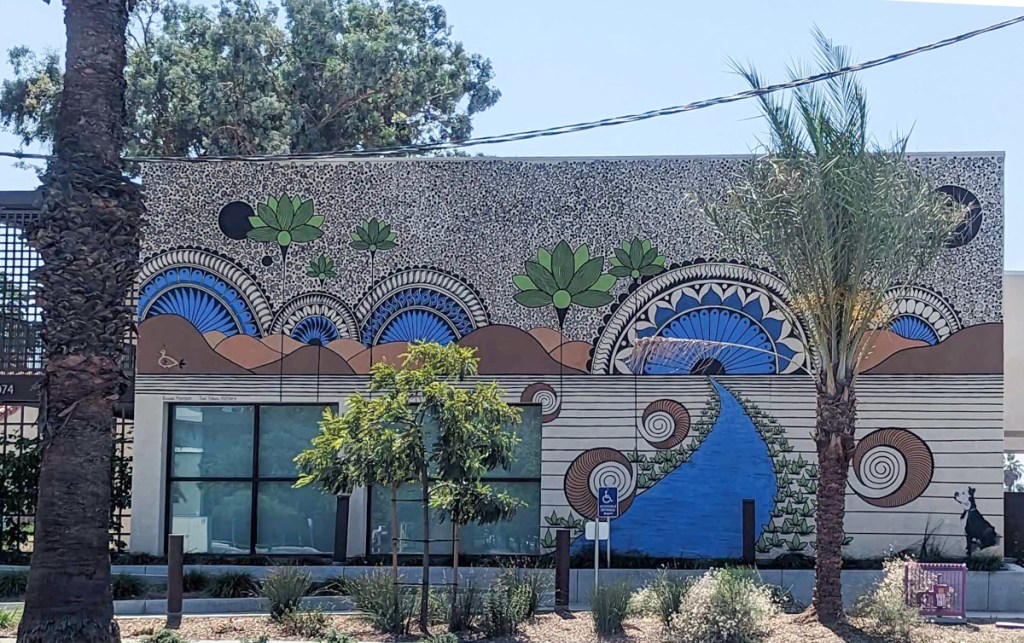
When St. Michaels church in Riverside California built new apartments for low income and homeless people, they decided to include a mural on one of the facades in the complex. This mural was painted in the fall of 2022 by Rowan Harrison of Two Tribes Pottery.
Support for the mural was provided by Art From the Ashes, a non-profit group based in southern California
More information about the mural, as well as pictures taken during the painting process, can be found on the Two Tribes Pottery website
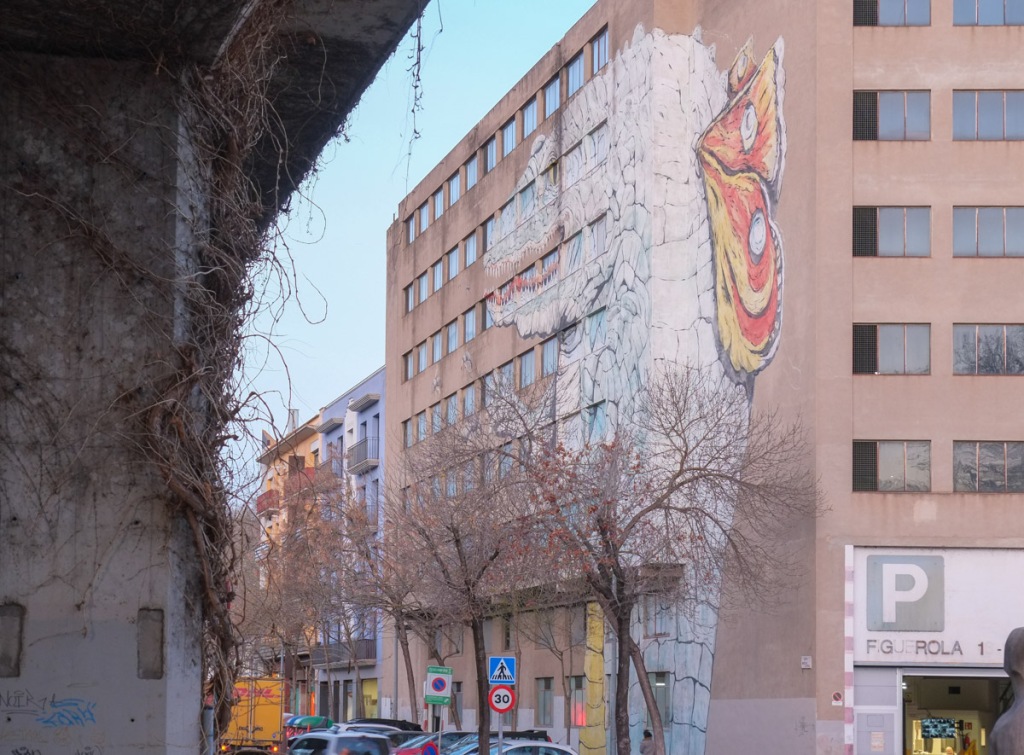
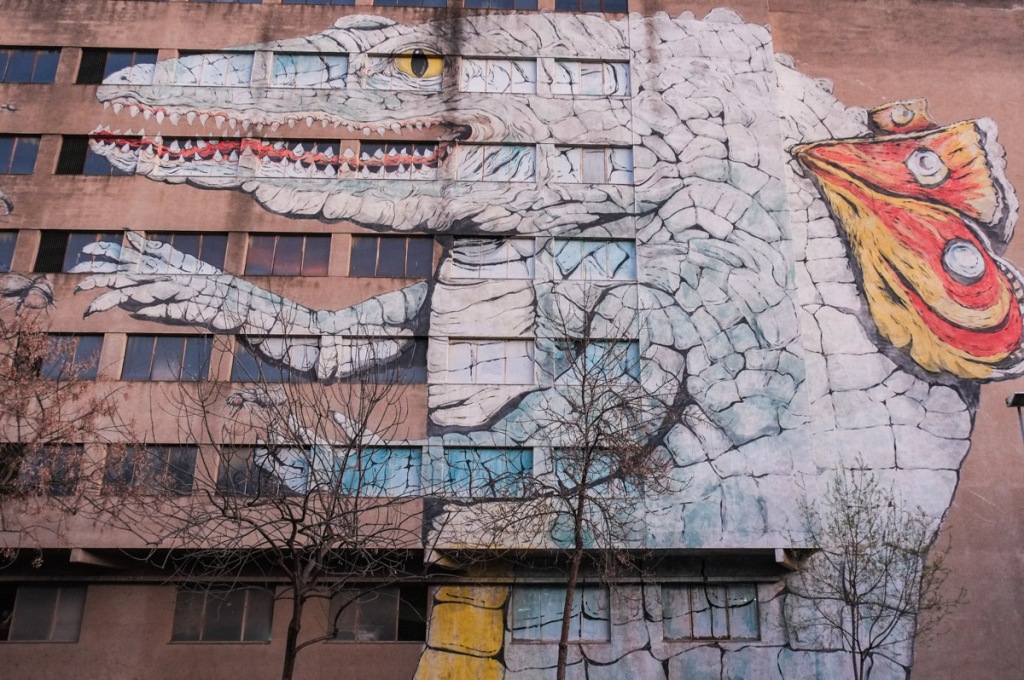
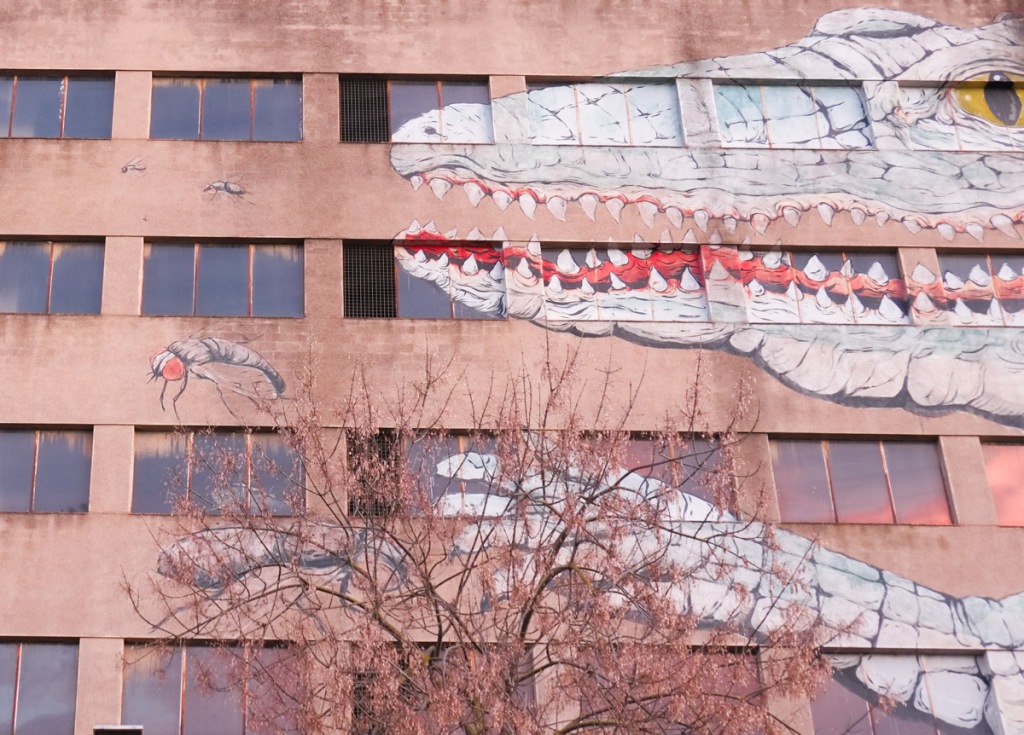
A large mural in Girona Spain painted by Erica Il Cane (ericailcane) oof a crocdile with wings on its back.
Over the years her scaly skin has lost its greenish blue colour but otherwise she is aging well.
From Wikipedia: “According to legend, she was once a nun who, due to her lack of faith, was punished and imprisoned in the dungeon of the city’s monastery, and could only leave to go to the river that runs through the city (Onyar River). After many years, due to her undernourishment and isolation, she grew scales until she fully metamorphosed into a crocodile-like creature. In spite of this punishment, she was still somewhat saintly, which manifested as a pair of butterfly wings.
Re-visiting Rochester to see how some of their older murals have fared.
400 Atlantic Ave. is a brick building that parallels the railway tracks. It was built in 1920 as an Ice Block Factory to service rail cars but has since been converted to offices and storage space.
The view at street level and still looking good – Abstract shapes stretch out along Atlantic in a painting by Italian artist Peeta, aka Manuel Di Rita.
below: On the other side of the building, is Aaron Li-Hill’s “Together we Fall” from 2015 Wall Therapy event.
Across the driveway, at 410 Atlantic –
Perhaps these squares aren’t really considered “street art” as they are more in keeping with the building’s prior use as a children’s centre/school,
but they do help to brighten up an otherwise dull and ordinary section of the street.
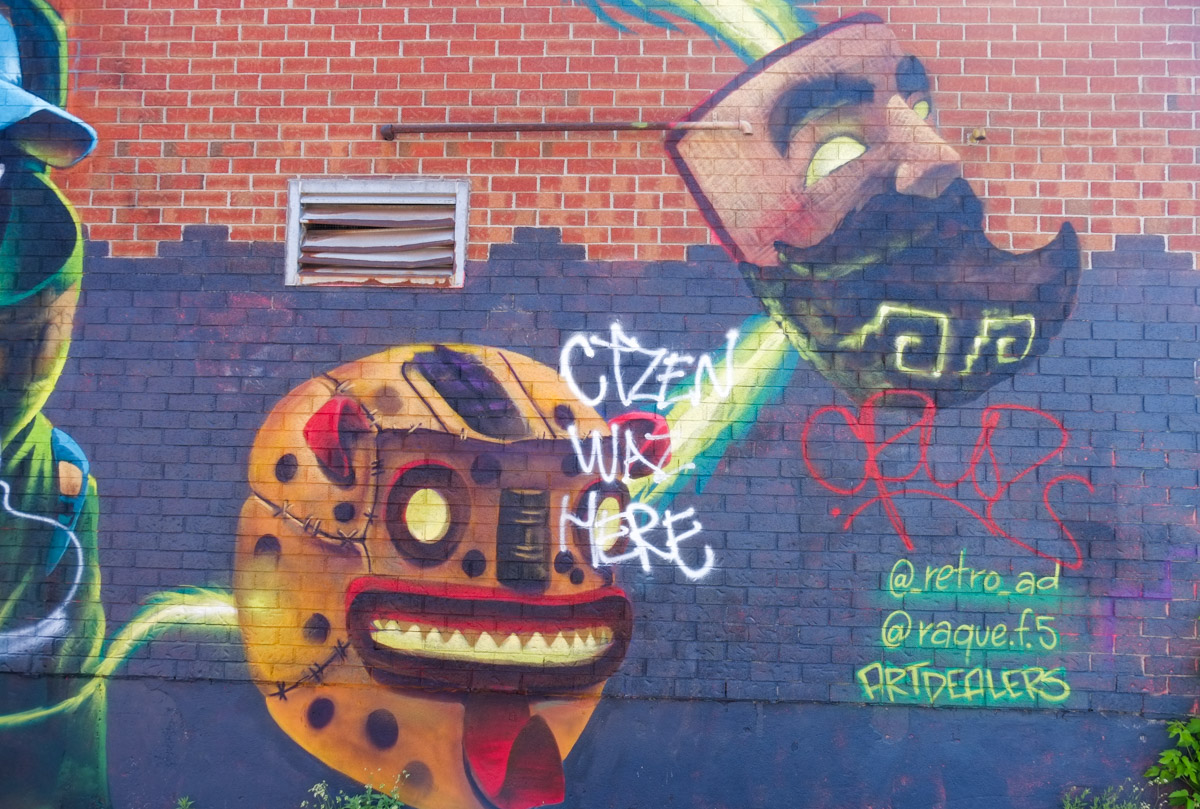
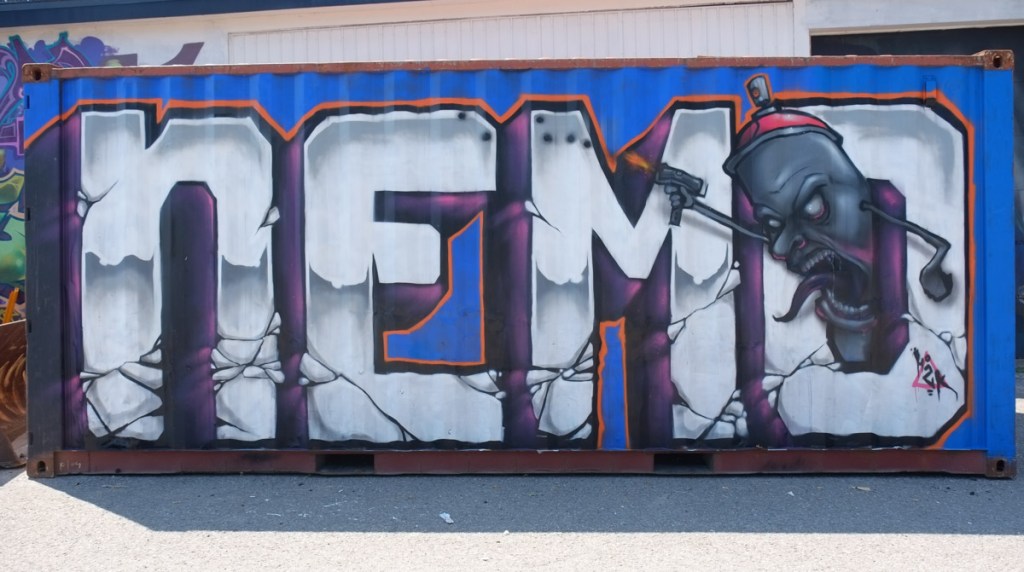
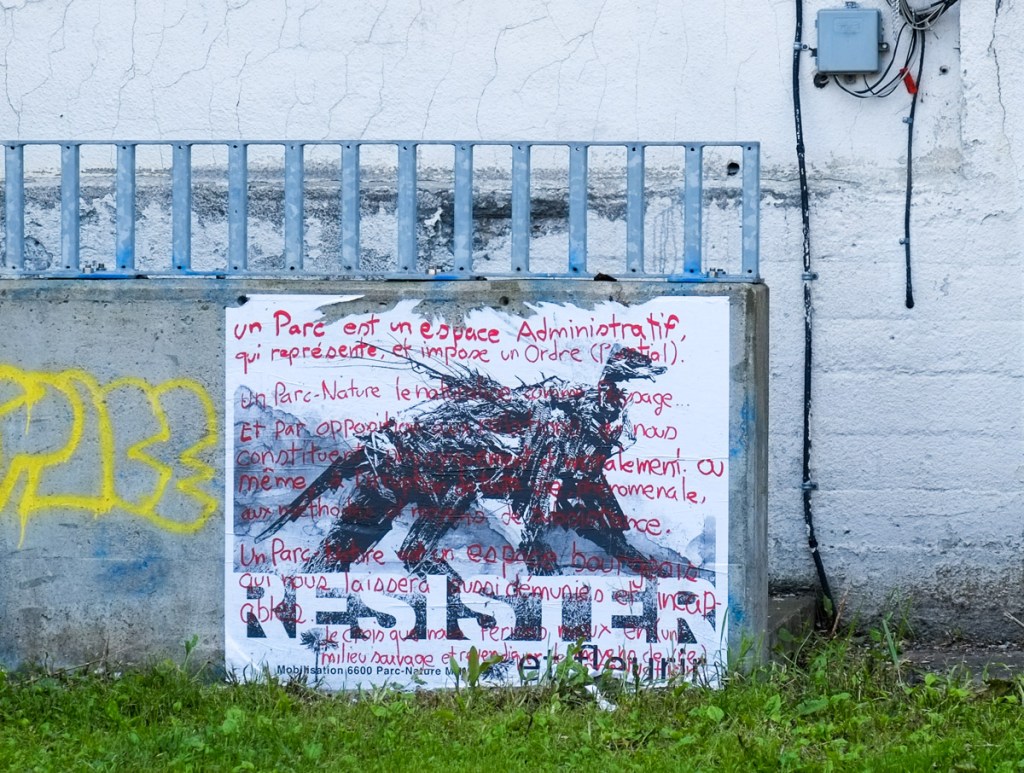
Breaking Walls was an Urban Arts and Culture event in Montreal that was held back in June of this year. It was supported by Kolors Worldwide (“Let’s kolor the world”) and MOS Canada – Meeting of Styles Canada. The event was held in a space between rue Moreau and the railway tracks, close to rue Rouen, in the Hochelaga-Maisonneuve neighbourhood. In hindsight, I realize that I missed a couple of the murals the day that I was there. Additionally, a couple of the smaller pieces that I have included may be graffiti that pre-dates the Breaking Walls event.
below: I am going to call it a blue traffic circle because it’s blue and it has traffic related items in it such as an orange cone, the front of a car, street signs, and traffic lights yellow. It was painted by Sergio MB. Unfortunately, the red and white tag has already defaced the work.
To the left of this purple dog (by Hank) was a painting of a woman’s portrait in turquoise that unfortunately has already been tagged over. It was painted by Polographe and can be seen on his Instagram page.
below: Arlick Enigma ( Arlick PaXman Team), originally from Mexico, painted this wonderful portrait of a child wearing a parka with a fur lined hood.
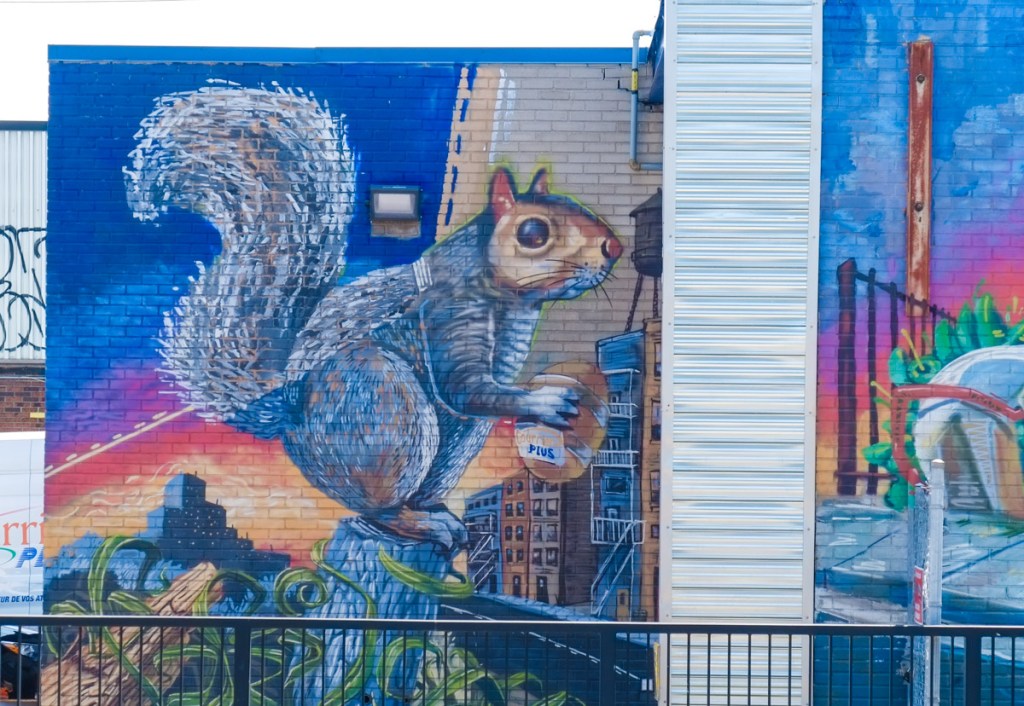
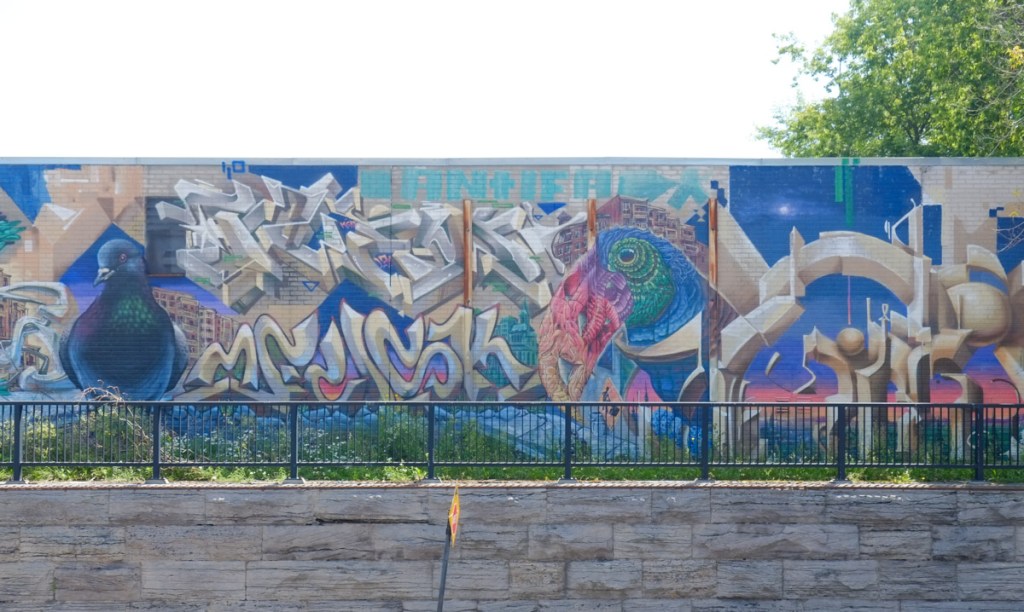
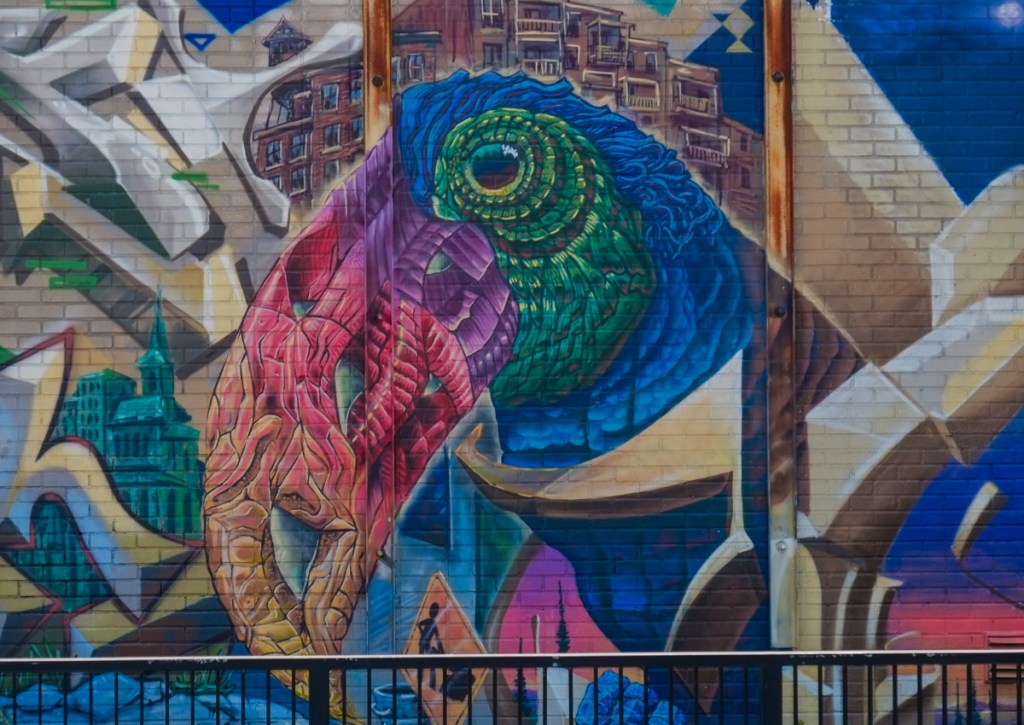
On Montreal’s rue Ontario, close to rue Moreau and the railway tracks, there is a long brick building close to the sidewalk. At one end there is a painting of a squirrel with an object in his little front paws. This nut shaped object has a label that says Courrier Plus which turns out to be a trucking/transportation company and the owner of the building on which the mural is painted.
The rest of the mural features a red fire hydrant, a pigeon and a toucan with a beak in rainbow colours.
This row of old two storey row houses has been vacant for years. Recently the developer that owns the properties provided a couple of Toronto artists the opportunity paint the exterior. This is the result.
If you look carefully, you can see that Nick Sweetman and Luvs (aka Moises) have painted the word CHANGE across the front of the buildings. As a theme for a mural on a redevelopment site in a city bursting at the seams with such sites, change seems very appropriate.
below: I’ve played with the colours a bit to highlight some of the letters. You should be able to see C, H, and A across this image.
But the mural is more than colour and letters. There are three animals featured here – pigeon, raccoon, and coyote – all of which have adapted to changes and now thrive in urban environments.
In the Byward Market area of Ottawa, you can find a collection of large mural as you look across a parking lot on Dalhousie Street. They stretch along the wall of a funeral home on St. Patrick Street.
below: The darker end of the murals is signed by three. They are Juan Carlos Noria, The Laporte Brothers (Phil and Dom Laporte) and the Higher Ups.
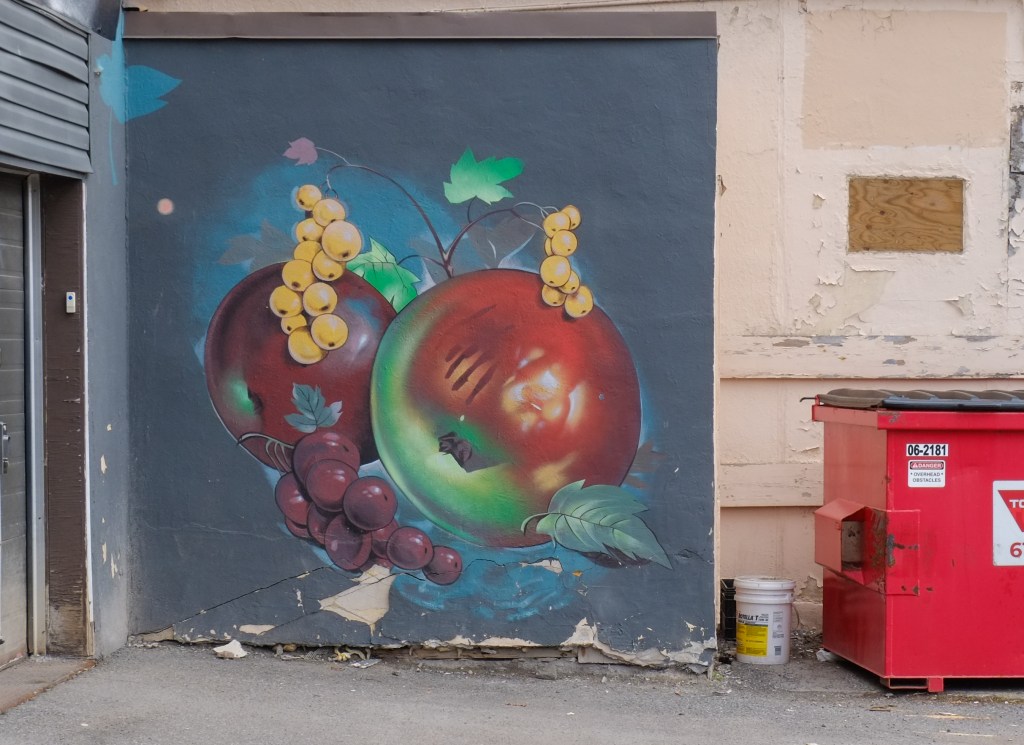
below: Apples and currants in the corner
below: The other part of the wall is for the birds so to speak. The blackbird (raven?) on the left was painted by DRPN (Drippin’ Soul).
below: This is a closer look at the head of the bird on the righthand side. It is the work of Mique Michelle, an artist who work often features feathery birds (or other animals)















 Eyes on the Streets