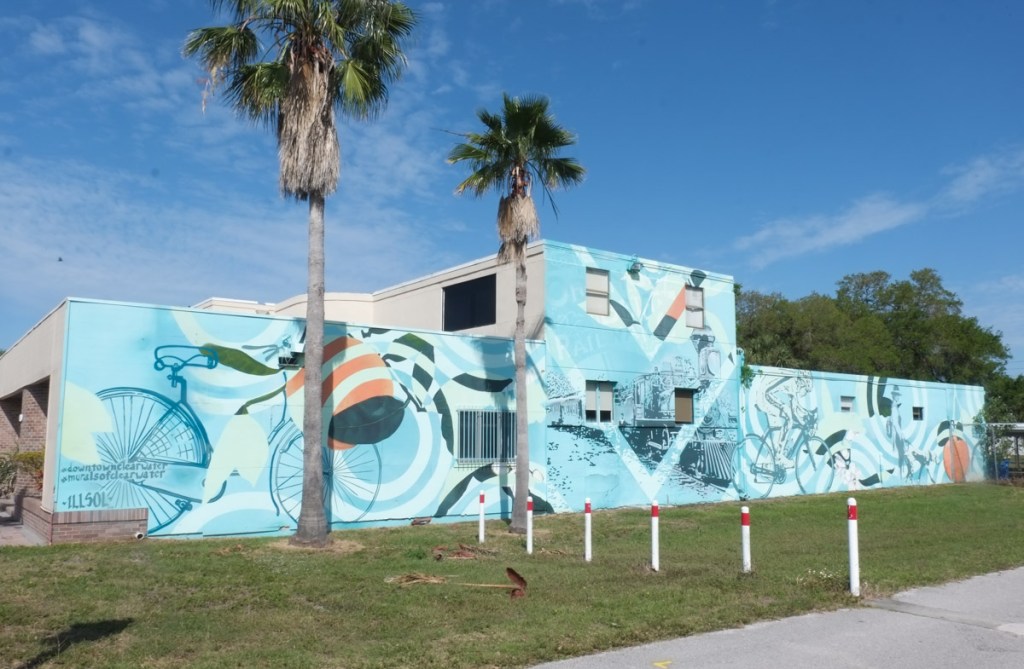
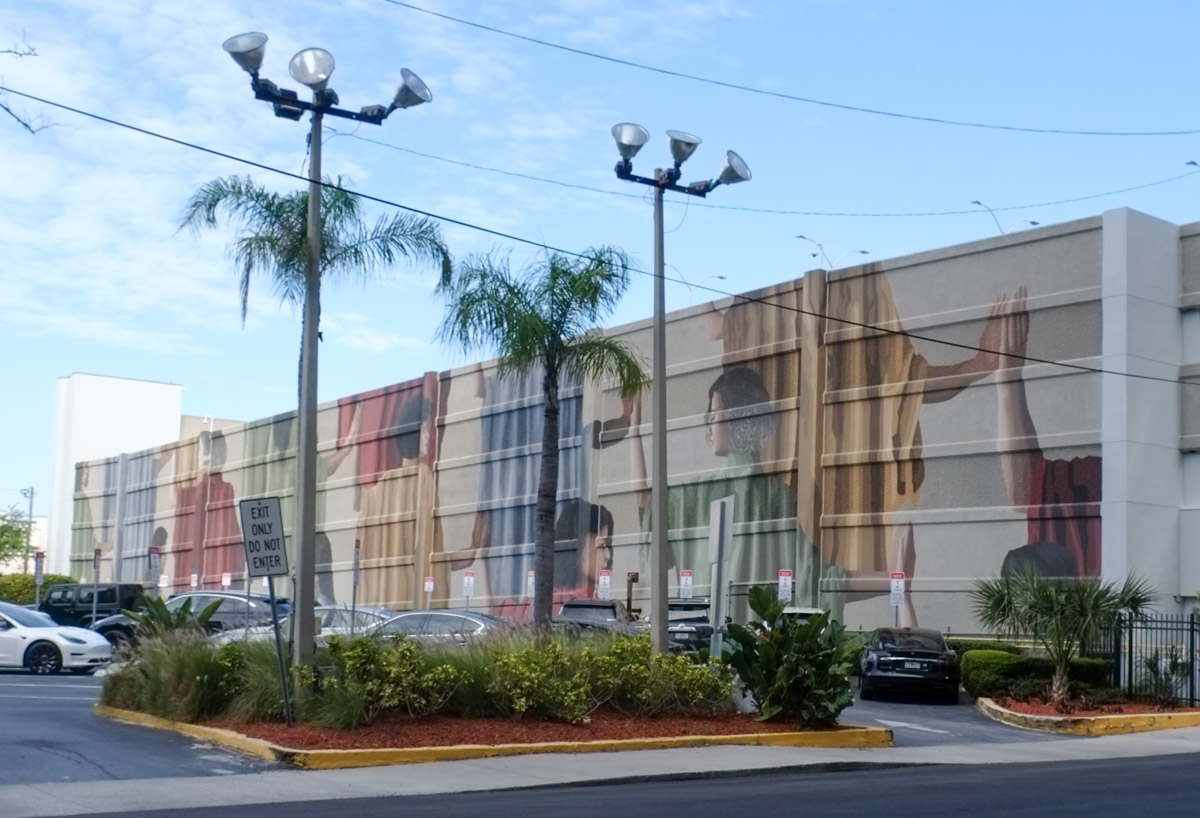
The previous blog post was about a large mural in Clearwater that was on the Pinellas (bike and walking) Trail as it passed the downtown area, “See yah later Alligator”. Slightly to the north of that alligator, but still on the trail, is this mural….
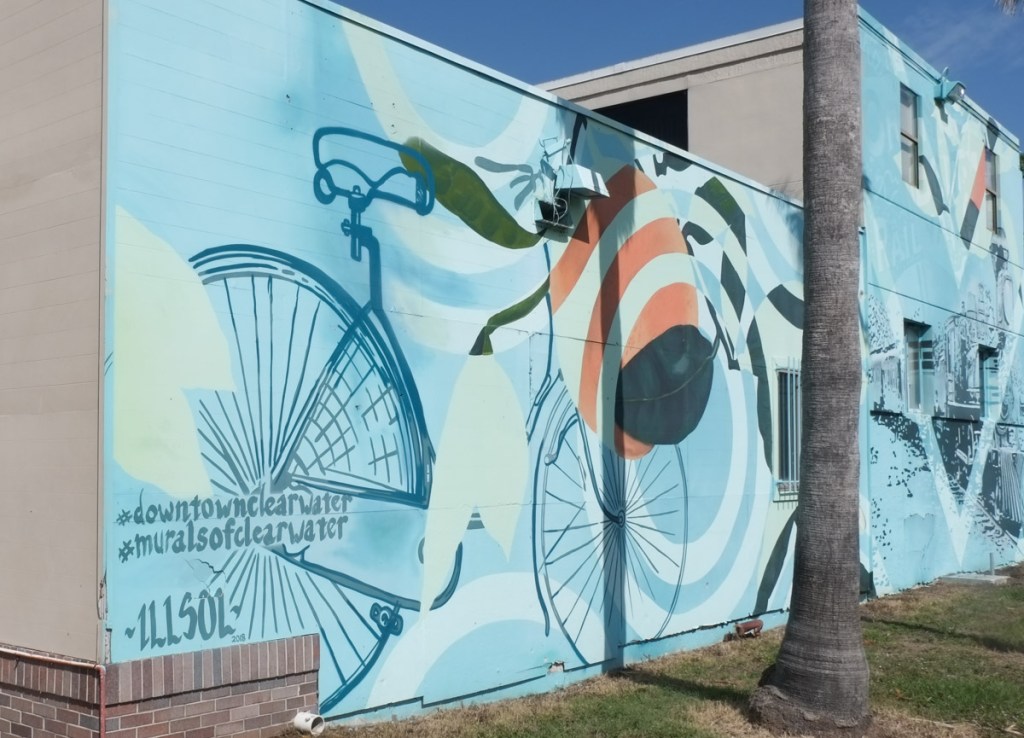
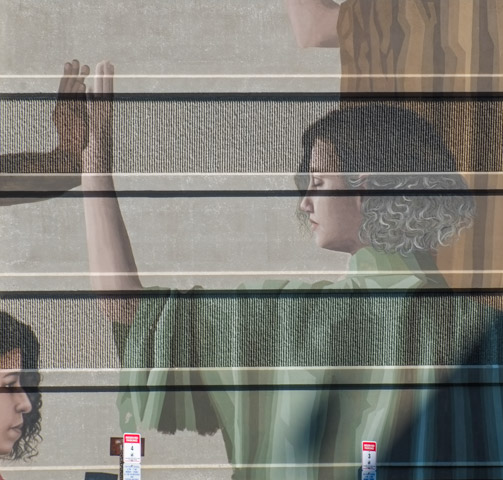
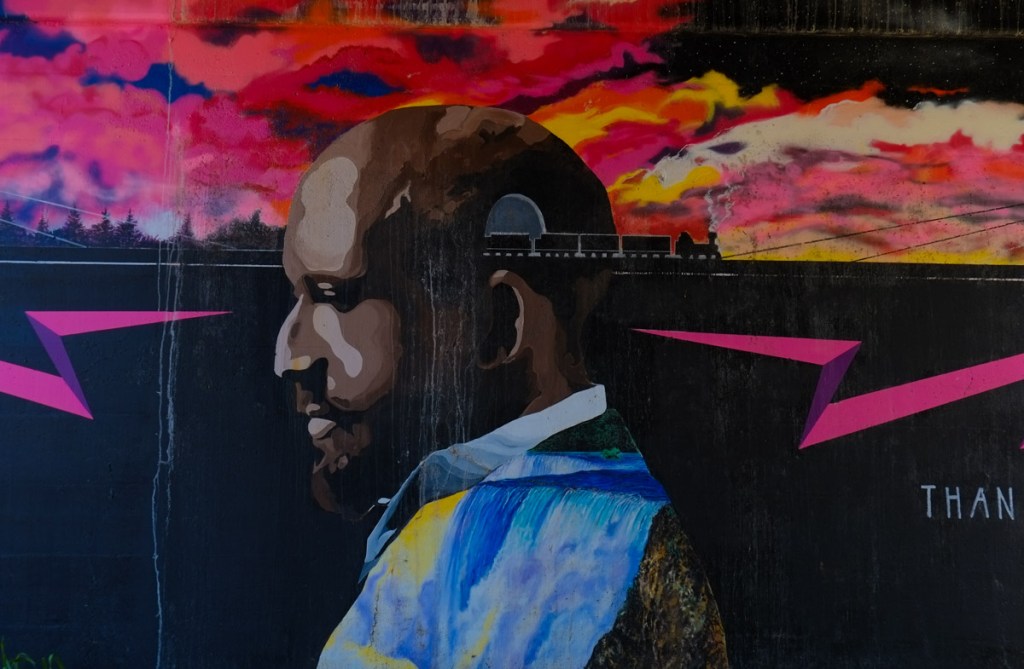
It was painted by Illsol, a husband and wife team of Michelle Sawyer and Tony Krol and is titled, “One hundred years before J. Cole”. In 1885 the Orange Belt Railway, a narrow-gauge railway, was opened. This was also the year that the bicycle (with the same design as modern bikes) went into production. Today, the Pinellas Trail runs along the route of the Orange Belt Railway. The reference to J. Cole is because of a song of his called ‘1985’ about change and history.
below: “Ikebana”, a flower arrangement. The word ikebana is Japanese and it refers to a style of flower arranging. It was painted by DAAS.
below: “Elysian Days” by Cecilia Lueza, rainforest inspired colours and shapes.
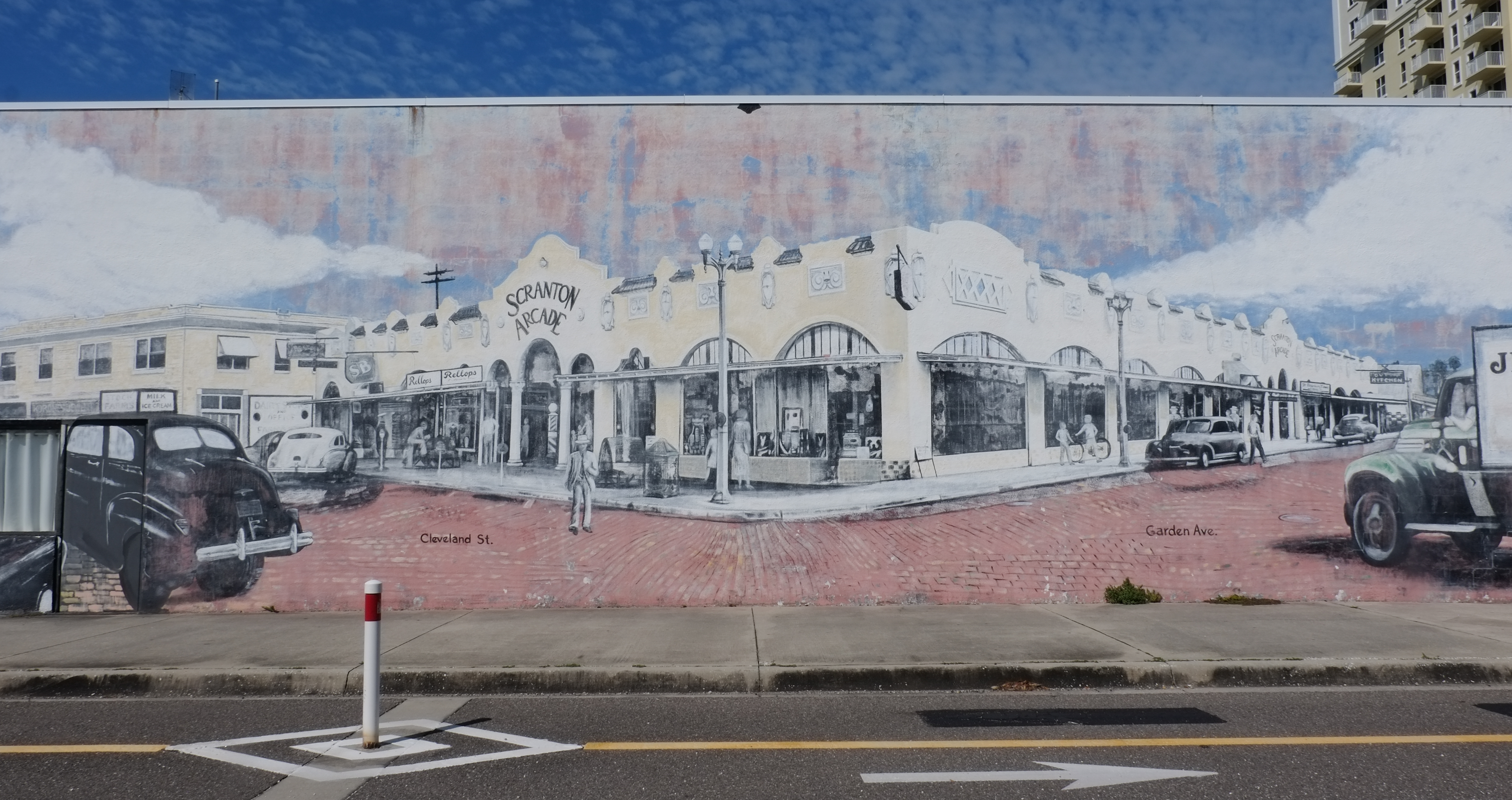
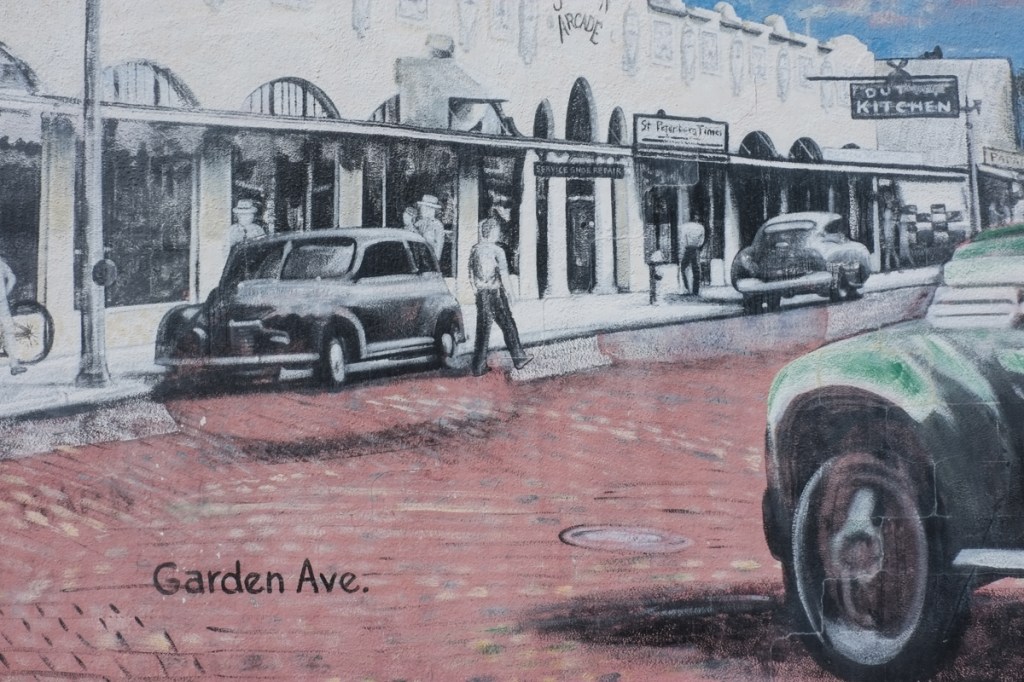
below: History at the corner of Garden and Cleveland.
below: “Avenue du Jardin” is quite faded (I’ve played with the colours and enhanced them a bit). The plaque on the wall says, “This mural is dedicated to the citizens of Clearwater in celebration of our history and our future.” It was originally painted in 2002 and then restored not too long ago by Ana Livingston.
below: United We Stand, signed by four artists: Maria Chang, Jennifer Vallieres, Miriam Vallieres, and Laurie Anopach,
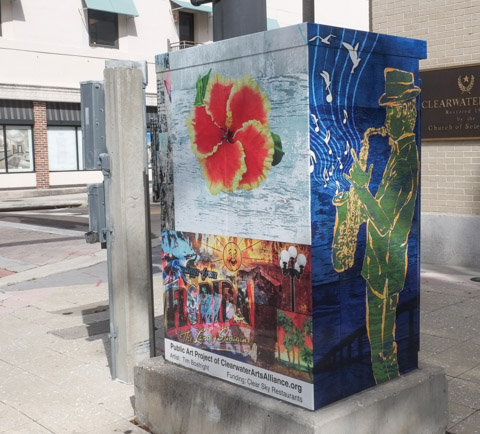
below: A bit of colour on the sidewalk brought to you by the Clearwater Arts Alliance.
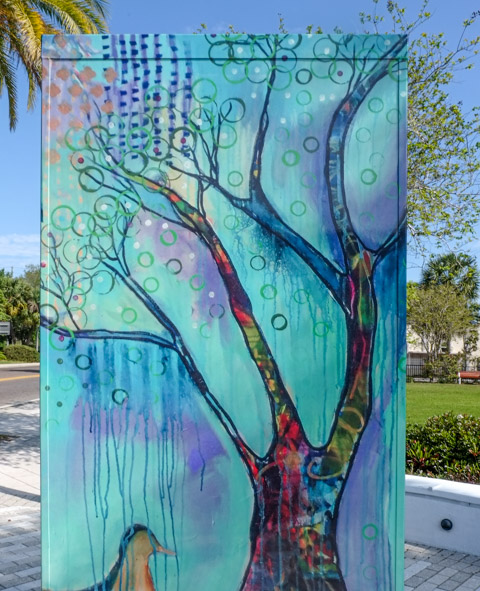
below: With drips and bubbles and great shades of blue, a tree by Candy Schultheis
Delft is a lovely city with a large public square by an old church. There are some old houses along a few canals as well as some narrow lanes. There is also some street art there.
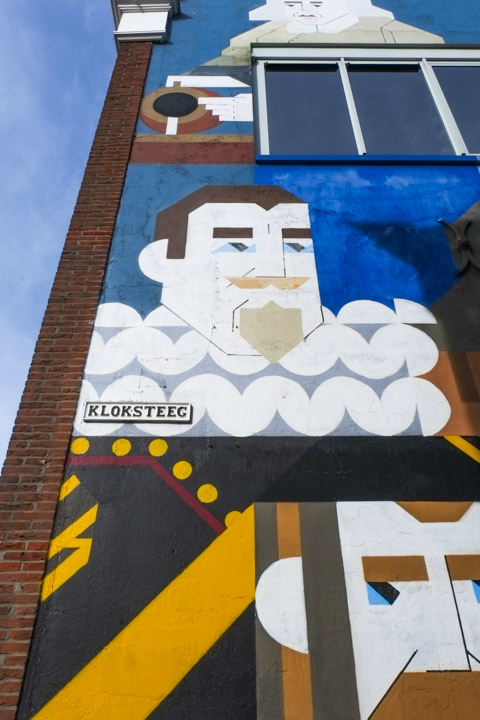
below: In a very narrow lane, Kloksteeg, is a large mural by Micha de Bie
below: The mural contains portraits of characters from Delft’s past such as Hugo de Groot (1583-1645), Antoni van Leeuwenhoek (1632-1723), “The father of microbiology”) and Vermeer’s Milkmaid (from the famous painting).
below: A mural by Serge KB (aka Serge Kortenbroek), a handful or two of little creatures.
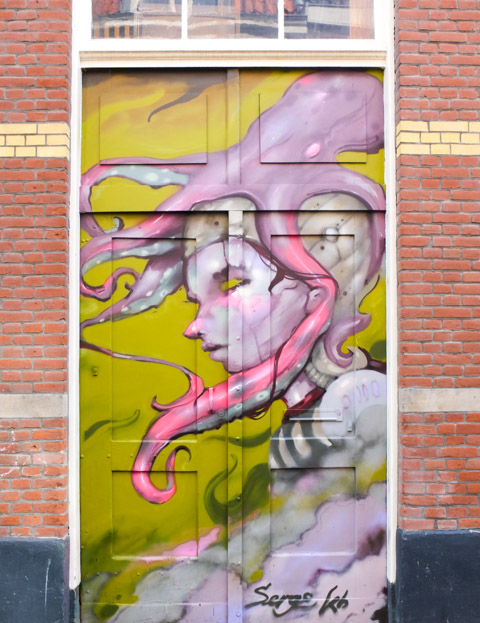
below: Another Serge KB painting, biomechanical. Ectoplasmic ooze. paints surreal creatures, animals, cyborgs and androids.creates grim scenes with a twist.
below: On a wall in Papenstraat is a map of Delft in the 17th century and it is made entirely of mosaic tiles. It is the work of Nan Deardorff McClain and Colja de Roo.
below: A closer look at part of the map. At the top, close to the left side is Antoni Van Leeuwenhoek’s house (mentioned in the Kloksteeg mural above). The word “microscoop” appears beside it.
below: Catching and eating fish.
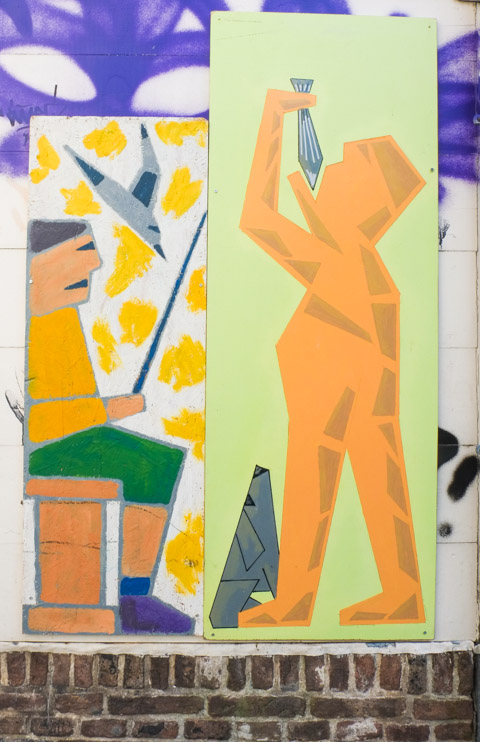
below: Are you sure they fit? Poor Henk
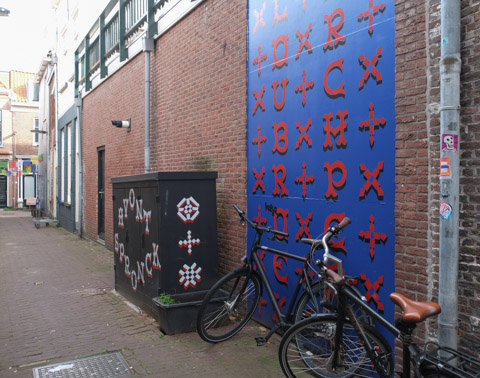
below: A decorated lane
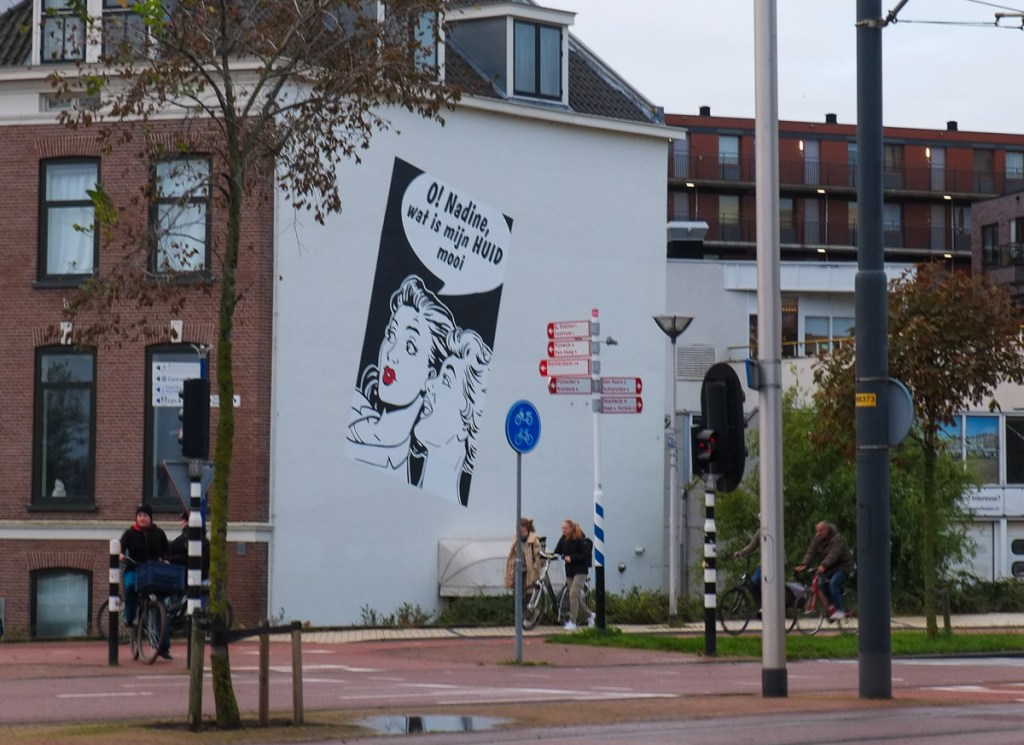
below: “O! Nadine, wat is mijn HUID mooi” or Nadine, my skin is so beautiful (or nice). This replaces a very similar painting that featured a man and a woman with the text, “O Jan wat zit je haar mooi (Jan, your hair is so beautiful”)… But wait…. this is also an ad for beauty products?
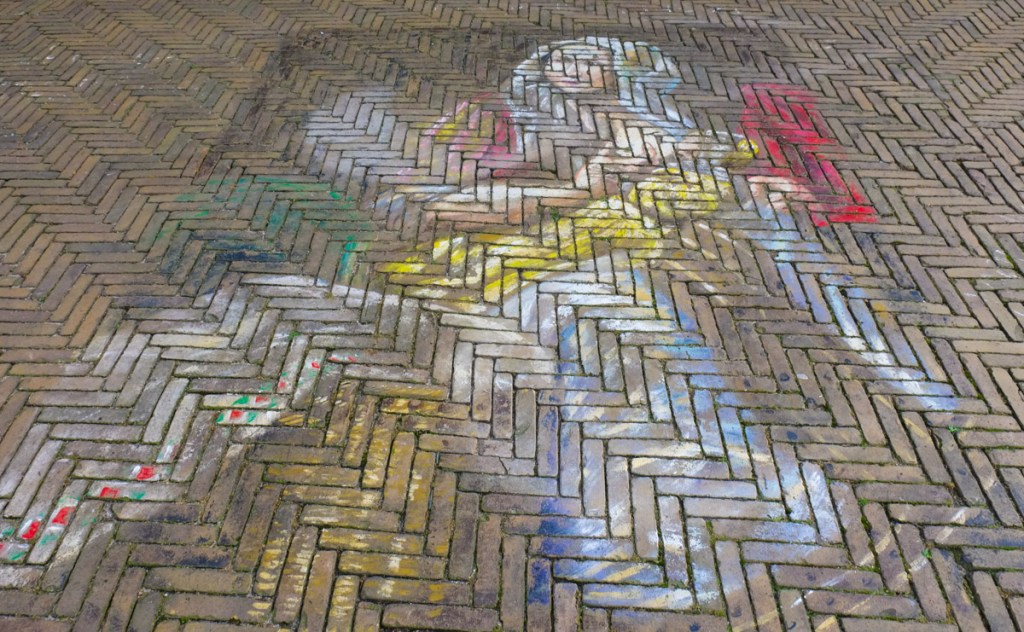
below: Literal street art – chalk (paint?) on the paving stones.
below: Stand with Ukraine, a sticker in the main square.
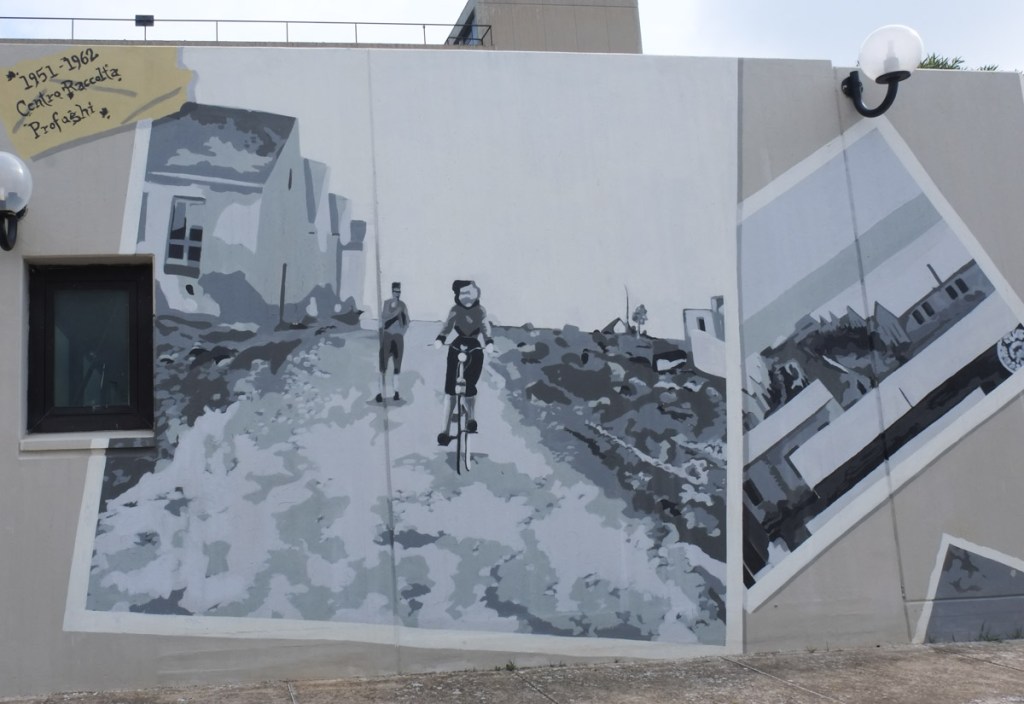
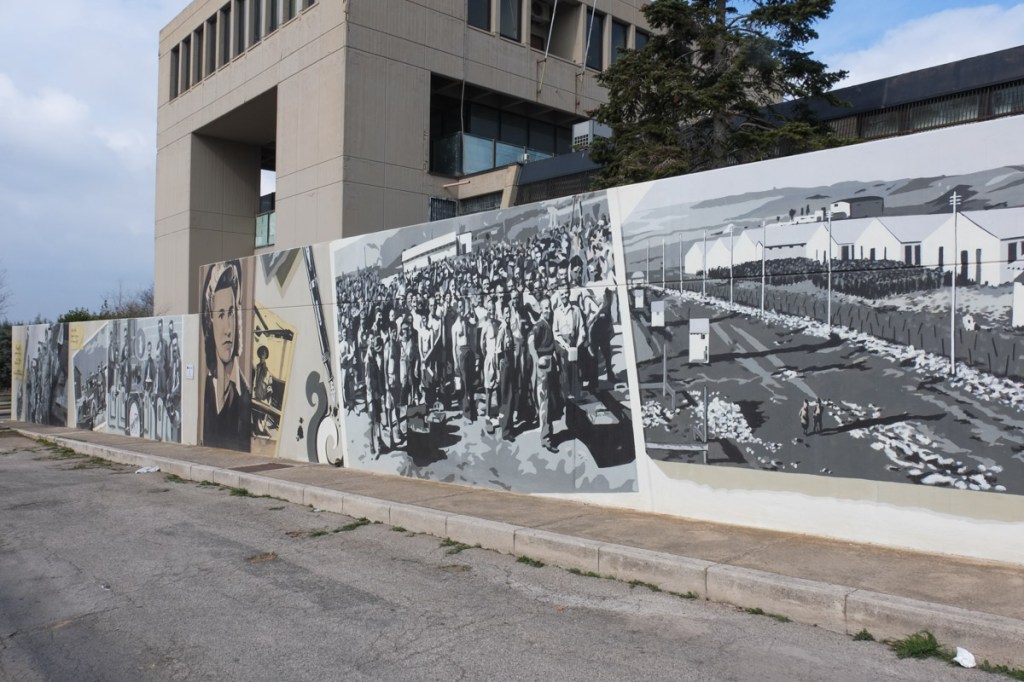
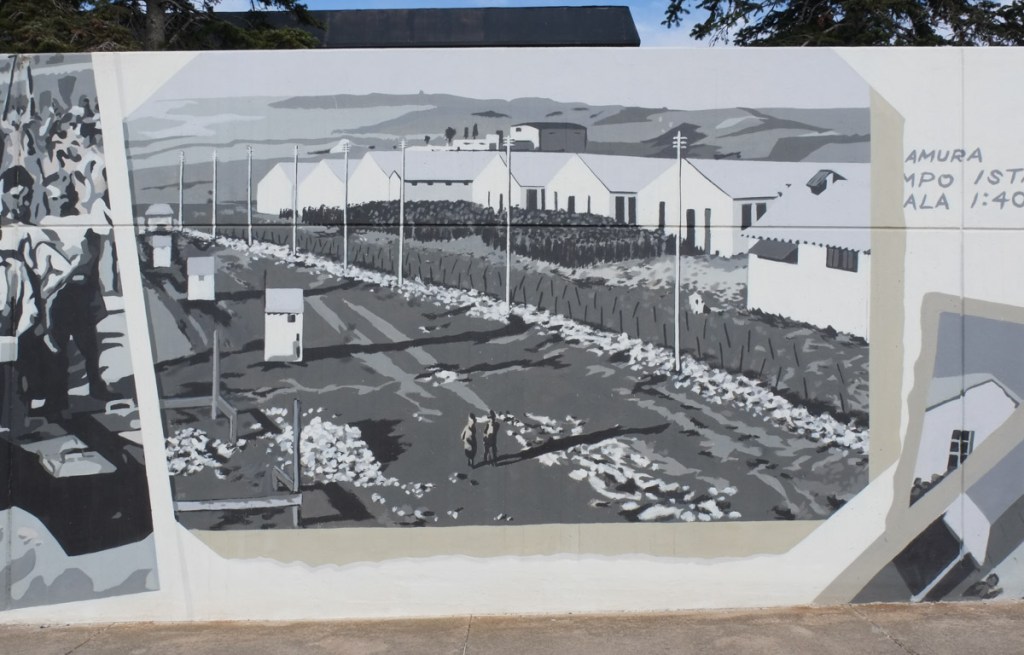
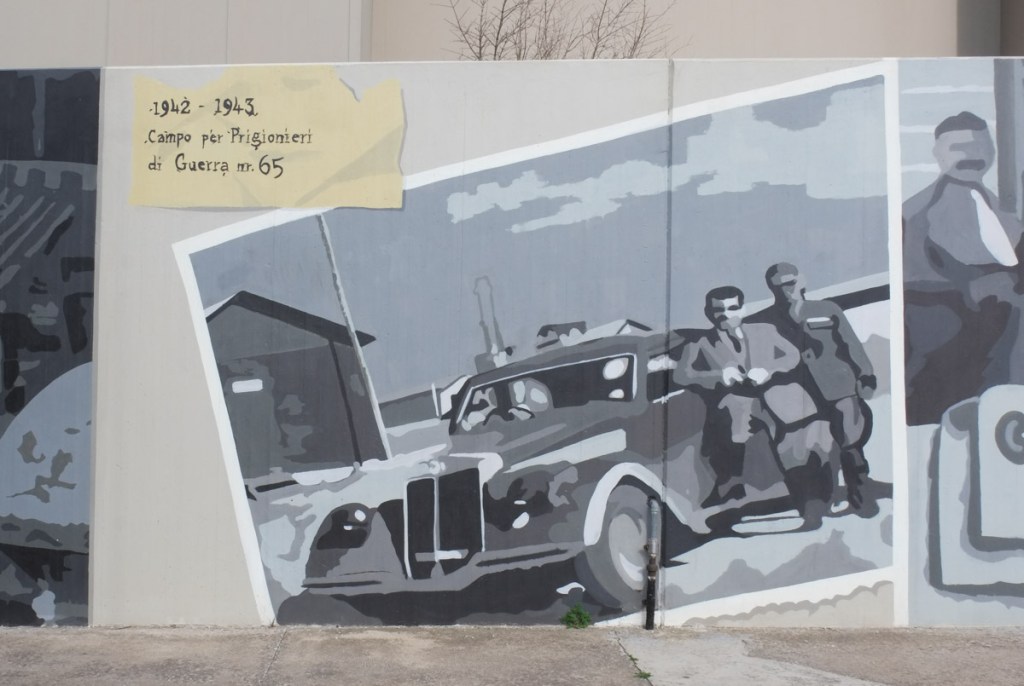
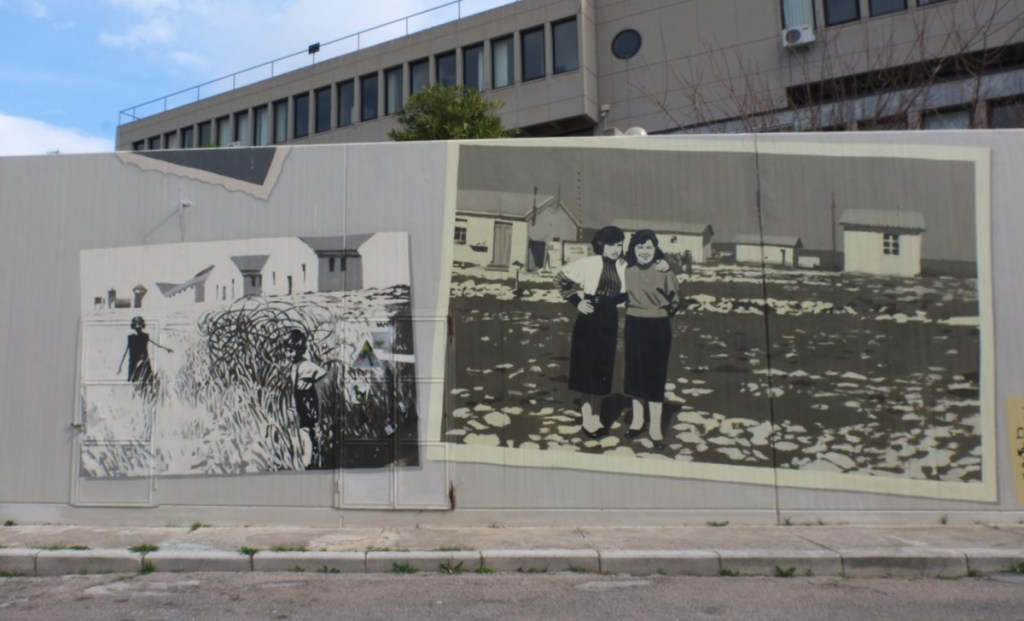
In Altamura a wall has been painted with copies of old photographs of Campo 65. This camp, or center, began as a Prisoner of War camp during World War 2. Allied POWs were held here in 1942 and 1943. It was also a training center for troops that liberated Yugoslavia in 1945. After the war was over, it was then used to house refugees.
below: The 36 barracks contained up to 12,000 Allied prisoners of war: British, South African, New Zealand, Canadian, Cypriots, and Palestinians mainly from the North African war front. It was the largest Italian WW2 prisoner of war camp.
Murals painted by: Donato Lerusso, Marco Forte, and Mattia Pellegrino, 2022
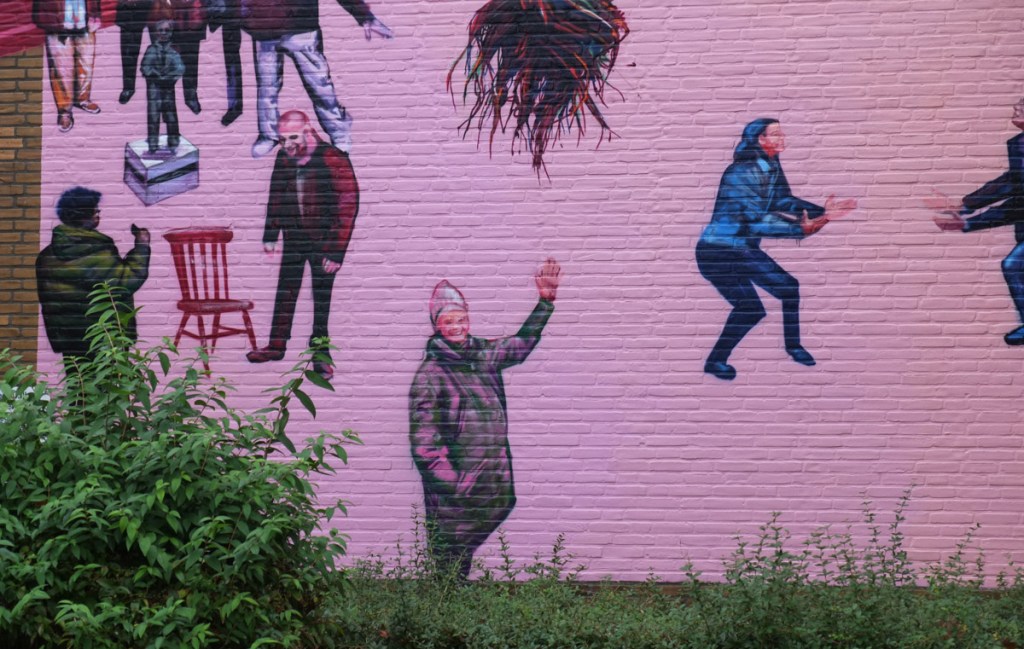
On all four corners of an intersection in a residential area of Heerlen (Netherlands) there is a mural on the side of one of the buildings. They were all painted by the same artist and they all feature some aspect of Dutch culture or history. A pink and purple theme also runs through them all.
below: On Oude Kerkstraat is “Operation Heartbeat” by American artist Gaia – A heart surrounded by different flowers from the Dutch “Empire”
below: Another Gaia mural across the street from his hearts and flowers is this bit of local history – Former Prime Minister of the Netherlands, Joop den Uyl, announces the end of the coal mining in Limburg, December 1, 1965.
below: ‘Tulipmania’. The face is that of Frederik Hendrik (1584-1647) who was a Statdtholder of the Dutch Republic, as well as a sovereign Prince of Orange during the Dutch Golden Age, i.e. in the time of Tulipmania. I doubt that he’s a recognizable face these days but it’s an interesting detail just the same.
below: ‘Resilience’ was influenced by the painter Pieter Bruegel the Elder (d. 1569) who painted scenes of everyday peasant life. Here is a contemporary scene of everyday urban life.
The historic Casa Blanca Citrus Fruit Crate Label is the center focus of this mural recently painted by Juan Navarro in Riverside California. It is located on Madison Street by the small “Welcome to Casa Blanca” sign that marks the start of this neighborhood (see bottom right in photo).
Images of three old Casa Blanca landmarks were provided by the local historical group – the original adobe Saint Anthony’s Church (1923-1975), the old elementary school, and the railway depot. The depot was built in 1897 and serviced the Santa Fe railway that ran between San Bernardino and Los Angeles; the building was demolished in the late 1960s.
The soldier in the mural represents Medal of Honor (WWII) recipient Ysmael Villegas who was from the neighborhood. There is also a park named in his honor.
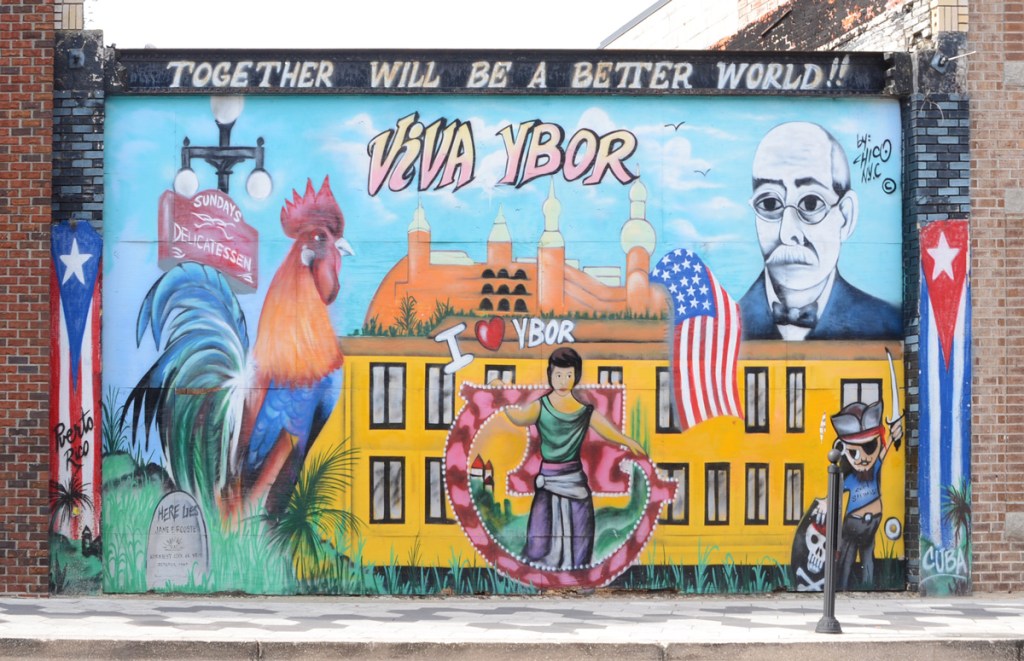
Ybor City is an historic neighbourhood close to downtown Tampa Florida. It was founded in the 1880s and was home to a large immigrant population, many of whom were employed in cigar making factories. The cigar industry, and the city, flourished from the 1890s to the Great Depression of the 1930s when demand for cigars dropped.
below: Viva Ybor! Painted by Chico Garcia in 2012. It features a portrait of Vincente Martinez Ybor who brought the cigar making industry to this part of Florida.
Athens Ontario that is. This Ontario town has decorated its walls with murals for many years now. Some of the older ones have been painted over and some have been refurbished. Most tell stories about the history and people of the community.
below: Main Street in Athens, June 2023
below: A tribute to Joshua Bates and his founding of the community of Farmersville. Bates was a surveyor and an architect. He donated land and built schools, churches, and stores. The town was renamed Athens in 1888.
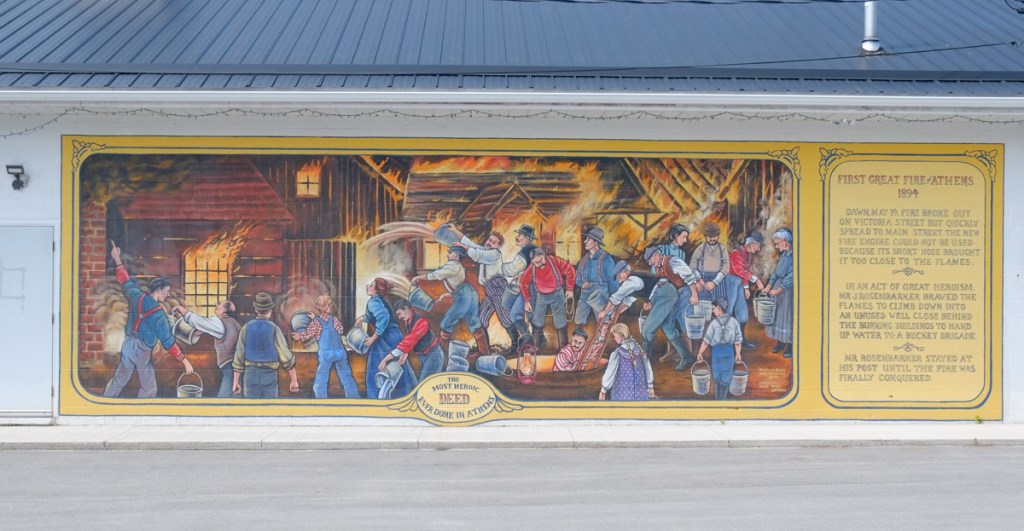
below: On the wall of the fire station is a mural titled ‘The Great Fire/Athens 1894’ – “Dawn, May 19, fire broke out on Victoria Street but quickly spread to Main Street. The new fire engine could not be used because its short hose brought it too close to the flames.”
“In an act of great heroism, Mr. J. Rosenbarker braved the flames to climb down into an unused well close behind the burning buildings to hand up water to a bucket brigade. Mr. Rosenbarker stayed at his post until the fire was finally conquered.”
below: The day that I was in Athens there were two large trucks parked alongside this mural so I couldn’t get any proper photos of it. It is a series of medallions showing local landmarks such as the House of Industry, Dr. Giles House, Quaker Meeting House, the mill, and the First Nations Market.
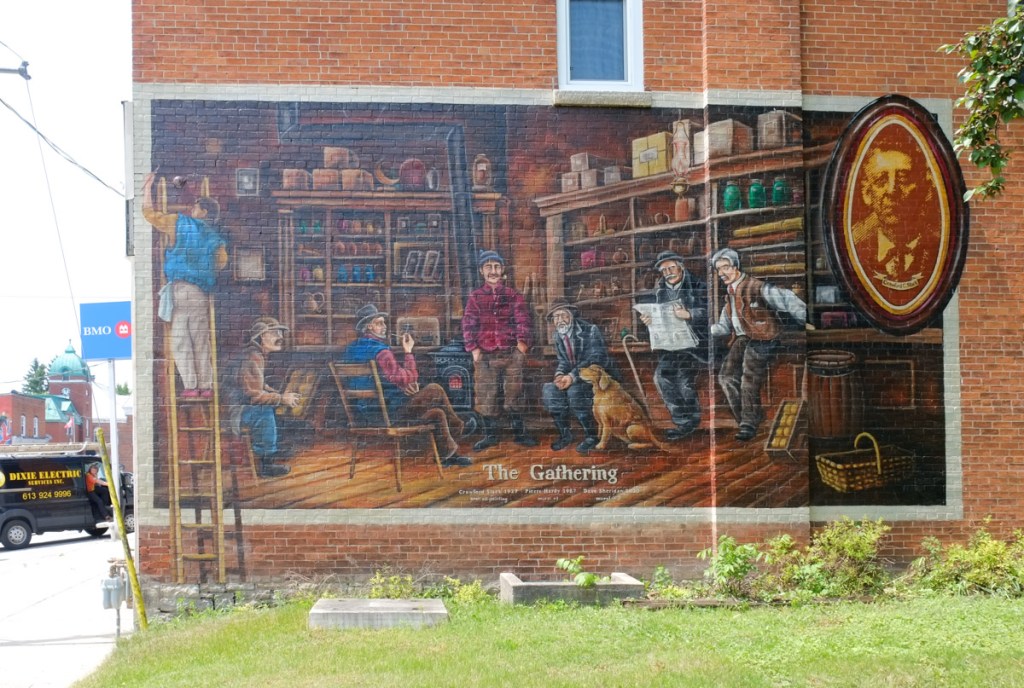
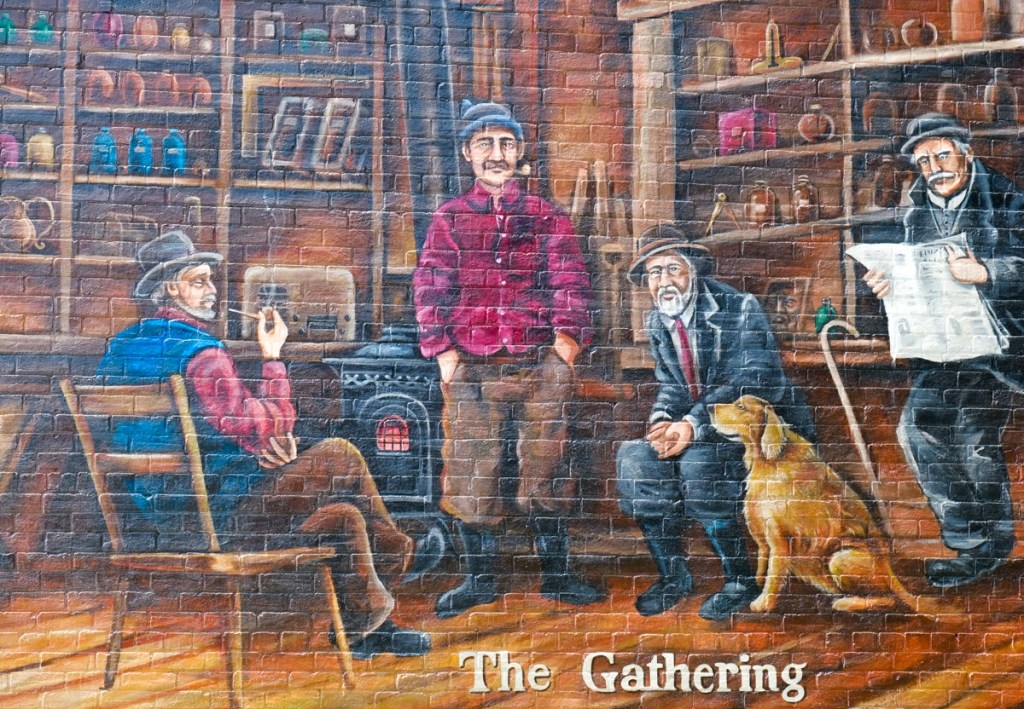
below: ‘The Gathering’ 2020 by Dave Sheridan. This replaces an earlier 1987 mural by Pierre Hardy which in turn replaced a small painting on canvas by Crawford Slack in 1927. The portrait in the oval frame, top right, is Crawford C. Slack. Crawford Chelson Slack was born in nearby Wiltsetown in 1855. He was a painter (and a poet and a musician).
“Needn’t talk ter me ‘bout livin’ in the city with its show, Druther live ‘mong these surroundin’s where the folks are rather slow… Where the golden summer sunset gilds the village church’s dome — There among the slantin’ shadows, I would druther have my home.” by Crawford Slack
below: A lazy afternoon by the lake, “Charleston Lake Picnic” by Noreen Mallory. Granite outcroppings, pine trees, and water, all very Ontario cottage country scenery.
below: Mallory’s family had a cottage nearby and summers spent there helped inspire this mural. Another inspiration was “Le Déjeuner sur l’herbe”, a painting by French Impressionist Édouard Manet (except there are no nudes in Mallory’s version).
below: Manet’s picnic painting of 1893
below: At the corner of Victoria and Main streets.
below: A pair of work horses busy on the farm, another mural by Dave Sheridan.
below: Paint cans – the mural was not quite finished the day that I was there. I’m sorry that I missed seeing it painted.
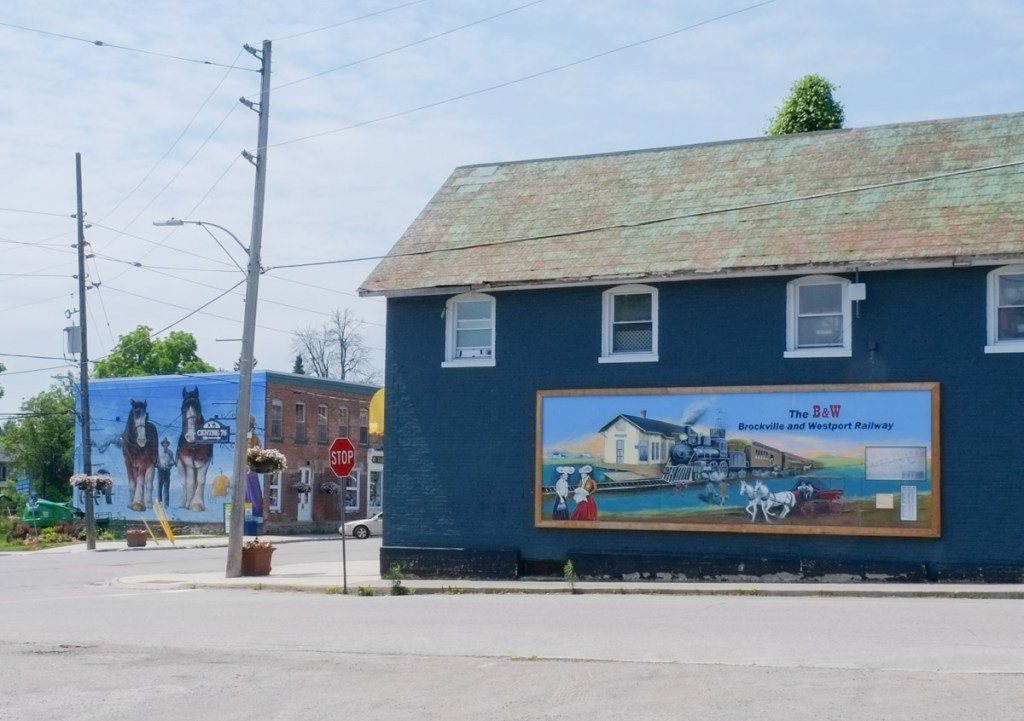
below: Brockville and Westport Railway. No signature. Former Athens railway station. The first train ran on B&W railroad in 1888 pulled by engines built at the Kingston Locomotive Works. The line was 45 miles long and had 16 stops.
It replaces an earlier 1987 mural by Lorrie Maruscak
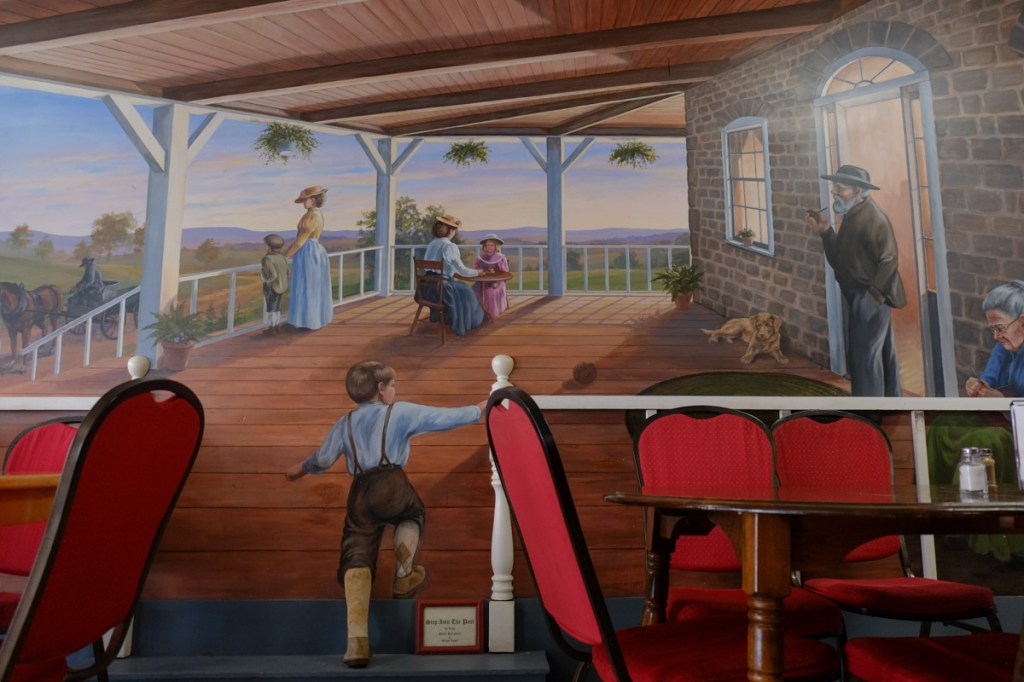
below: Inside the Main Street Cafe is yet another mural, ‘Step into the Past’. It was painted by Sheila Ballantyne and Sergio Lopes.
below: A copy of an older mural that no longer exists is displayed on a fence. “This mural originally graced the hardware store on this site and was created in 1990 by Cathy McGuire. The border features alternating patterns of quilt squares and historic farm scenes. The center of the mural depicts farmers and a steam engine threshing the grain that separated the grain from the stem.”
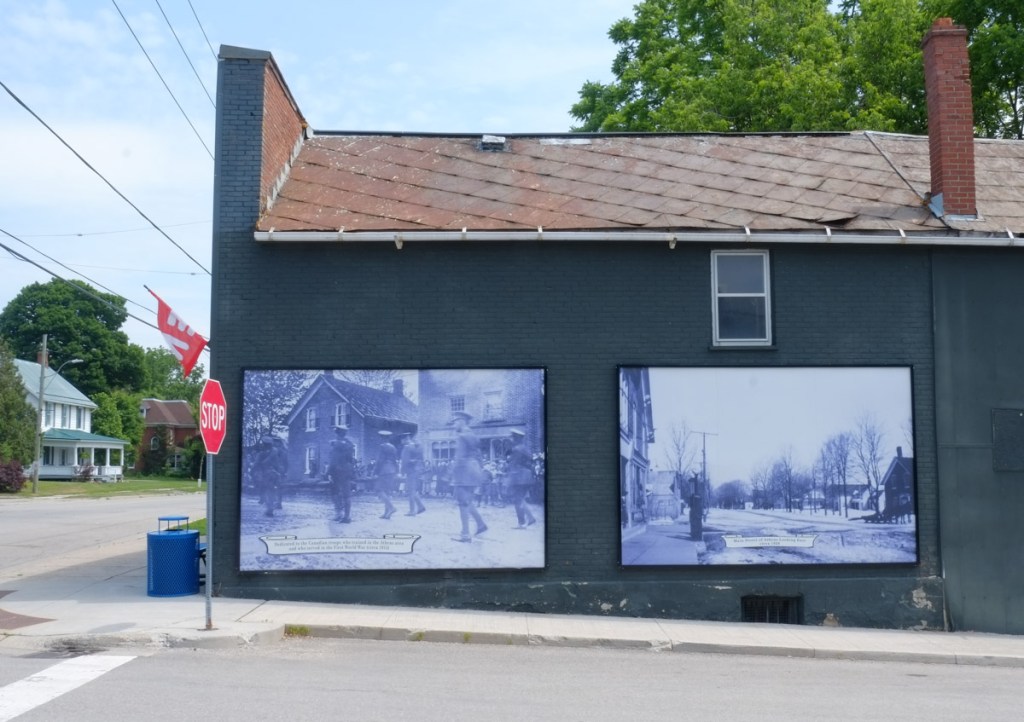
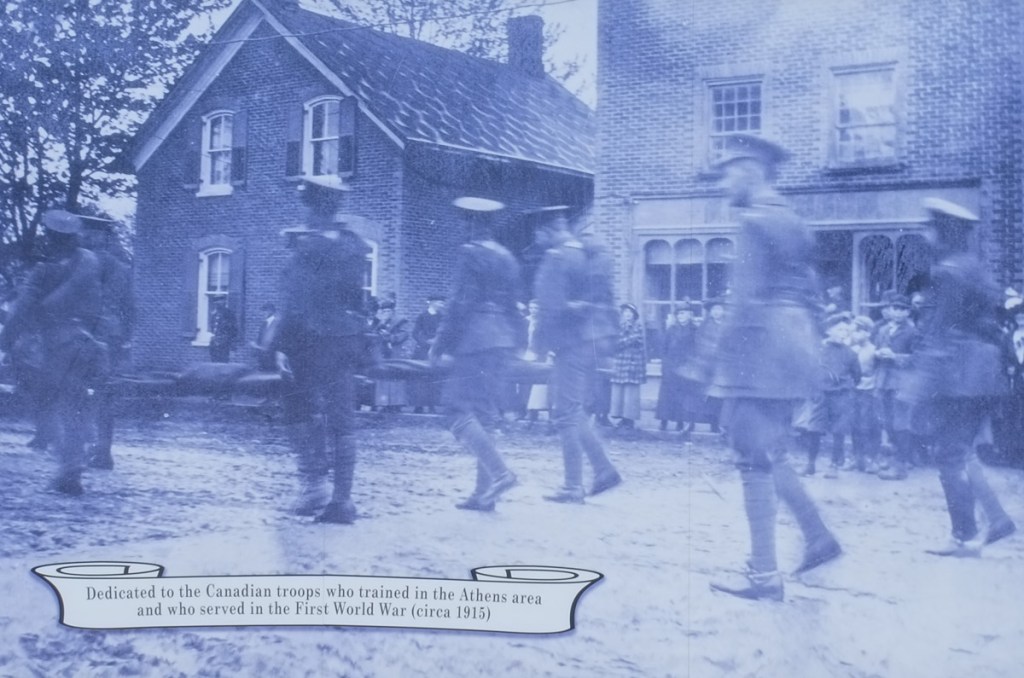
below: Two large weathered photographs on display.
below: “Dedicated to the Canadian troops who trained in the Athens area and who served in the First World Ward (circa 1915).
below: Main Street, Athens, 1920.
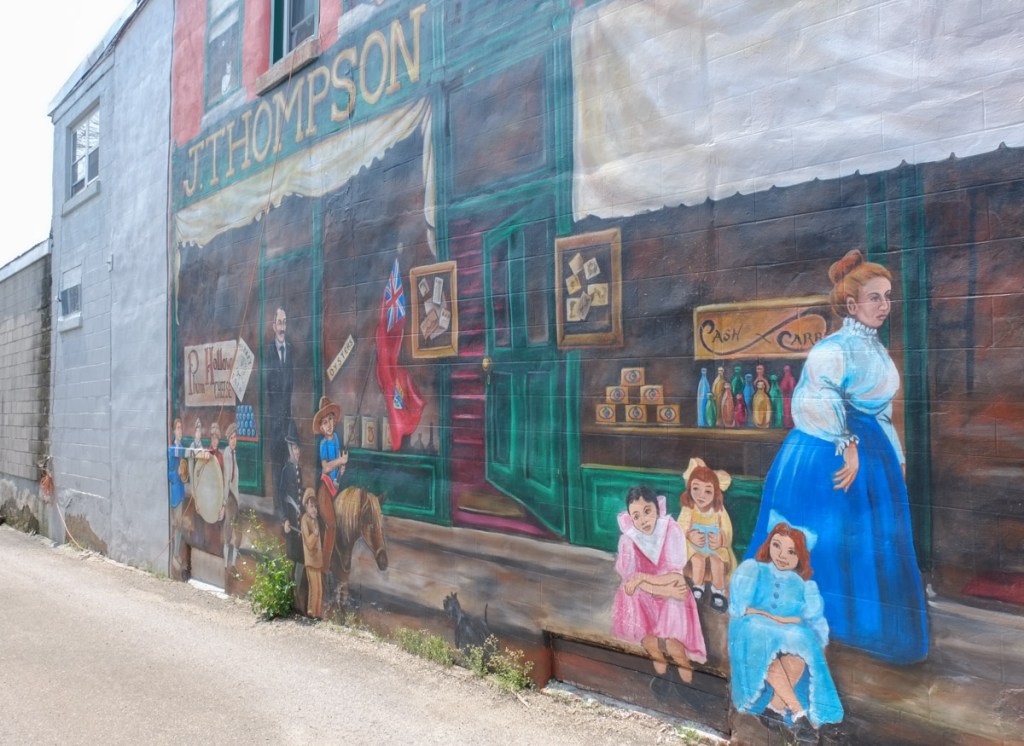
below: Main Street is also represented by a mural that features some of the businesses that were established here.
below: The flag that the boy is holding is the version of the Canadian Red Ensign that was in use between 1922 and 1957.
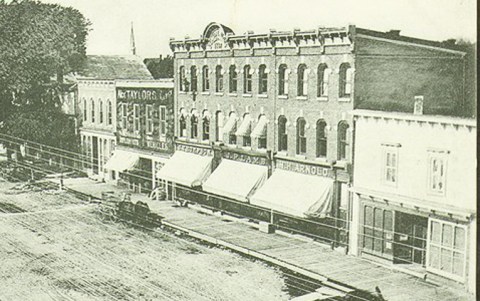
below: Main Street 1910 (found on Wikipedia, original source Special Collections, Toronto Public Library. Photographer: H.R. Knowlton). The large brick building with the three awnings in front is home to three businesses, Thompson, Lamb, and Arnold like those in the mural.
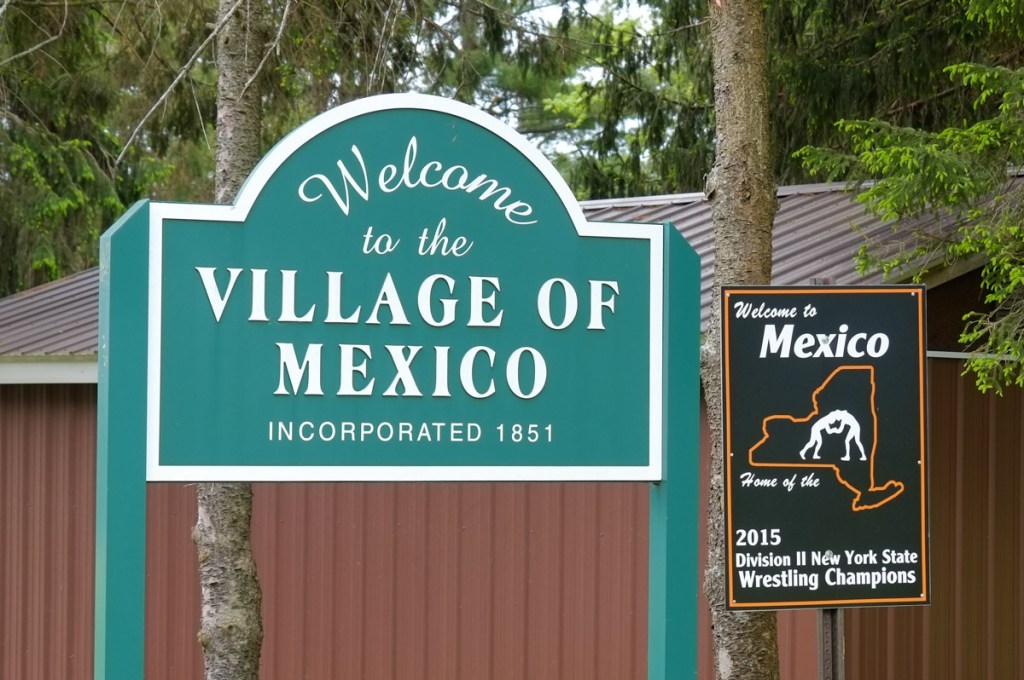
Well, probably not the Mexico you’re thinking of…. I was referring to the village of Mexico in upstate New York.
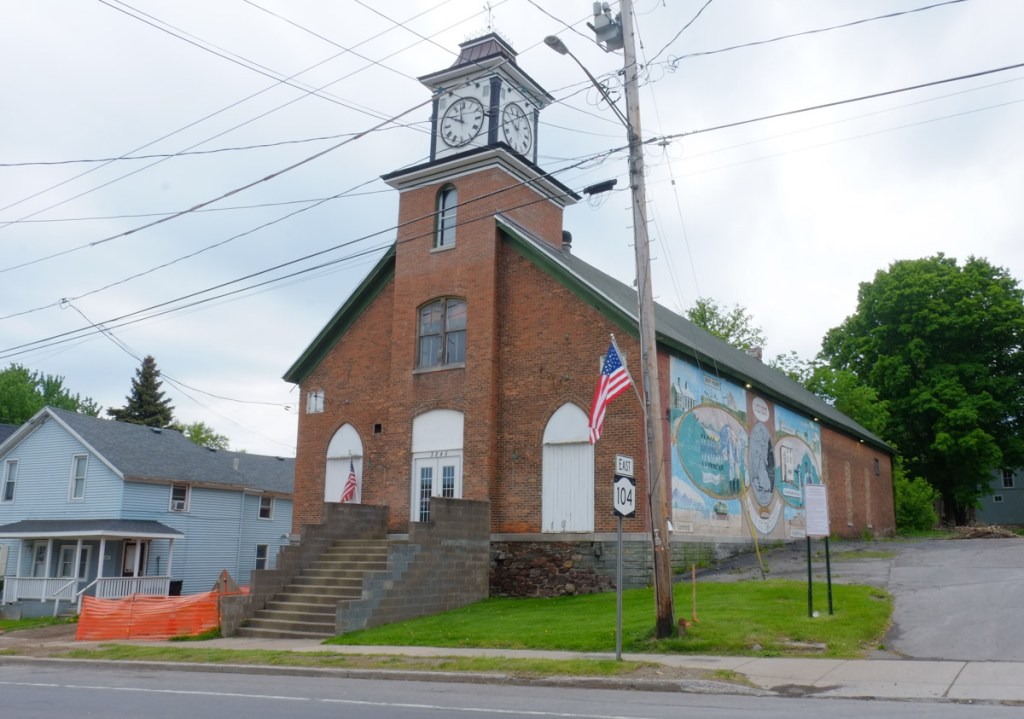
below: This brick building with the clock tower is the Town Hall in Mexico NY, where one wall is now home to a large mural.
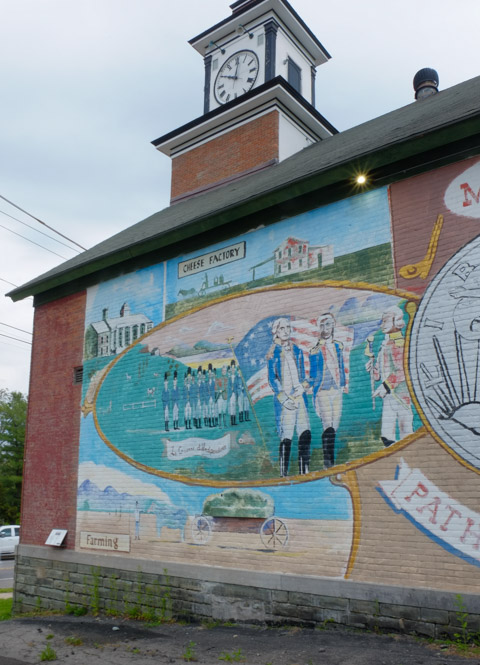
below: The mural illustrates some of the history of the area.
below: The subtitle on the left is La Guerre d’Independance. I am not sure why it is in French.
below: In the center of the mural is a circular coin shaped piece, a Liberty Walking half dollar with the motto “In God We Trust”. It is dated 2004 when the mural was painted.
below: A tribute to the area’s role in the Underground Railroad. Mexico was one of the most active abolitionist and Underground Railroad centers in central New York. Starr Cark (1793-1866) and his wife Harriet Loomis Clark who lived in the village played a central role. Rather than recount the story on this page you can find a link to the National Park Service website describing Star Clark’s Tinshop.
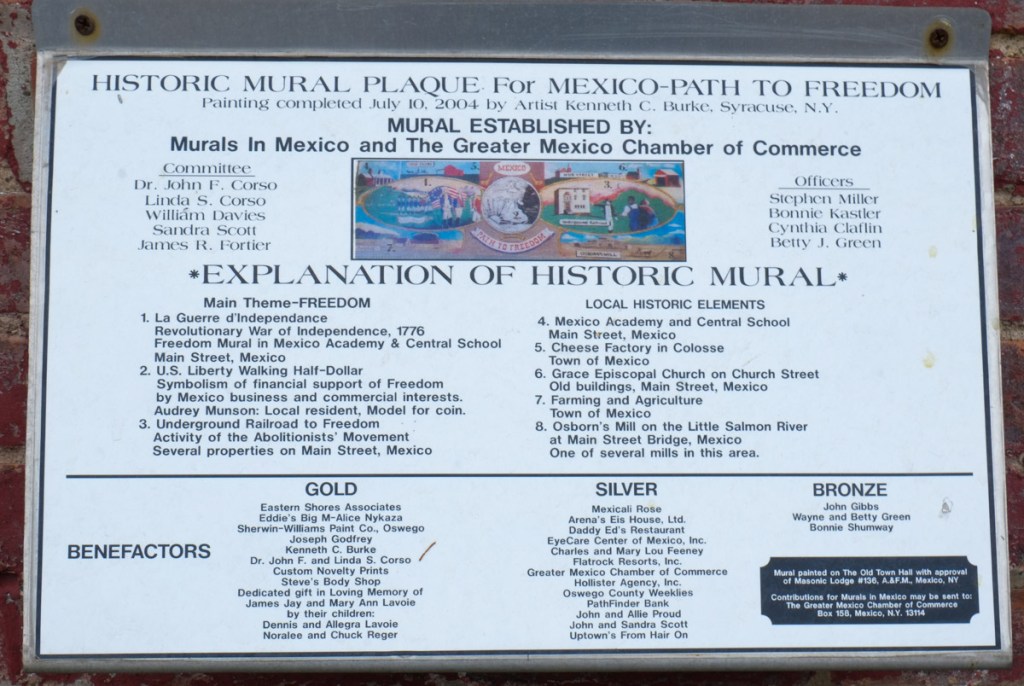
below: The plaque that accompanies the mural states that the artist was Kenneth C. Burke of Syracuse NY. Everyone who donated in support of the mural is also listed as are the members of the Greater Mexico Chamber of Commerce.
below: The old building shown in the mural still exists and looks almost exactly the same – it is directly across the street from the Town Hall.
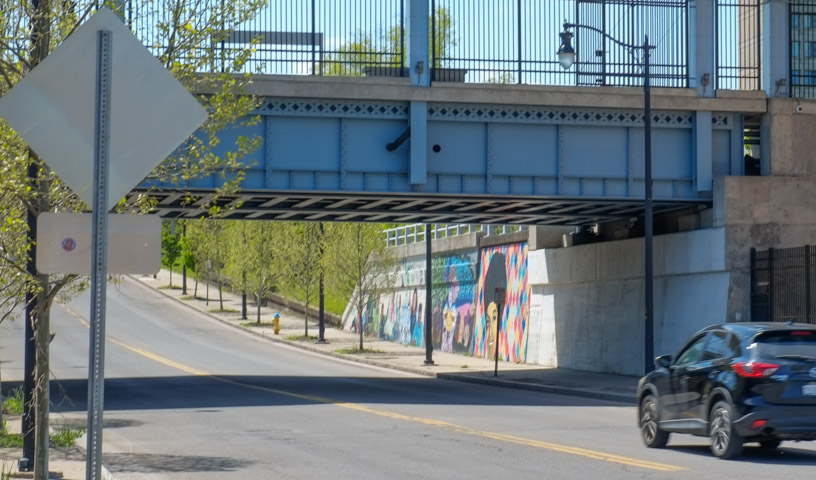
Just north of the falls, there is a railway bridge that crosses the Niagara River. On the American side of the river is the Niagara Falls Underground Railroad Heritage Center. It is housed in the 1863 Customs House adjacent to the Amtrak station. Niagara Falls was the last stop of one the routes of the Underground Railway, a network of routes and safe houses used by enslaved Black Americans to escape to freedom. It was an established border crossing that was readily accessible via numerous transportation routes, including the Erie Canal. There was a well-established network of abolitionists and anti-slavery activists in western New York. It is estimated that between 30,000 and 40,000 freedom seekers settled in Canada.
below: “Enjoy this day that God has given us”, John Lewis (1940-2020) at the corner of Main and Depot in Niagara Falls NY. Lewis was a politician and civil rights activist. This mural was painted by Princessa Williams
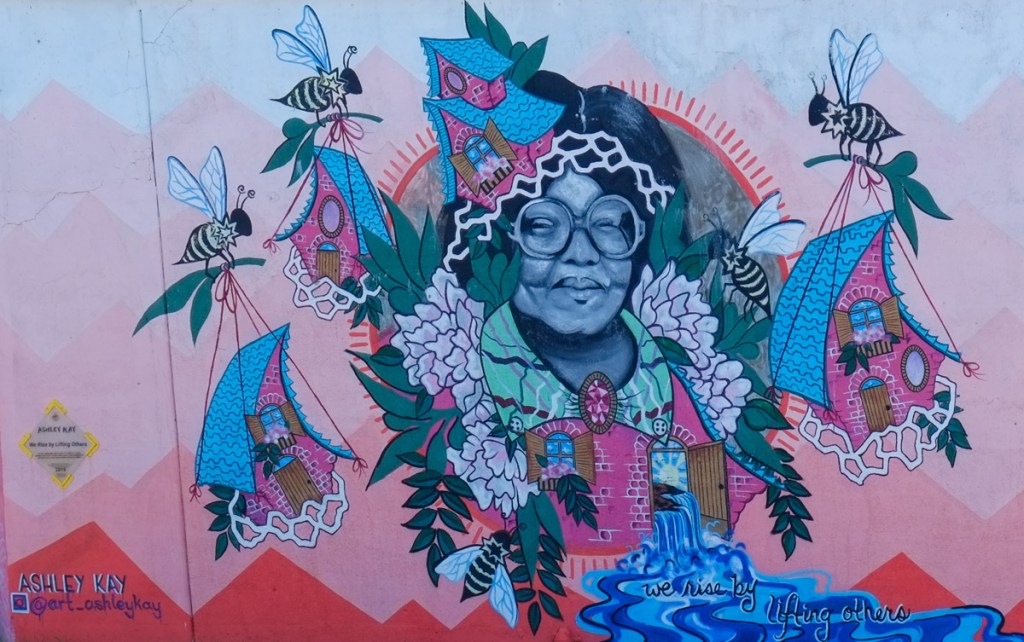
below: “We rise by lifting others” by Ashley Kay. This mural honours Doris Jones who was the head of the Niagara Falls Housing Authority for 25 years. Painted in 2019.
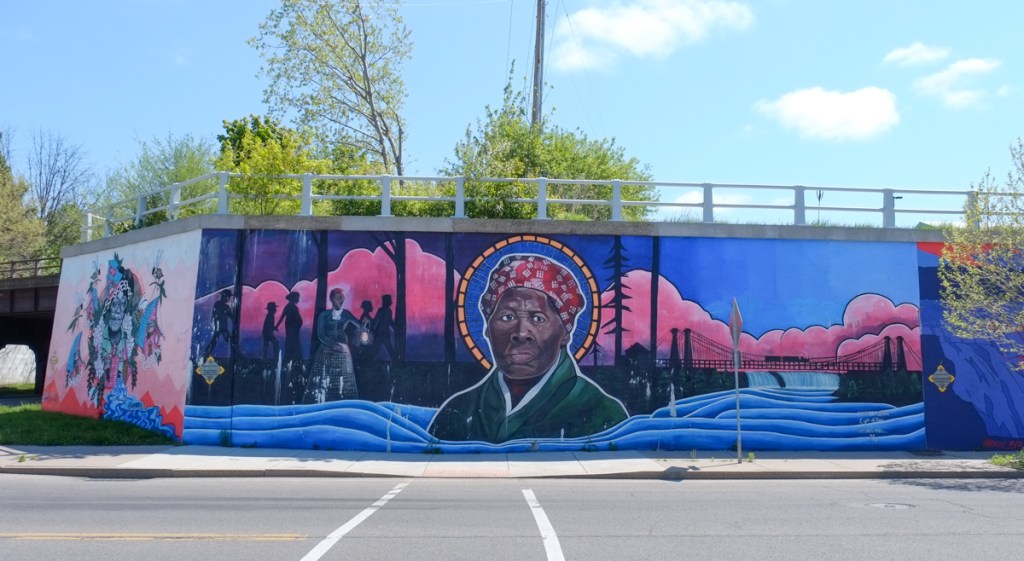
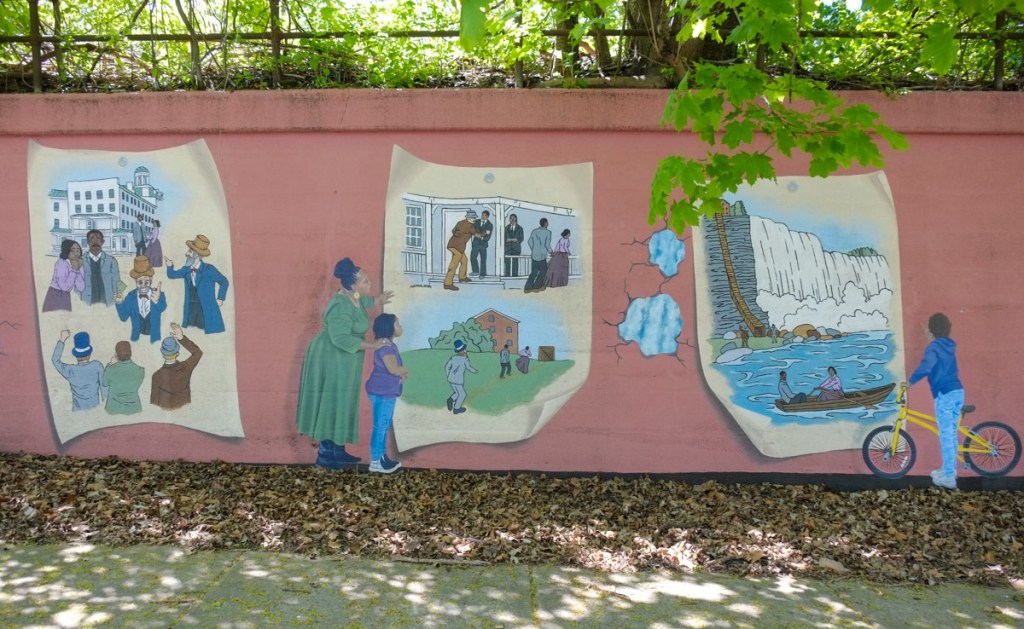
below: Harriet Tubman and “A Light of Hope” by Madonna Pannell, 2019. This image references a crossing across the Niagara Suspension Bridge that Tubman made in 1856 with four freedom seekers. The bridge no longer exists but its remains can be seen from the Heritage Center.
below: “Historic Cataract House” by Imani Williamson. the Cataract Hotel was built on the banks of the Niagara River in 1825. It had a wait staff that was entirely African American and these Black waiters often led double lives as secret Underground Railroad agents.
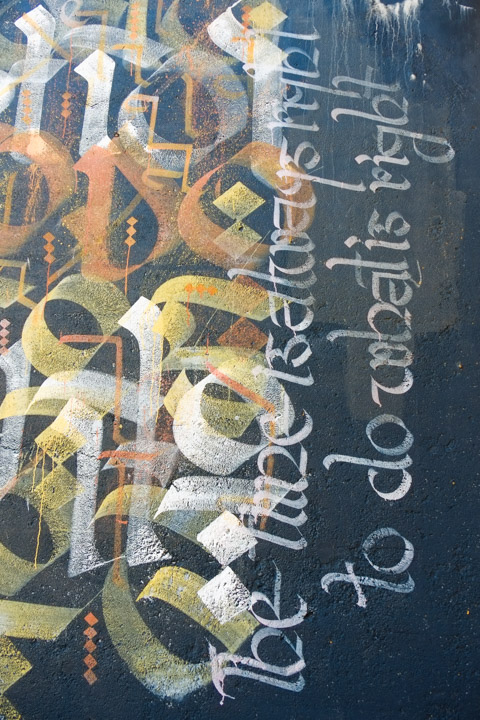
below: “The time is always right to do what is right” by Muhammad Zaman. This is a quote from Martin Luther King Jr’s final sermon on 31st March 1968 at the National Cathedral in Washington DC. The calligraphy is in Bengali, Arabic, and English.
below: Saxophone player with words and music a mural by Edreys Wajed; a portrait of tenor saxophonist and jazz musician John “Spider” Martin.
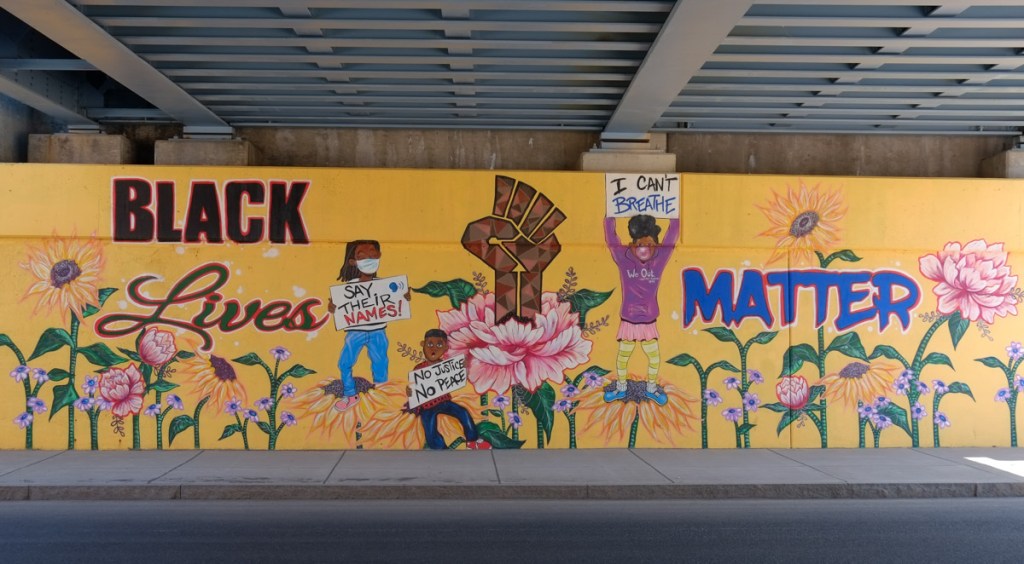
below: Black Lives Matter, a mural by Ashley Kay and Tyshaun Tyson, 2020
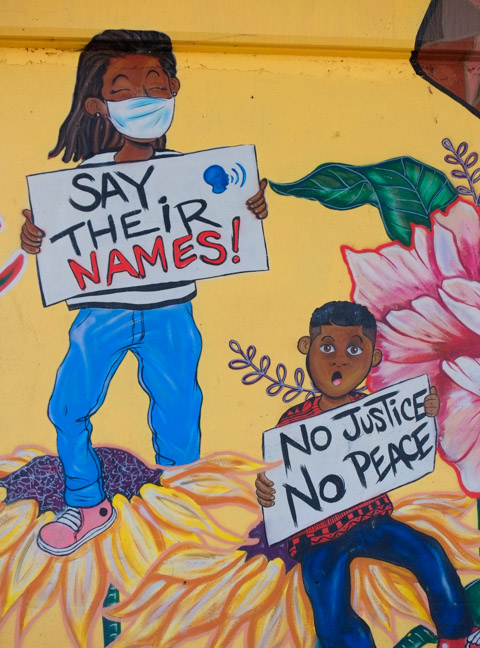
below: Holding signs with slogans and phrases that became synonymous with Black Lives Matter, “Say their names” and “No Justice, No Peace”.
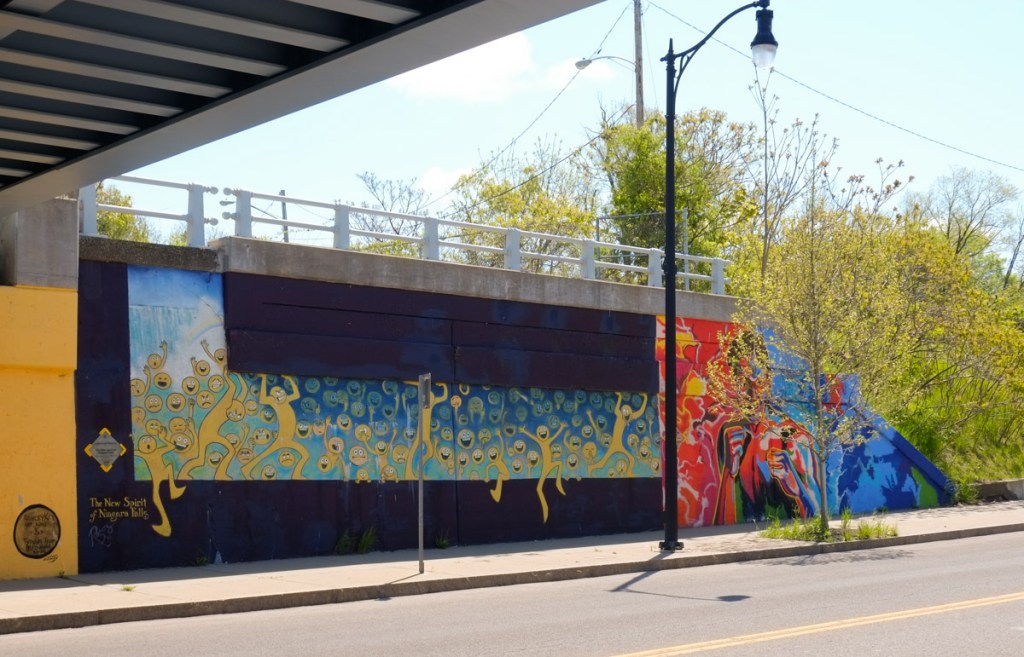
below: “The New Spirit of Niagara Falls” by Jonathan Rogers, 2019
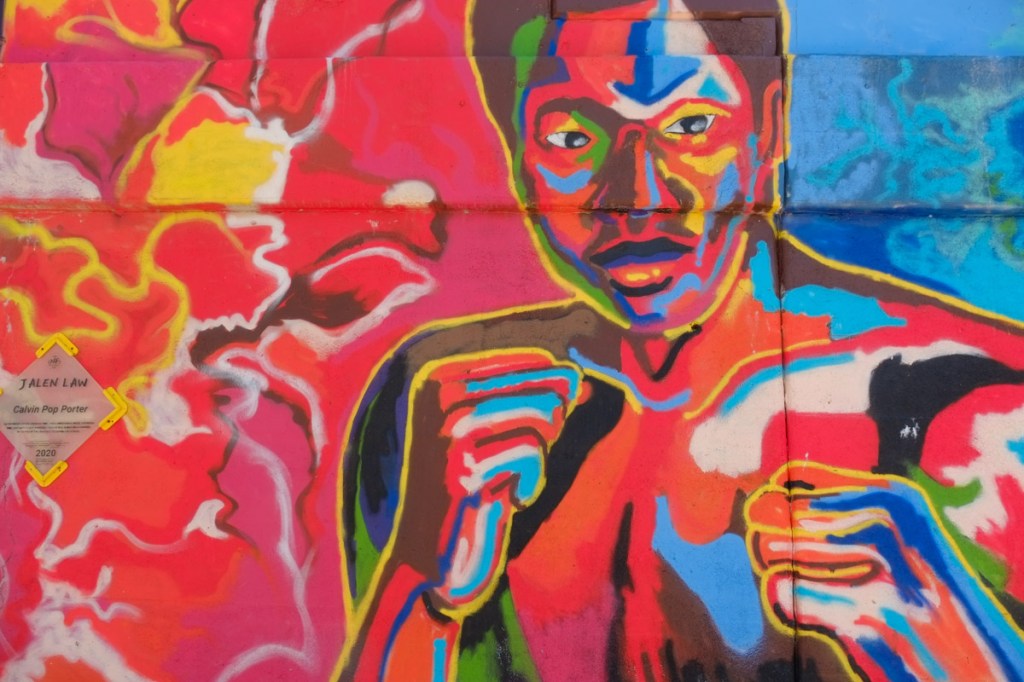
below: Portrait of Calvin “Pop” Porter, a professional boxer, gym owner, and community leader by Jalen Law.
below: This long mural featuring portraits of a number of kids is the work of Sarah Zak.
below: Support All Women, a mural celebrating the empowerment of women, painted by Amira Moore.
below: Uhuru Love, aka Dr. Gloria Daniels Butler, was an artist, educator, and civil rights activist. She adopted the name Uhuru Love in 1965 – Swahili and English words meaning “freedom (is) love”. The mural was painted by Lashonda Davis.
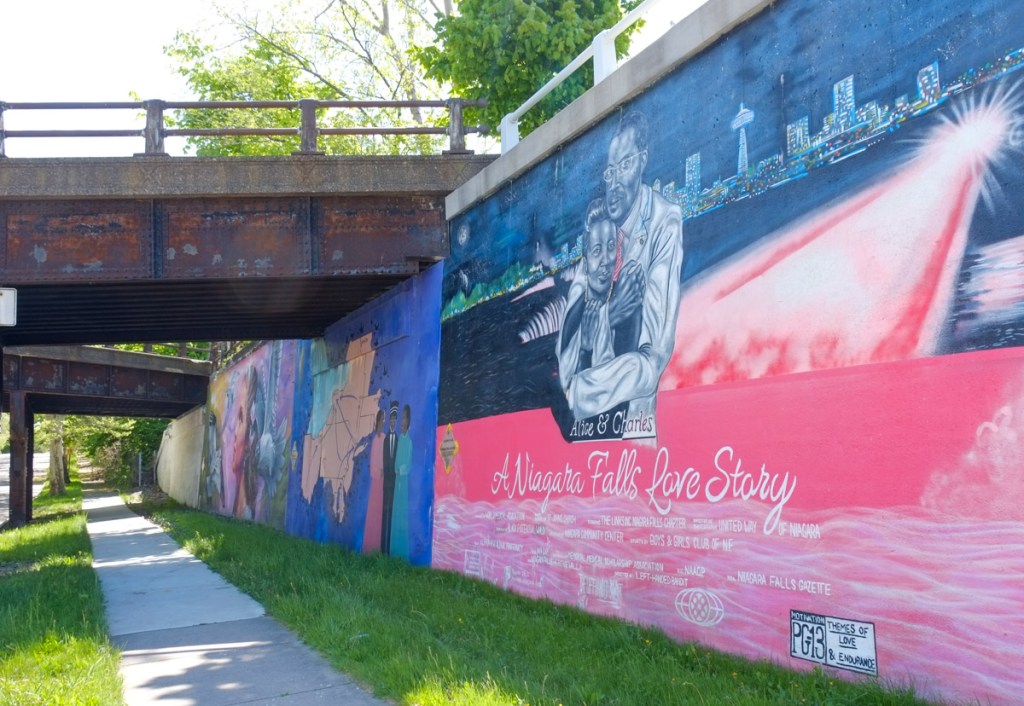
below: “A Niagara Falls Love Story” by Tyshaun Tyson, 2019. Alice Hayes was an active member of the community (her biography is online) and her husband Charles B. Hayes was Niagara Falls first black physician when the couple arrived in the city in 1935.
below: Freedom seekers map, the routes to Niagara Falls. Painted by Natalia Suska, 2019
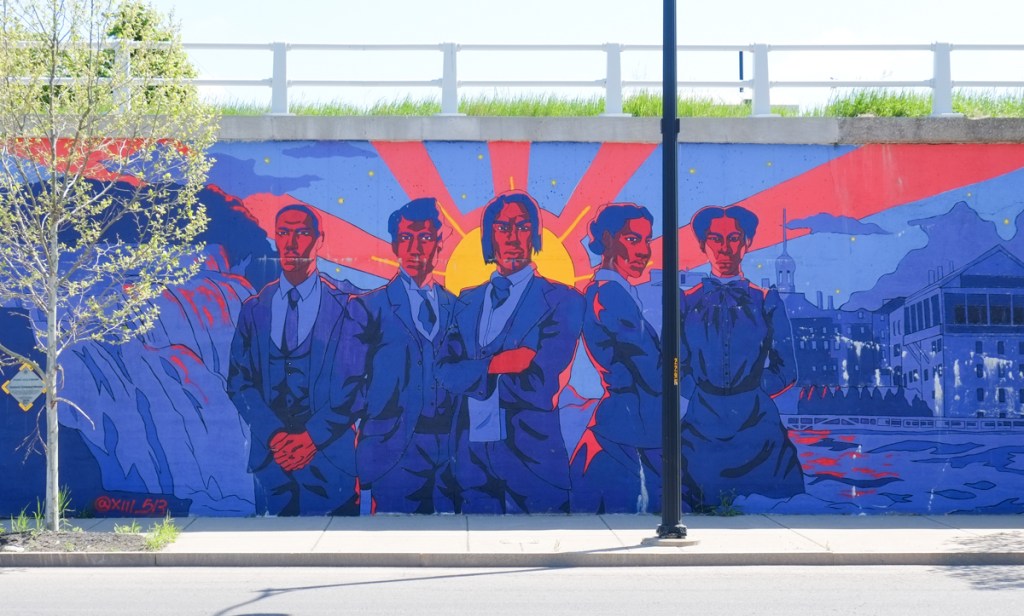
below: Channeling the energy from the falls to be put toward the pursuit of freedom. “The Niagara Movement” mural by Thomas Asklar and Matthew Conroy. The Niagara Movement was a black civil rights group founded in 1905 by W.E.B. Du Bois (pictured here) and William Monroe Trotter. It was named for the “mighty current” of change the group wanted to effect and took Niagara Falls as its symbol.
below:Aerosol Kingdom (aka Justin Suarez), “Girl with a Snail Earring”. 2021
below: A 2022 mural about Black history and the underground railroad in Niagara Falls in three scenes, painted by Abigail Lee Penfold.
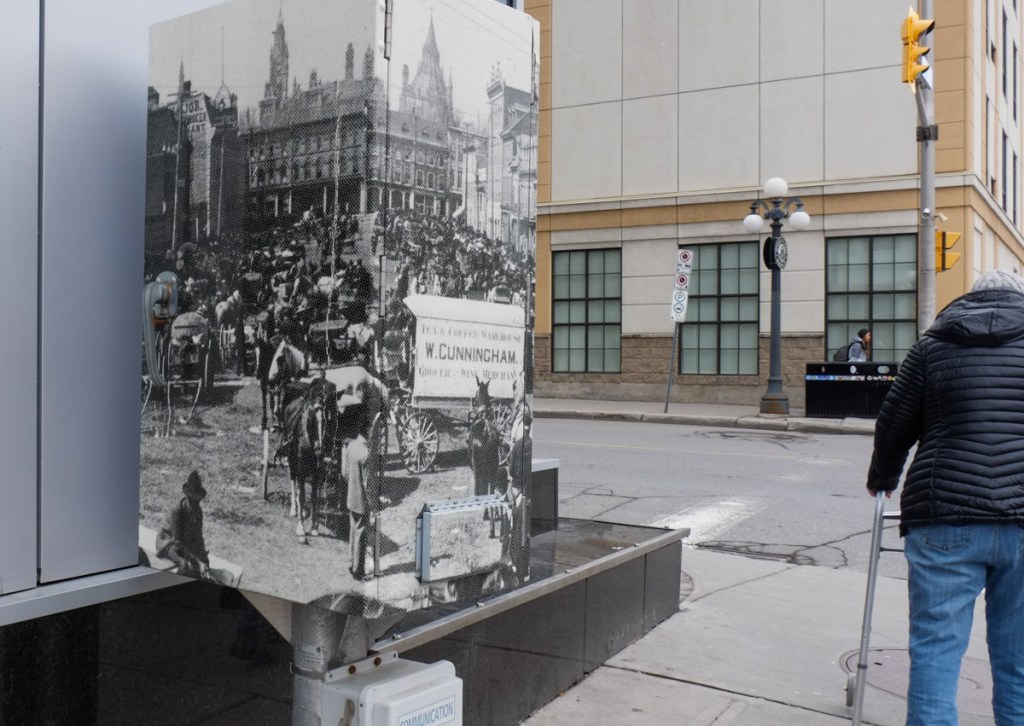
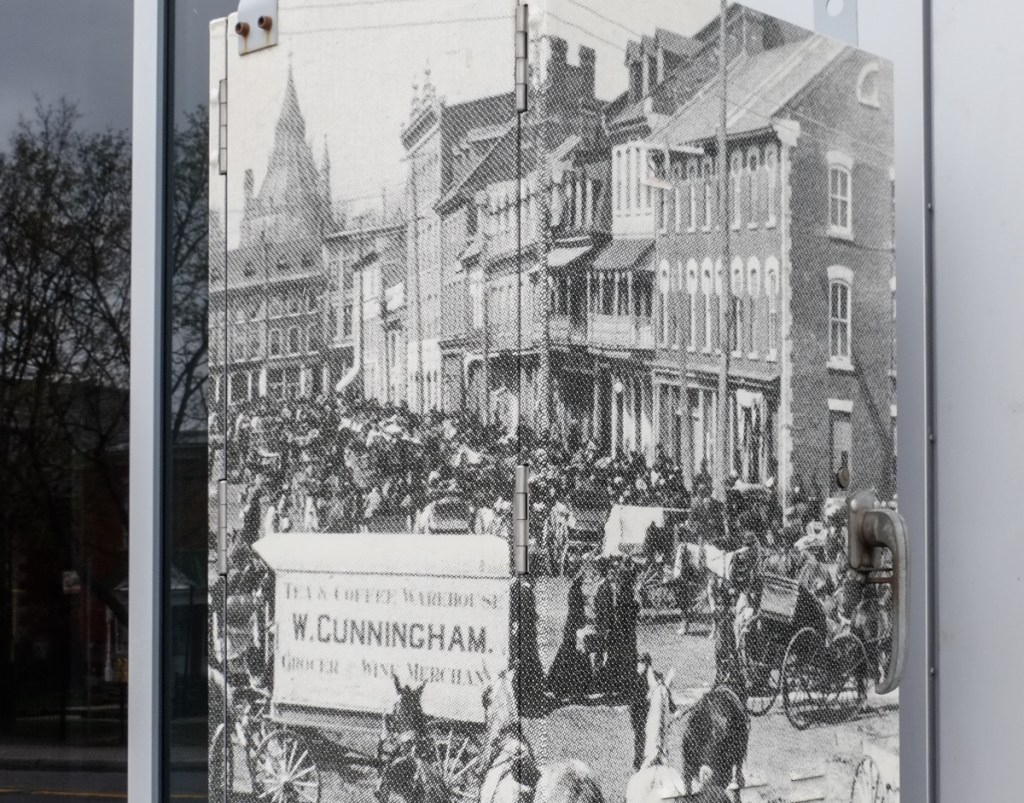
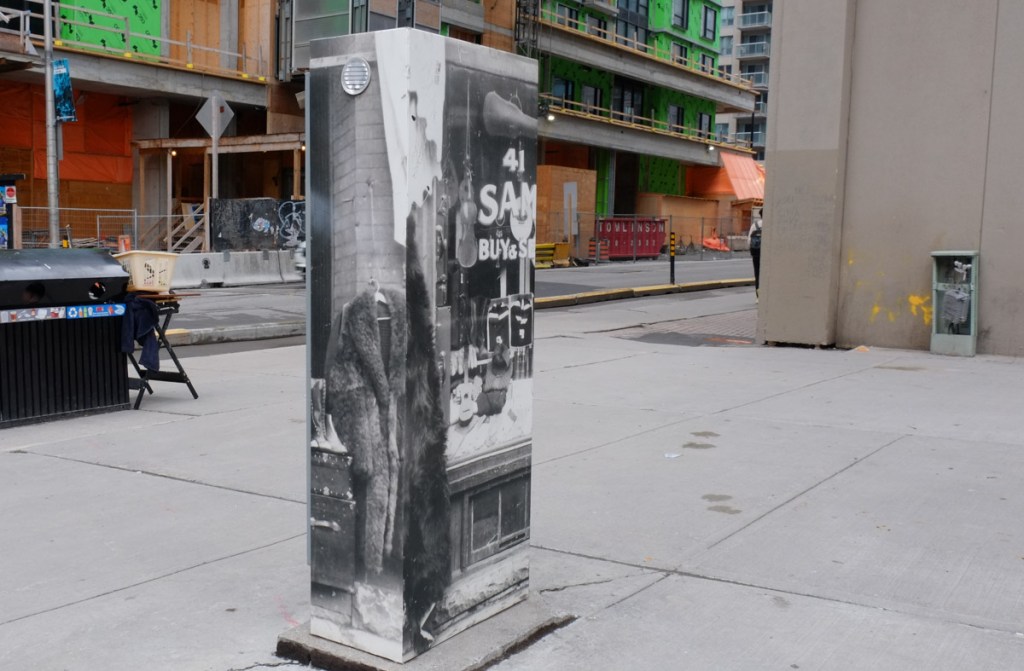
While walking around the Byward Market in Ottawa, I saw a lot of traffic control boxes at intersections that were wrapped with old black and white photos. This is the result of The Capital History Project, a collaborative effort between Carleton University, the Workers History Museum, and the city of Ottawa. These boxes first appeared 2017 and they are/were all over the city. I am not sure how many there still are …. but here are a few of them….
below: Petigorsky’s shoe repair. Mr. Oscar Petigorsky in front of the store that he and his wife Nina ran, 1930s. The store was at 289 Dalhousie Street.
below: The sign on the side of the horse drawn wagon says “”Tea and Coffee Warehouse, W. Cunningham, Grocer, Wine Merchant”
below: “Ottawa band Modern Rock Quartet at Cafe Le Hibou”, photo by Dave Sproul circa 1970. MRQ was formed in 1967 and over the next few years they played with many top rock groups of the era. According to Wikipedia, their first live performance was at the Prime Minister’s official residence – that would be Pierre Trudeau.
below: Sam’s? Buy & Sell
For a complete story of these boxes, see the Capital History website. There you will find an interactive map showing the location of all the boxes.
























































 Eyes on the Streets