murals in 29 Palms

Twentynine Palms California is a desert town with a population of about 26,000.   It lies directly east of Los Angeles and slightly northeast of Palm Springs.  It is the site of the Oasis of Mara, the site of the 29 palm trees planted by the Serrano Indians.  The Marine Corps Air Ground Combat Center is just outside of town.

Robert Plant sings a song called ’29 Palms’ although it’s not about the town.

Frank Sinatra recorded ‘The Lady from Twentynine Palms’ in 1939 and it was later covered by the Andrews Sisters as well as Doris Day.   Again, it’s not a song about the town!

I drove through it the other day because it is one of the towns at the northern edge of Joshua Tree National Monument.   As I entered the town, I noticed a sign that claimed that 29 Palms was the city of murals.  As it turns out, there are quite a few murals in town.

As I was taking pictures, I realized that it must be rare for people to walk around this town with a camera.  Then a few minutes later I decided that was wrong.  It is rare for people to walk around this town. Period.

What follows is most of the murals.  I am missing one of desert wildflowers and one of a giant lizard.  So be it. Most of the murals have an historical theme and most come with a story.  So, here is a brief account of some of the characters and events in the history of Twentynine Palms.

below: The story of cattle days in Hidden Valley.  Hidden Valley is a rock formation in what is now Joshua Tree.  Entrance to the ‘valley’ is through small openings in the rock formations.  It was once home to castle rustlers.

mural of a man lying on his back on scaffolding. He is painting a mural that is unfinished. The sky is blue. Other parts are drawn and labelled as to which color they should be painted. A very realistic cow stands beside the scaffolding.

Mural painted by John Pugh with help from Mark Molchan, Jeff Bryant, Alexis Ingle and Michelle Smith.

part of a mural - text with the story of cattle at Hidden Valley

below: The 29 Palms Stage and Express, a 1929 Chevrolet truck modified by John Hastie and used in 1938 when he started providing public transportation in the area.  John Hastie continued to drive until he retired in 1973.  It would be interesting to know how long this truck was in service!

a mural that illustrates the story of the 29 Palms stage and express. An old truck is full of people and there are trunks and bags tied to its roof.

The text that appears on the mural about the stage and express in 29 Palms.

below: Keys’ Desert Queen Ranch.  Bill Keys arrived in 29 Palms in 1910 as the caretaker of the Desert Queen mine.  When the mine went bankrupt, Bill Keys claimed the mine site. He and his wife Frances raised their five children here and Bill remained until his death in 1969.  The wikipedia entry for Bill Keys (William F. Keys) mentions that they had seven children, four of whom survived.  It also depicts Bill Keys as more of a ‘character’ including the fact that he spent time in San Quentin prison for murder.   The ranch buildings still exist (they are within Joshua Tree National Monument) and tours of the site are available.

A mural titled 'Keys' desert queen ranch' with a painting of the ranch building as well as the Keys family.

part of a mural showing a portrait of Bill Keys (as an old photograph) and his wife. In the middle of the painting is text that tells the story of their ranch in 29 palms.

below:  Orville Jackson Cones, aka Cactus Jack, or Jack Cones, the flying constable.  He became Constable of the area in 1932 and he held that job for 28 years.  He helped patrol the area by flying his Piper J-3 Cub.

mural depicting the story of Jack Cones, a policeman who flew airplanes.

The text that appears on the mural of Jack Cones

 below:  The above mural is signed,  O’Connor ’96.
Apparently the two guys who look like they want to help are Fergie and Floyd.

the signature on a mural, O'connor '96 and then there are two little workmen beside the signature that are drawn in black, both are wearing funny hats, both are older men. One has a can of paint and the other has a ladder

below: Another O’Connor mural, this one painted in 2002, depicts the story of Smiths Ranch.

A mural about the story of Smiths Dairy and their Saturday night dances

The text is smaller and more difficult to read in these photos but apparently Bill Smith and brother Harry came to 29 Palms in 1923.  They drilled a well that supplied the early settlers with water.  It also supplied a small swimming pool (see right side of mural).

part of a mural - pictures of Smith and text telling a story
Thelma Head (Mead?) arrived in 29 Palms a few years later and in 1930 she and Bill Smith were married.  Together they raised their family here.  They also developed Smiths Ranch with ice house, dairy, ice cream parlor,  outdoor theater, recreational hall, and trailer park.

mural, a young girl is eating a slice of watermelon while a man in blue overalls is sitting beside her. Other children are in the background.

below:  O’Connor Graphics has a store in town.  Unfortunately it was closed the day that I was there. But he does have a website!

Two small stores that share a common wall. O'Connor Graphics on the left. A very tall palm tree is near the center of the two buildings.

below: Prior to a flood control channel built in 1969, flash floods used to occur in 29 Palms.  During thunderstorms water would race from the mountains above the town, flood the highway, and then flood the main streets of town.

Whole mural showing scenes of a flash flood that passed through the town of Twentynine Palms.

The right side of a mural showing scenes of a flash flood that passed through the town of Twentynine Palms.

mural showing scenes of a flash flood that passed through the town of Twentynine Palms. Left side of the mural.

Photos taken in 2017.
This post originally appeared on another website but I am consolidating all my street art and mural blog posts into one collection.

Chatham history

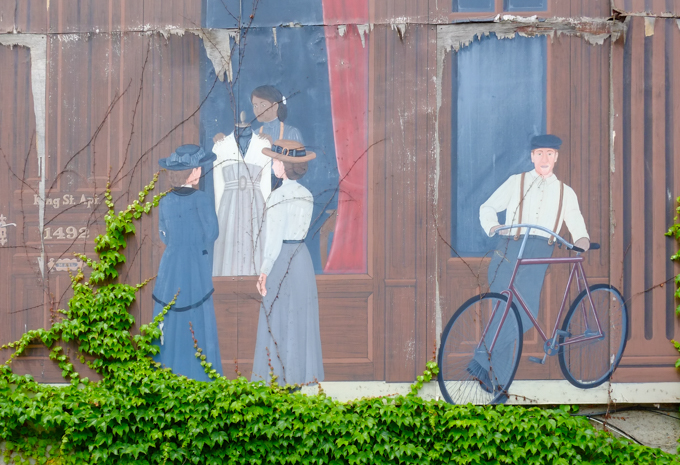
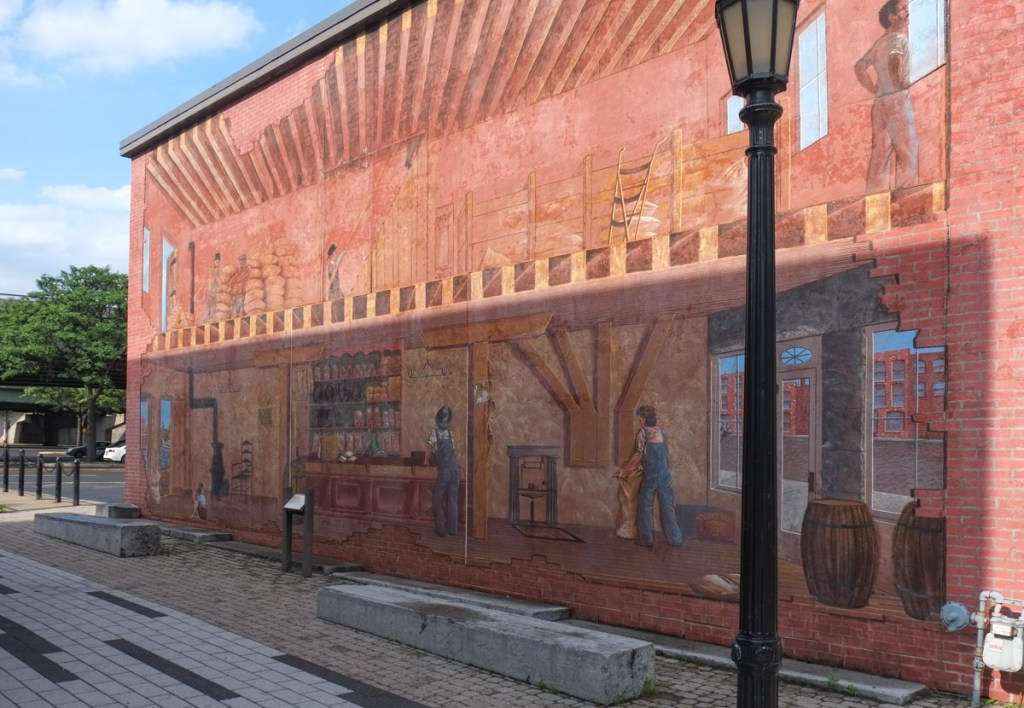
There are 2 older murals in Chatham Ontario that depict some scenes from yesteryear. The first is at least 25 years old and shows a line of stores and businesses. Even the upper windows are part of the artwork. Just this week (mid June 2025) it was announced that a new mural would be painted here this summer. I have just discovered that there is a video on Facebook of this old mural being dismantled and removed. I must have been in Chatham the day before it was removed!

So…. for a limited time only, here it is (in two images)

below: People enjoying meal at the Savoy cafe while others are tempted by the desserts on display in the window.

history of Chatham mural, older, peeling and faded a bit, a line of businesses, including the Savoy Cafe

below: Also in the row of businesses is Heintzman & Co Pianos, Lyons Tailoring, and Thomas Stone & Son (clothing?). People mingle on the street and a car drives past.

history of Chatham mural, older, peeling and faded a bit, a line of businesses, including Heintzman Pianos and Lyons Tailoring.

below: Ladies checking out what’s on display at the tailors, window shopping.

history of Chatham mural, older, peeling and faded a bit, a line of businesses, two women looking in the window of Lyons tailoring where a woman is adjusting a dress on a headless mannequin.  A man about to get on a bike is also in the picture

below: A girl plays a tune on a Heintzman piano while a family out for a drive, passes by.

The Historic Downtown Chatham Business Improvement Area (BIA) have chosen a design for a new mural that was created by local artist Ruth Ann Pearce. Apparently history will still be part of the theme but beyond that, a surprise awaits!

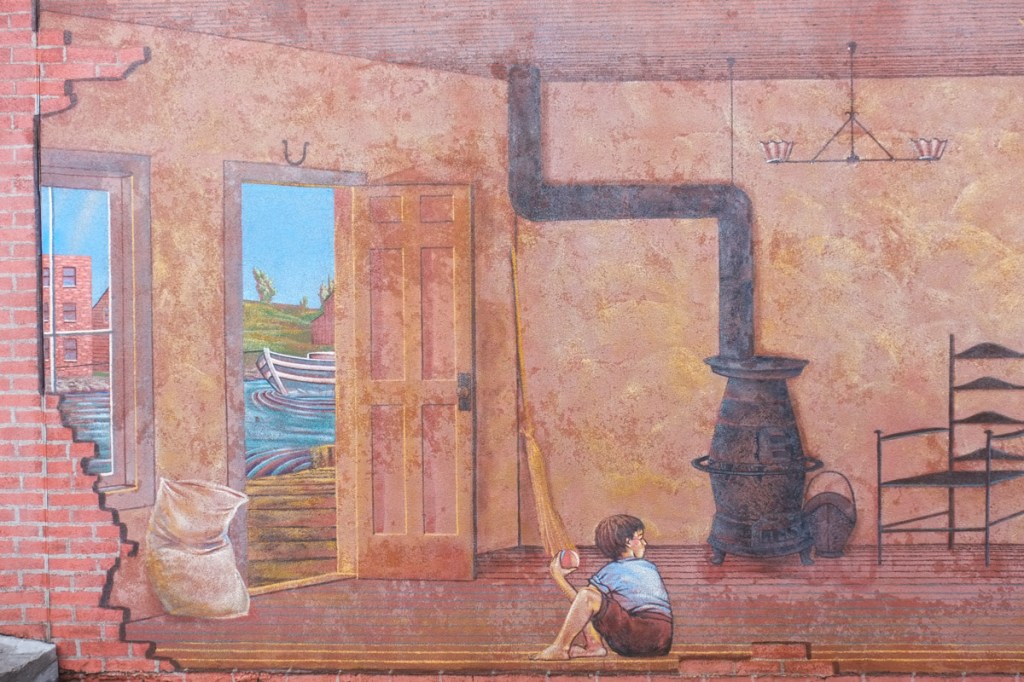
The second mural is newer but was painted by the same artist as the one above, C. Penelope Duchesne. Help was provided by Nancy Foulis, Bonnie Cernenac, Shannon Lindsay, Amy Maynard, Terry Nelmes, and John Reimer.

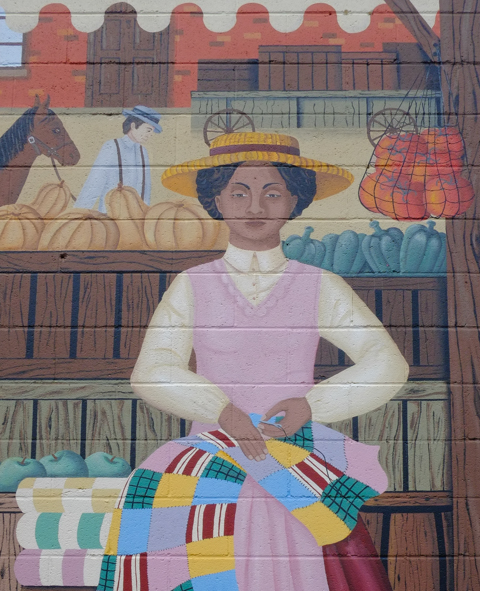
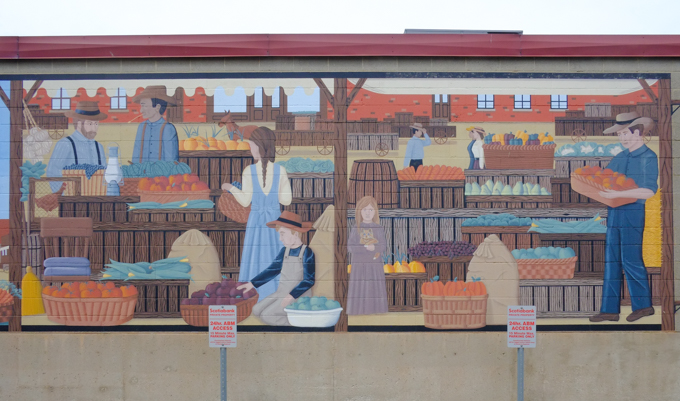
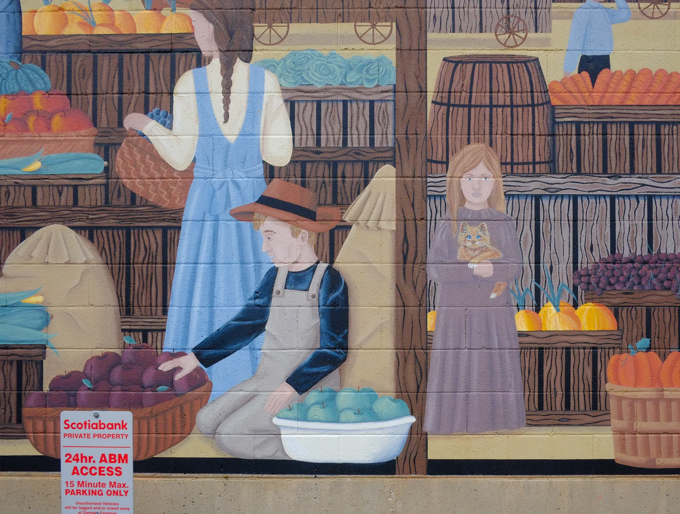
part of a history of chatham mural, market scene, woman in hat is sewing a quilt as she sits in a store

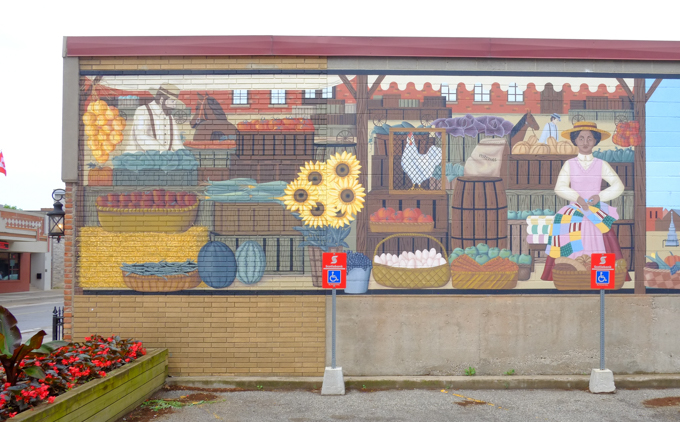
The mural is in three parts – on both the right and left side is a market scene.

part of a mural by Penelope Duchesne of a market scene from early in the 1900s
part of a mural by Penelope Duchesne of a market scene from early in the 1900s, a white chicken in a cage, a bunch of sunflowers

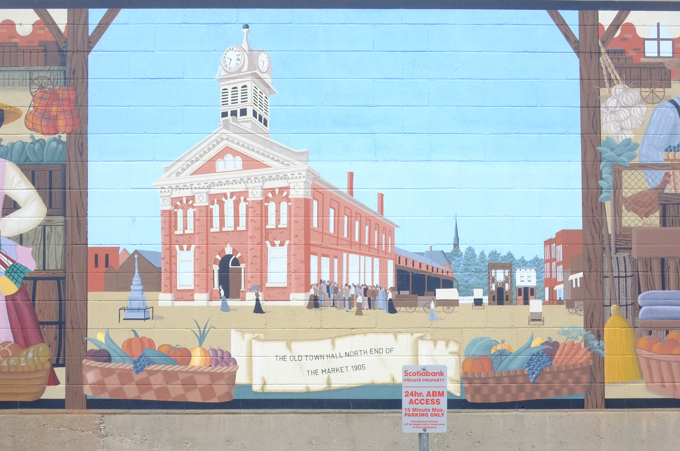
“The old town hall at north end of the market, 1905” The central panel of the mural features the old Town Hall which was built in the 1850s. The market stretched out behind it. The city sold it in the 1950s; it was demolished some thirty years later.

painting of the old Chatham Town Hall, a large brick building, in a mural
part of a mural by Penelope Duchesne of a market scene from early in the 1900s

downtown Syracuse

below: Put the “U” back in Syracuse, by Ally Walker

mural in syracuse new york, text with word syracuse with the u slightly askew, put the u back in syracuse

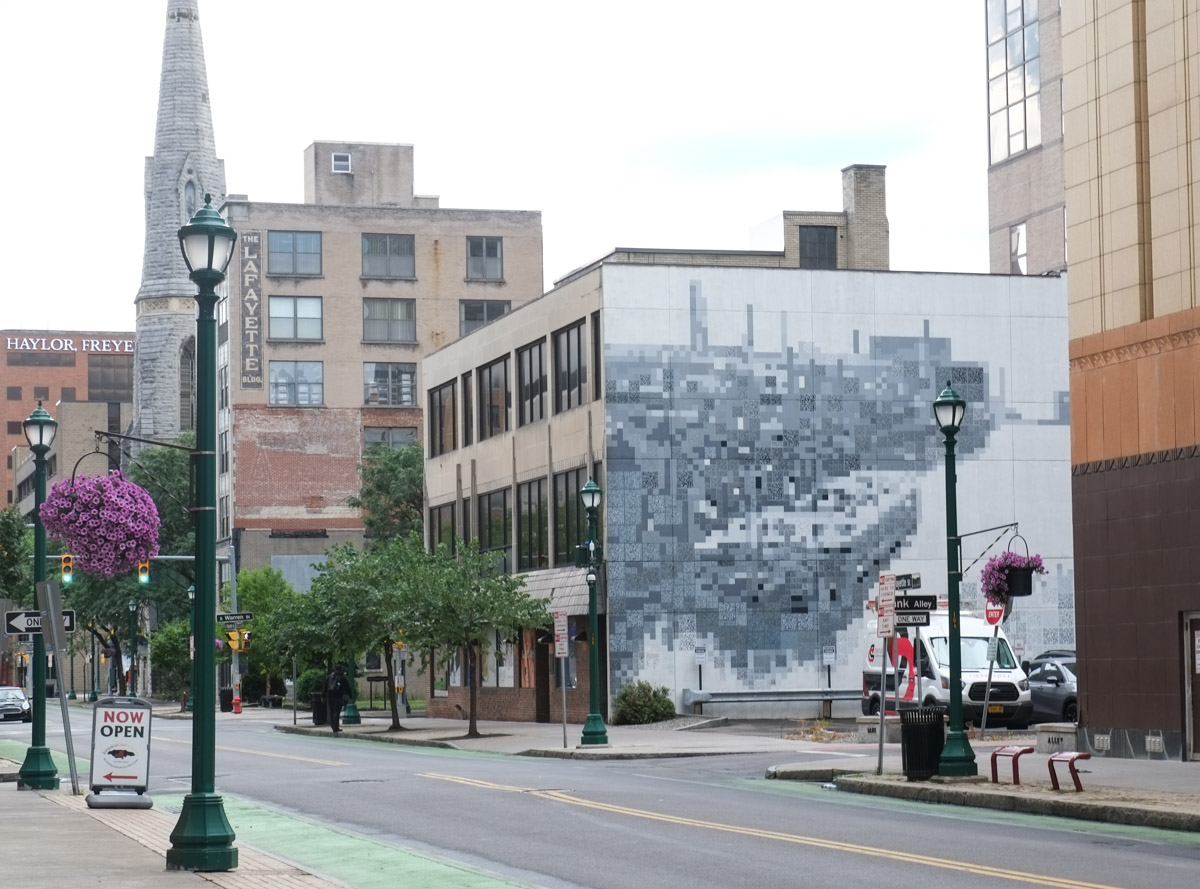
below: sAlt City by Brett Snyder and Irene Cheng, 2012.  Mosaic of squares and each square is a QR code that links to as arts organization in the city.

downtown syracuse new york mural composed of qr codes, shades of grey

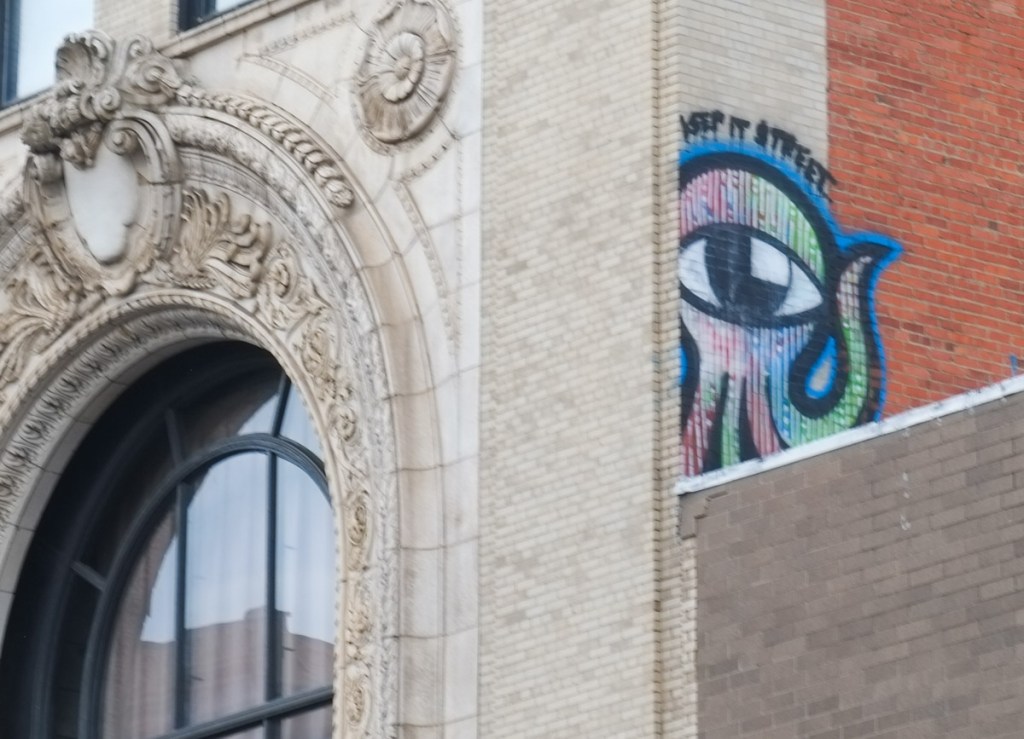
below: “Keep it Street”

small street art piece high up on a building, keep it street

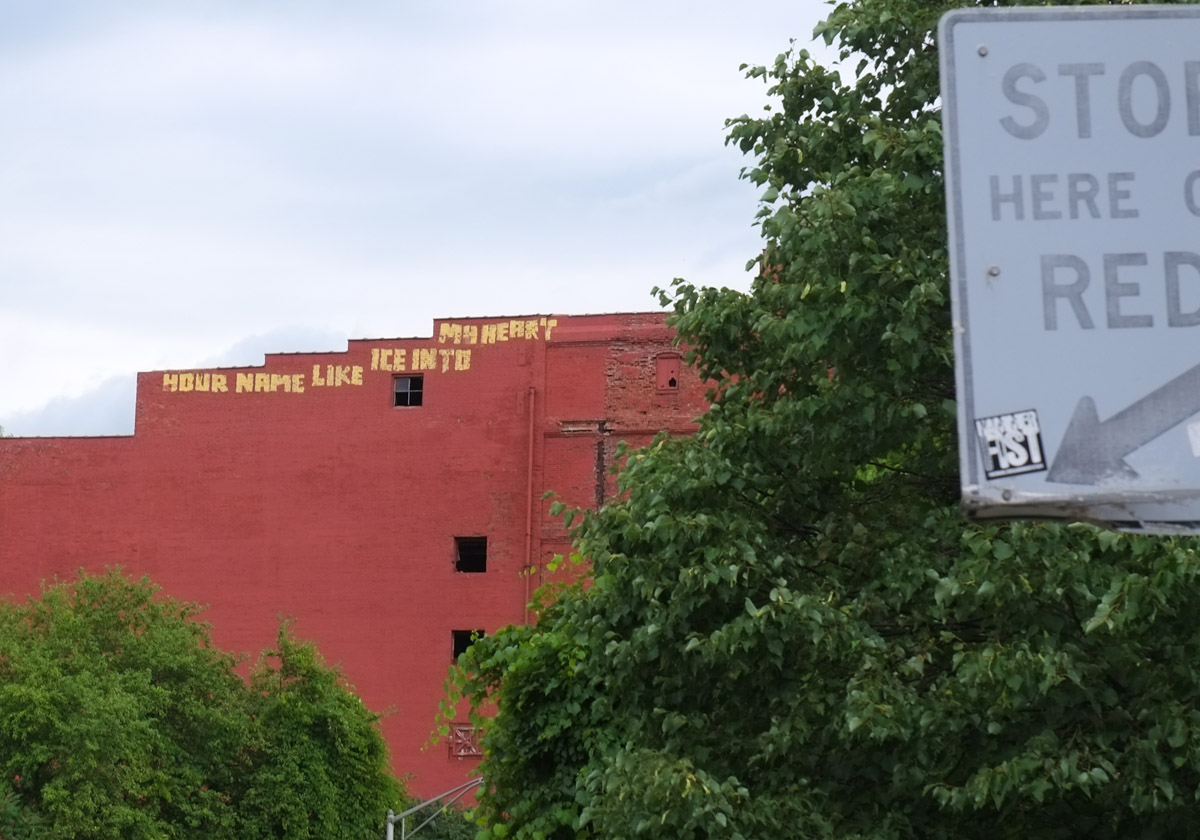
below: Your name like ice into my heart

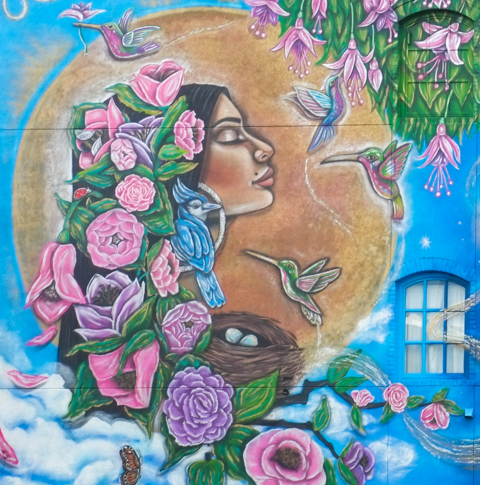
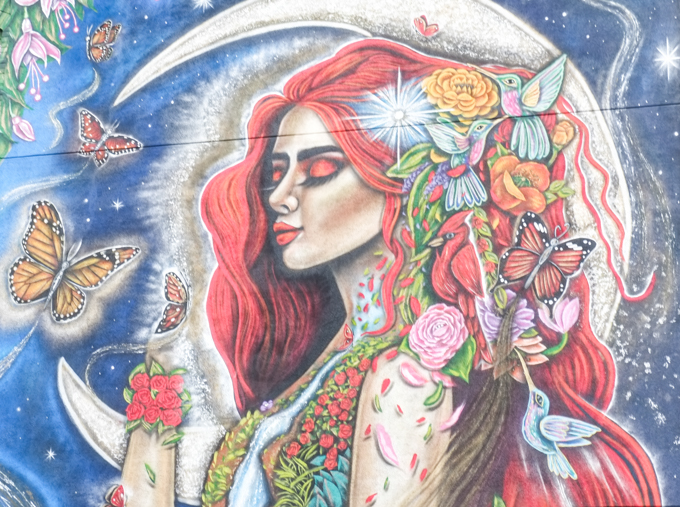
old red brick building now standing alone, with a large mural on the side of two women, one in blues and the other in reds, lots of flowers and butterflies in their hair and around them

below: A large mural by Colello Creations, aka Jacqueline Colello

part of a colello creations mural in syracuse

part of a colello creations mural in syracuse

part of a colello creations mural in syracuse
mural in syracuse by Jacqueline Colello

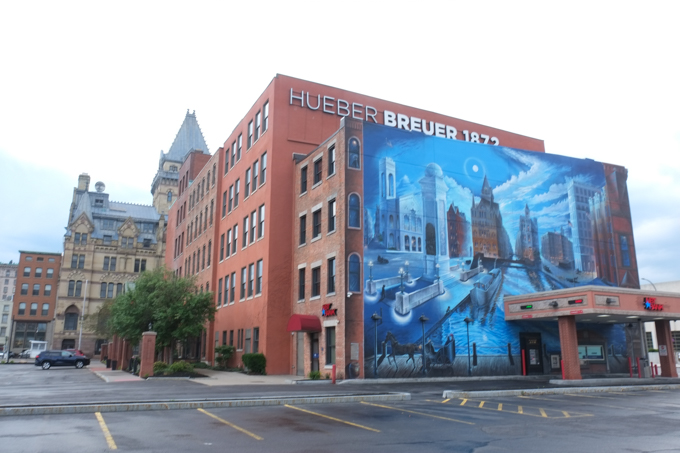
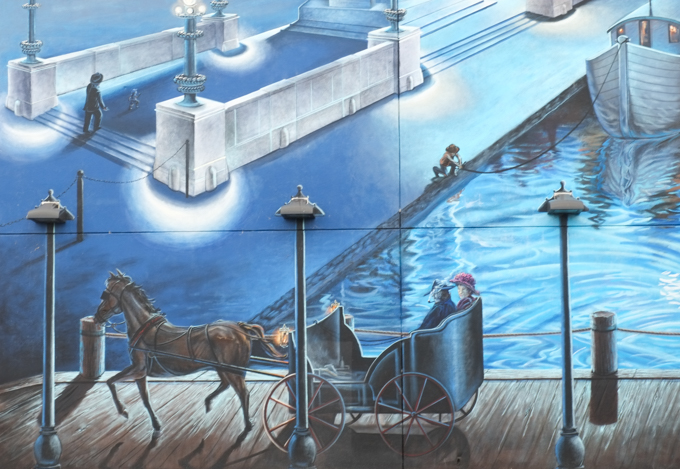
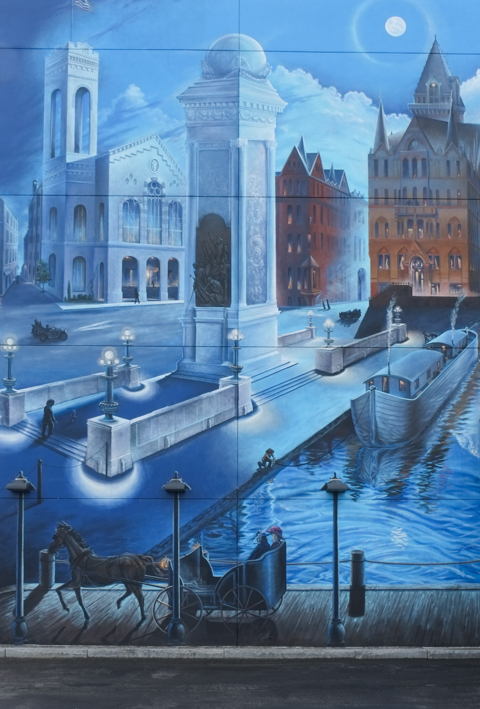
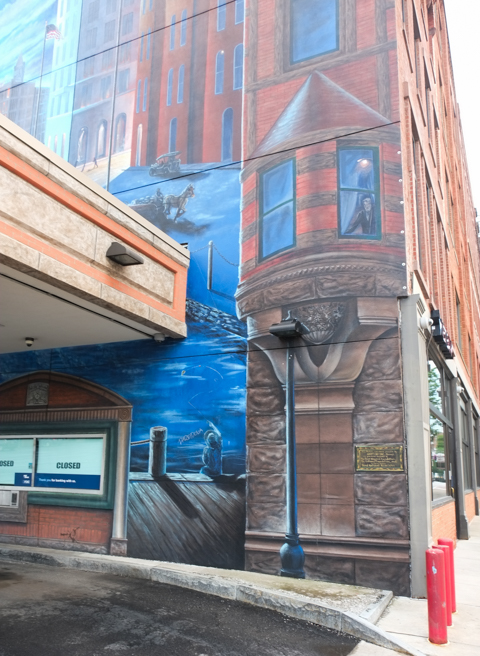
below: Another large mural, this one is on the side of a NatWest bank building and features images of Syracuse landmarks from a time when the Erie Canal played a large role in the city.  It was painted by Corky Goss and Chip Miller in 2010.

horse drawn carriage passing in front of the erie canal where a man is tying up a boat, two people in the carriage,

part of a mural, in blue tones, of syracuse landmarks

part of a mural, in blue tones, of syracuse landmarks, beside entrance to bank

mural, in blue tones, of syracuse landmarks

Photos taken August 2024

Nostalgia

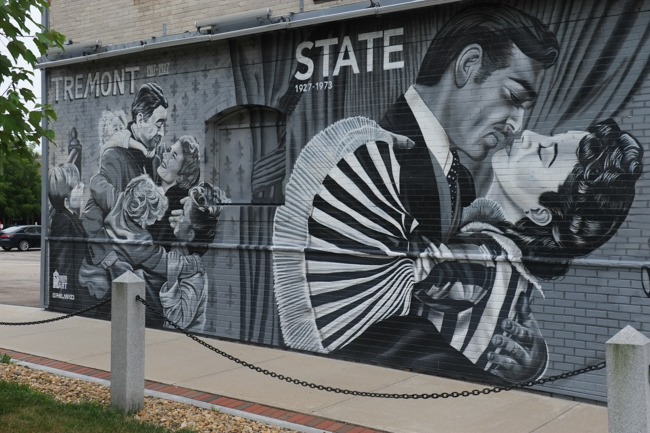
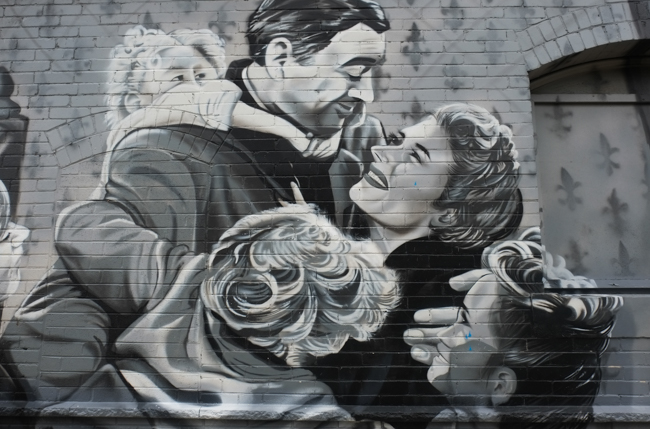
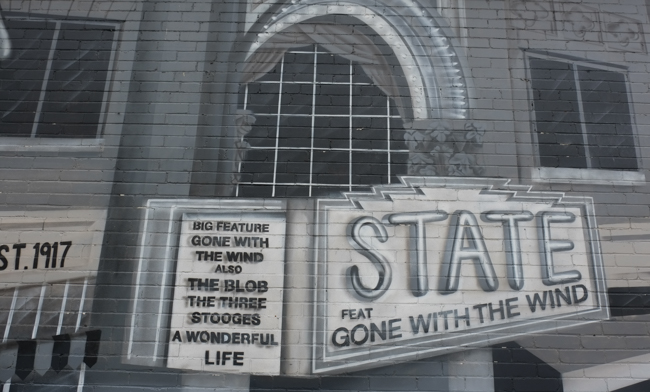
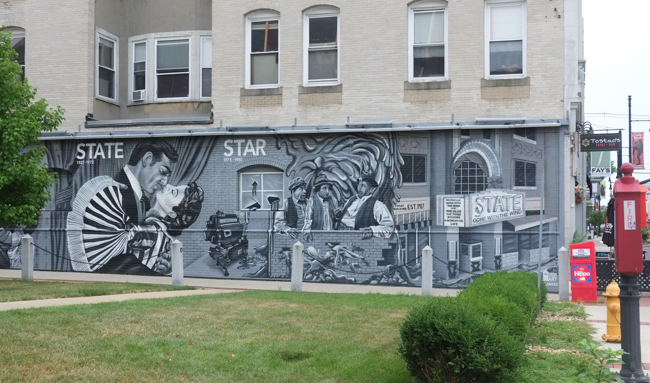
… is a mural on Main Street in Nashua that takes a look back at three of the highlights in the history of American movies – The Three Stooges, Cary Grant and Vivian Leigh in ‘Gone With the Wind’, as well as James Stewart and Donna Reed in ‘A Wonderful Life’. It was painted on the side of on the Chase Building on its 100th anniversary. Once upon a time this building was home to a movie theater with a few different names – the Tremont (1917-1927), State (1927-1973), and Star (1973-1980) Theaters.

Phelany23 painted the mural, with the support of Positive Street Art.

below: A Wonderful Life, Christmas 1946 with James Stewart and Donna Reed

below: Gone with the Wind – Cary Grant and Vivian Leigh

below: The Three Stooges in The Blob – Larry, Moe, and Curly

Nashua Heritage Rail Trail

Similar to other cities in the United States, Nashua New Hampshire has made a bicycle/pedestrian path out of land once used by the railway. The trail itself is short, only just over a mile starting at City Hall and running parallel to Hollis Street although there may be plans to extend it. Once it was part of the Great Northern Railway that ran from Boston to Lake Erie.

Some of the buildings along the trail have been painted with murals.

street art mural on trail in Nashua New Hampshire,

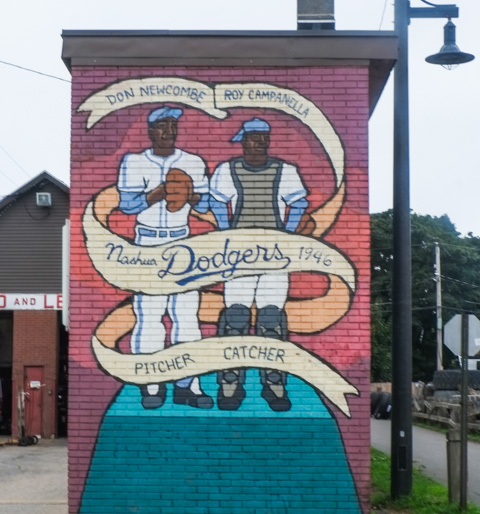
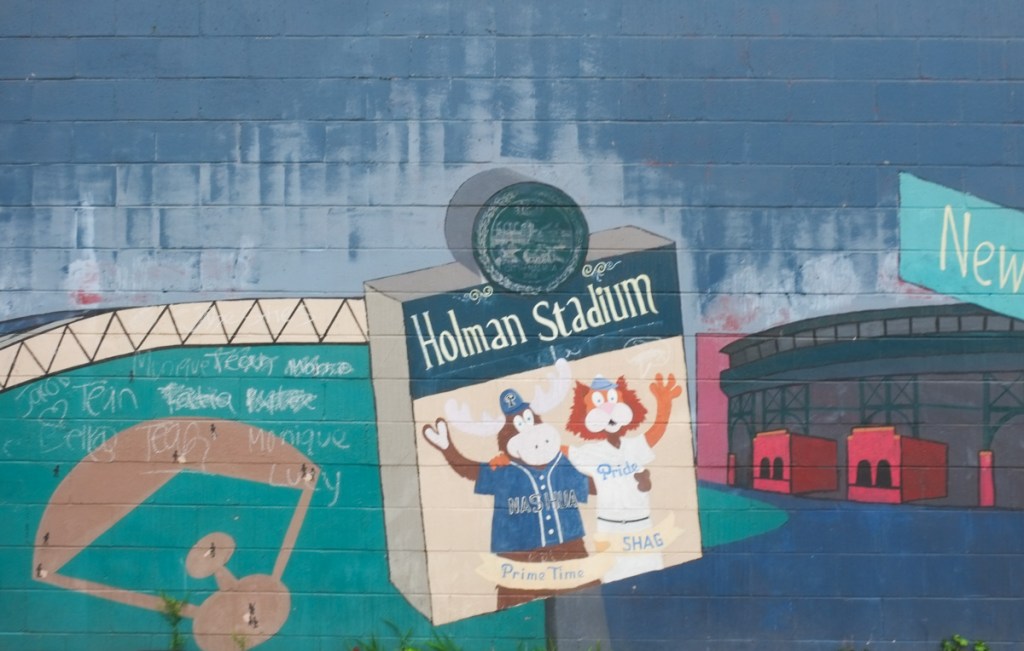
The Nashua Dodgers were a Brooklyn Dodgers farm team that played out of Holman Stadium in Nashua from 1946 to 1949 (four seasons). Two African American players, catcher Roy Campanella and pitcher Don Newcombe, were on the team in those years – this was shortly after the signing of Jackie Robinson with the Brooklyn Dodgers in 1945, and the beginning of the integration of major league baseball.

mural in nashua new hampshire, two african american baseball players for the nashua dodgers in the 1940s, roy campanello and don newcombe

street art mural on trail in Nashua New Hampshire,

below: Horse drawn public transit on the streets of Nashua, the Manchester Horse Railroad, “Main Street 1908”

street art mural on trail in Nashua New Hampshire,
street art mural on trail in Nashua New Hampshire,Horse drawn public transit the Manchester Horse Railroad, scene from 1908

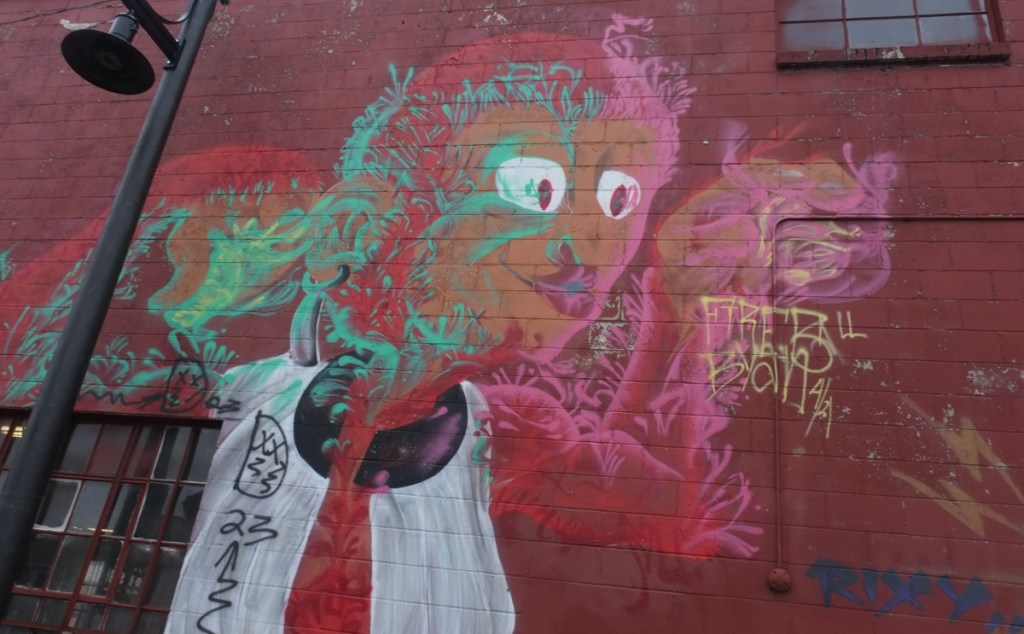
below: Fuzzy in pink and red with wisps of green.

street art mural on trail in Nashua New Hampshire,

street art mural on trail in Nashua New Hampshire, by Golden 305, a rhino

One of the projects of the Positive Street Art organization is the maintenance of two Legal Graffiti Walls. They happen to be on this rail path and this is what was on one of them when I passed by in mid August 2024…. It is a tribute to Joey Tombs by Jay Mac (aka The Backstah) on the 10th anniversary of Tombs’s passing.

street art mural on trail in Nashua New Hampshire,

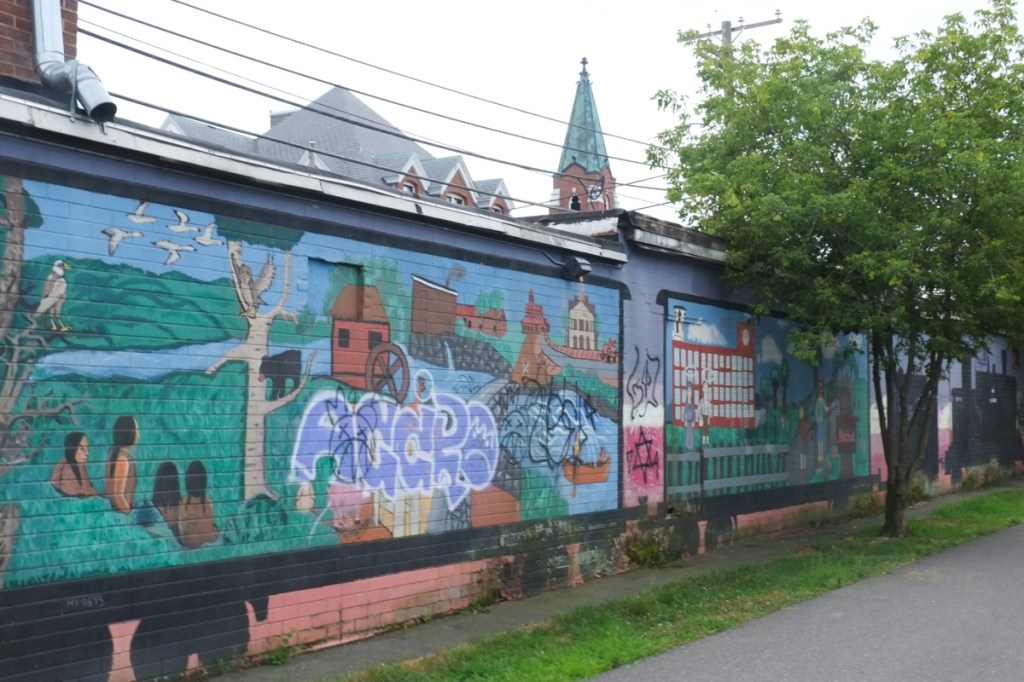
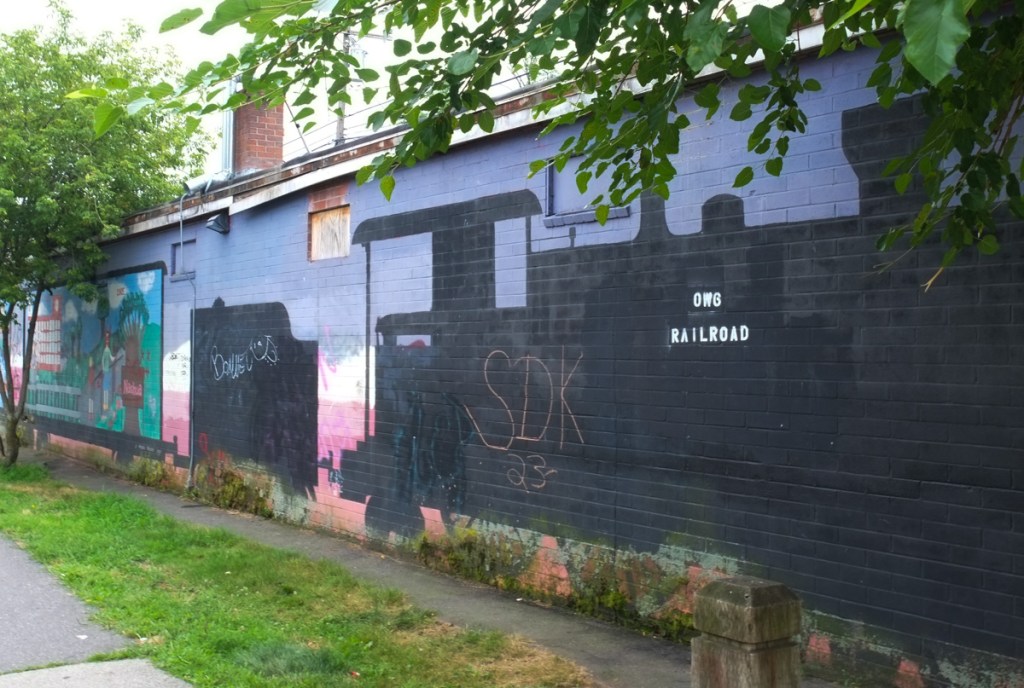
And last, there is one more train themed mural. A caboose and an engine with three railroad cars in between. These cars contain scenes painted by local artists. The mural was created as part of the 2005 Mayor’s Task Force on Youth along with the support of local businesses. It covers the entire block between Walnut Street and Chestnut Street.

street art mural on trail in Nashua New Hampshire,

below: “Native Americans admired and named the Nashua River – the beautiful river with pebbled bottom.”

street art mural on trail in Nashua New Hampshire,

Photos taken August 2024

on Congress St apartments

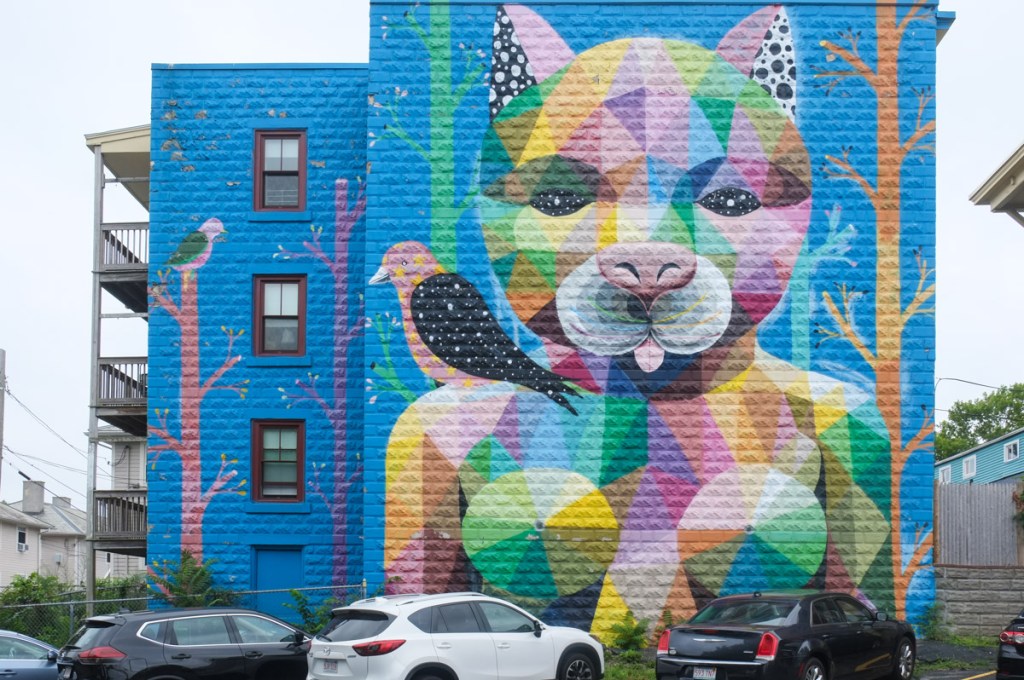
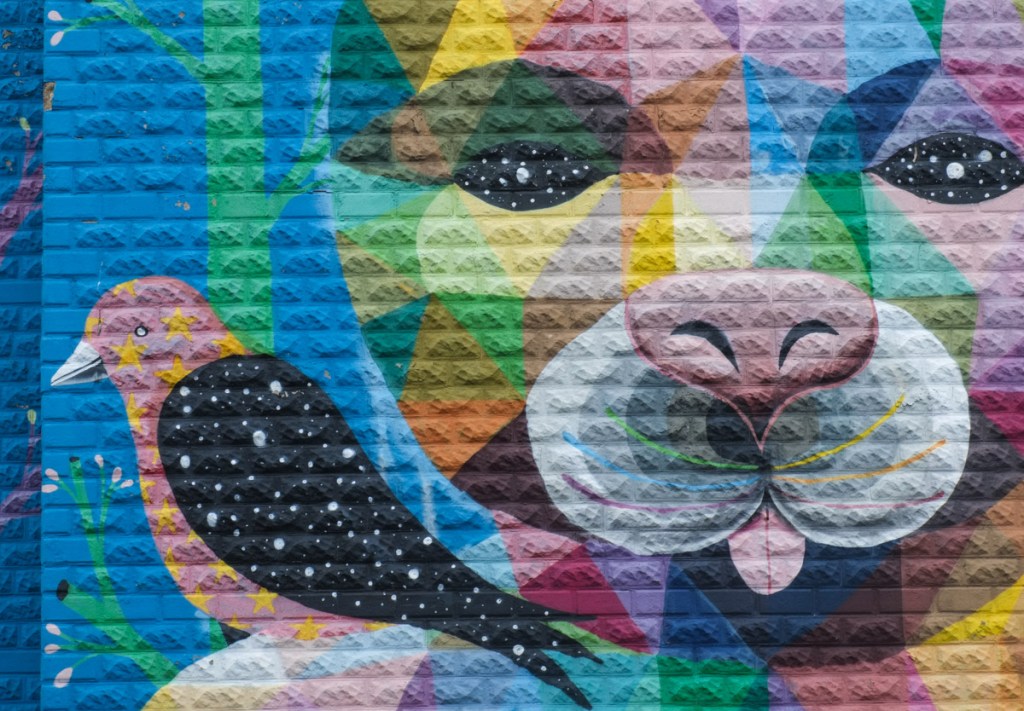
On the left is a mural by Okuda (aka Okuda San Miguel) called “Cat Witch” (it is Salem after all!) showing a figure that is both human and feline. Her fur/skin/body is constructed using many multicoloured triangles which is Okuda’s signature style. It was painted in 2017.

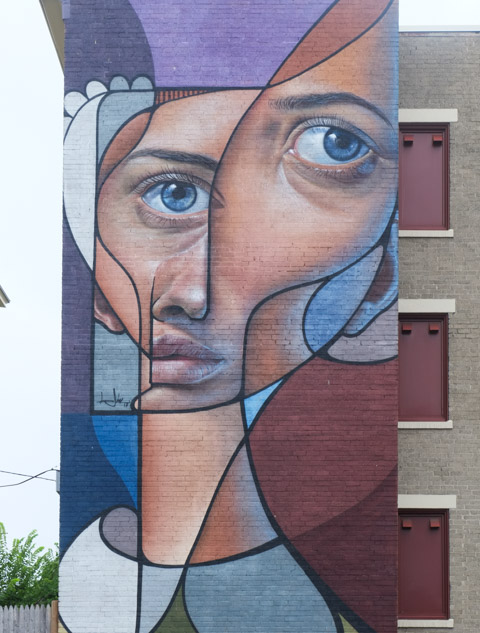
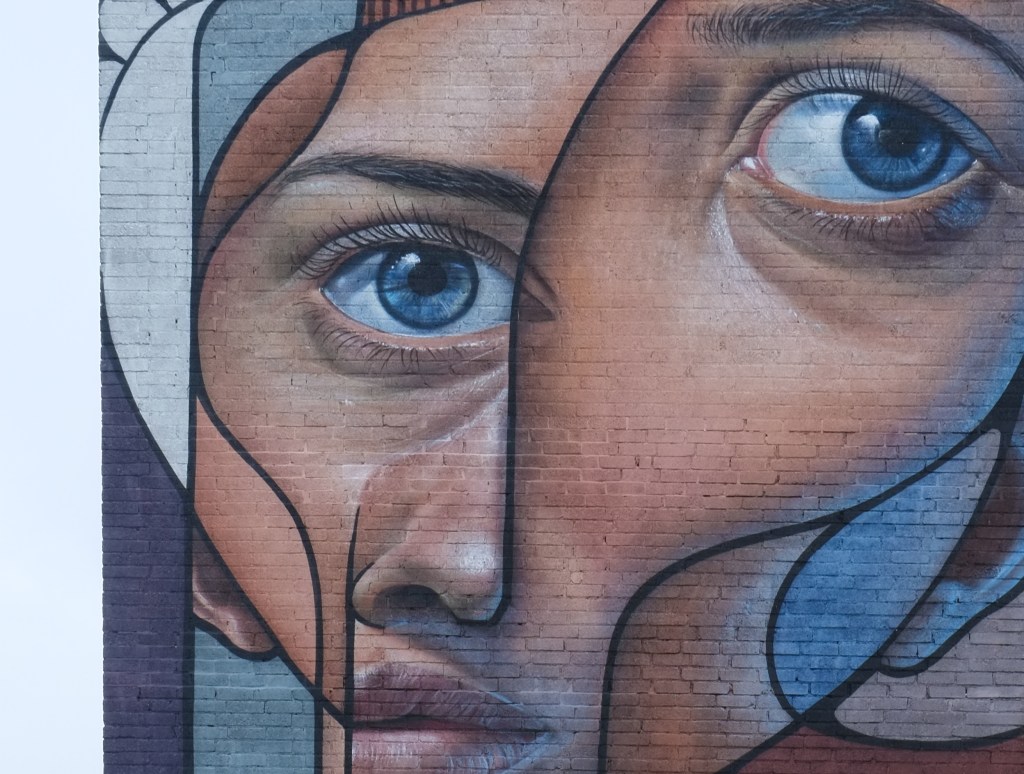
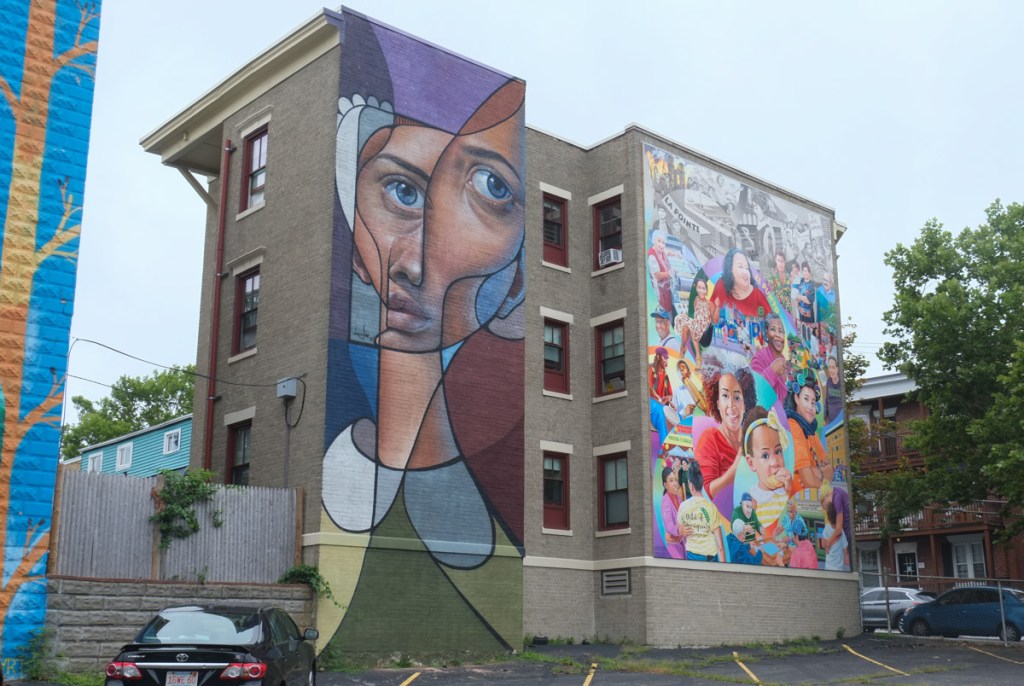
below: Also from 2017, is a mural with a very long title, “Una mirada que embruja por la calles de Salem.” In English this is: “An enchanted look in the streets of Salem”. The artist was Belin (aka Miguel Ángel Belinchón) and it is painted in a style that he calls post-neocubism. A modern day Picasso so to speak.

large vertical mural by Belin, of a person, split face, post neo cubism,

close up of the face of the person in large vertical mural by Belin,  split face, post neo cubism,

below: The last mural is also the most recent as it dates from 2023. On the right and partially hidden behind the tree, is an El Punto Community mural, “Generations” – “Generaciones” (follow the link for the full story behind the mural).

two murals on adjacent apartment buildings on congress street in salem massachusetts, one by belin and one designed by david fichter

It features events (e.g. a fire in 1914 that destroyed a church) as well as recognizable places and people in the community. It was designed by David Fichter.

el punto community mural designed by david fichter

The mural was painted on metal panels with the help of Xerxes Butt, Bianca Oppedisano and Joshua Winer, and then installed on the side of this building.

A shout out to Punto Urban Art Museum, the organization behind the murals in Salem.

Photos taken in July 2024

Planet Harlem

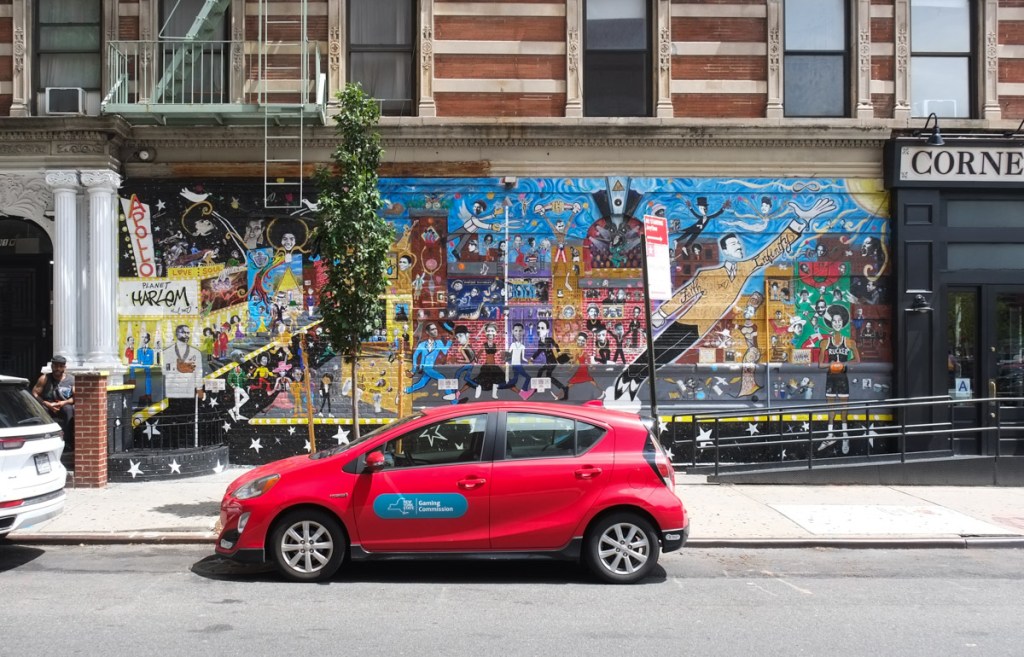
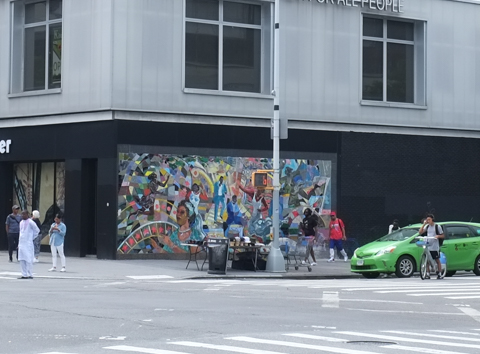
From across the street it looks rather chaotic, colourful but a bit of a mess.

a red car is parked in front of a street art mural beside corner social store, planet harlem mural by paul deo

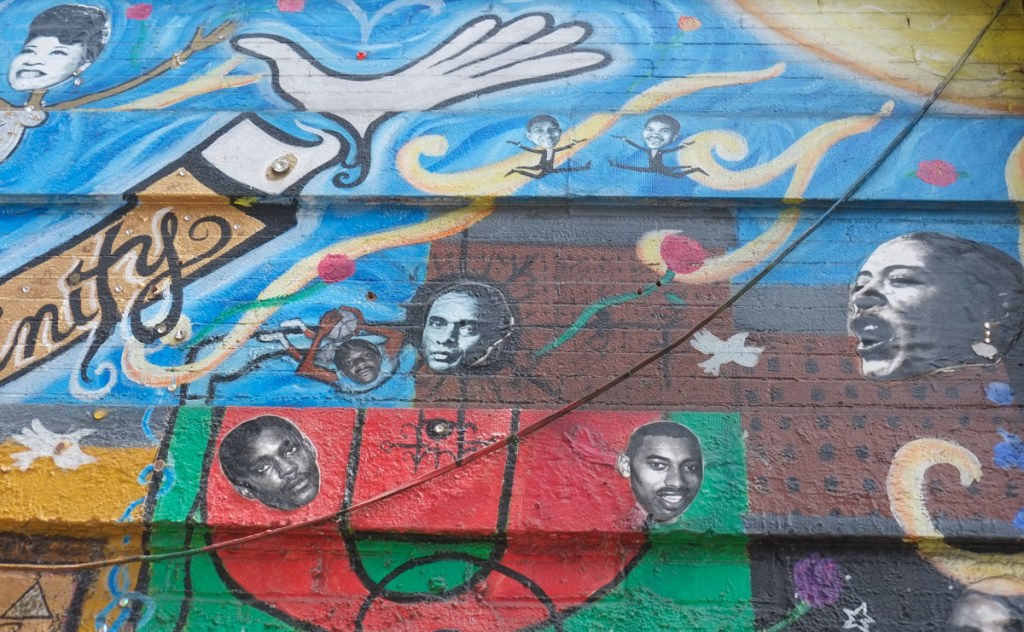
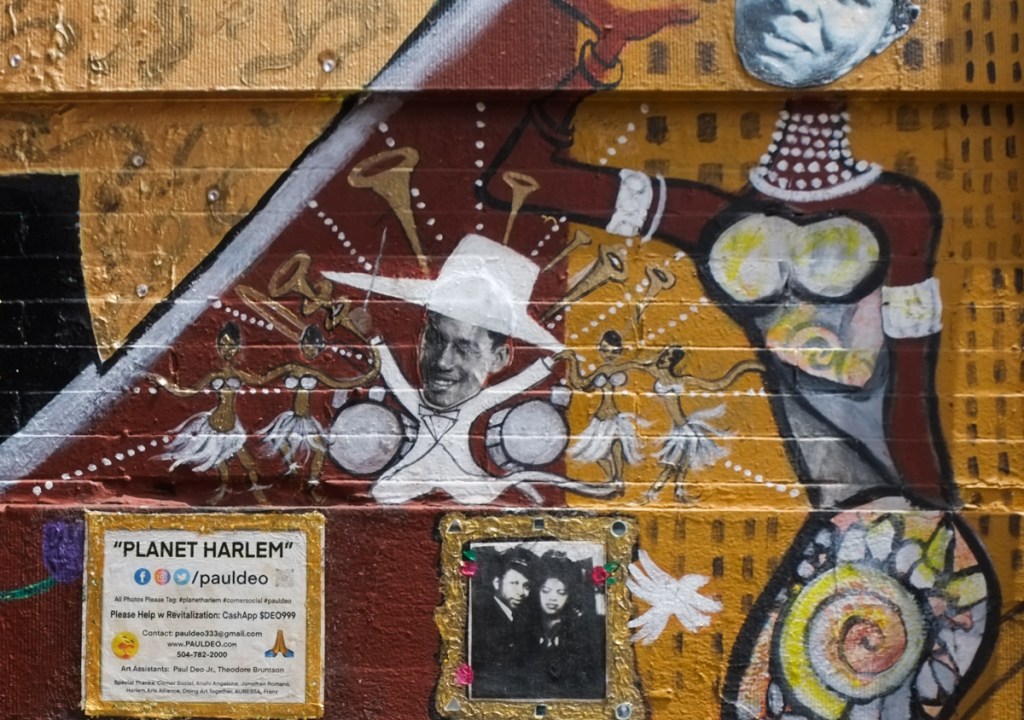
On closer inspection, it is an amazing collection of figures (mostly famous ones) and stories. This is Planet Harlem. It was started in 2012 by artist Paul Deo. At that time he won a competition to paint a mural by Corner Social (still there!) at 126th St and Malcolm X Blvd. Rucker on the basketball player’s shirt is a nod to Rucker Park, a Harlem park with a basketball court where a number of “stars” honed their skills.

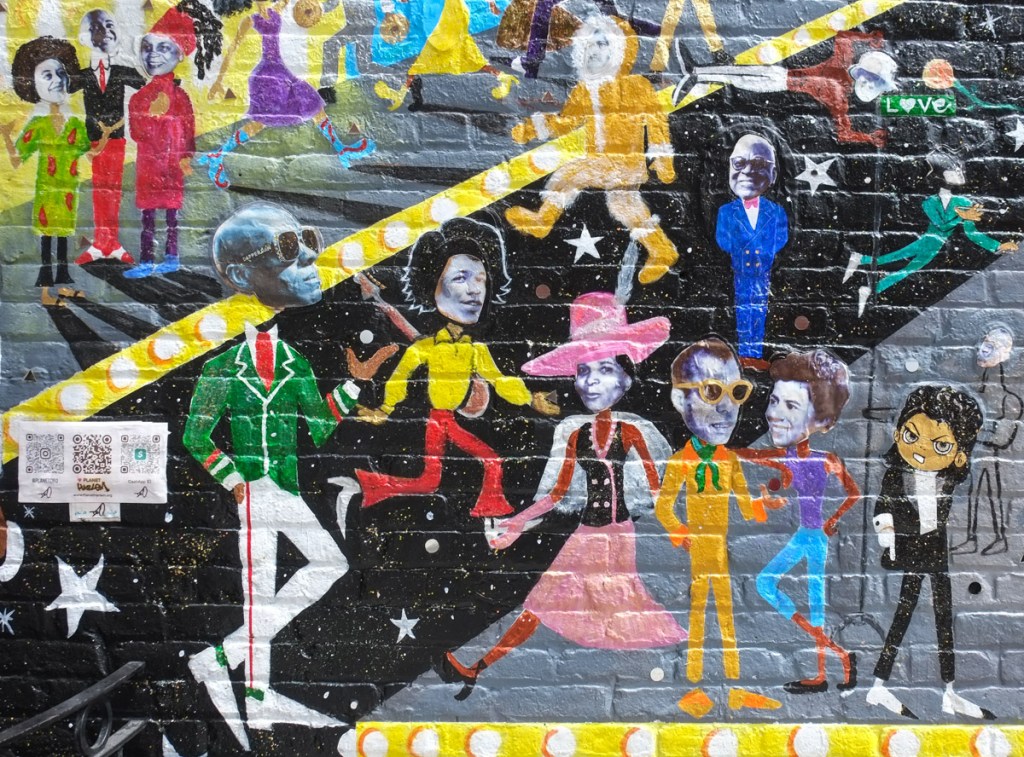
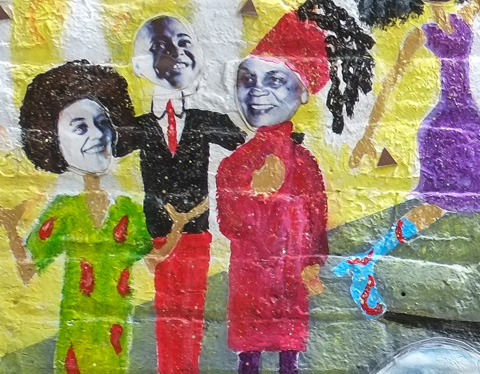
I wish that I could name all the people that this mural celebrates. There is Barak Obama as well as Micheal Jackson, the Jackson Five, and Aretha Franklin but there are other politicians and entertainers too.

part of planet harlem mural by Paul Deo

A Harlem landmark, the Apollo Theatre features prominently in the mural. 

part of planet harlem mural by Paul Deo

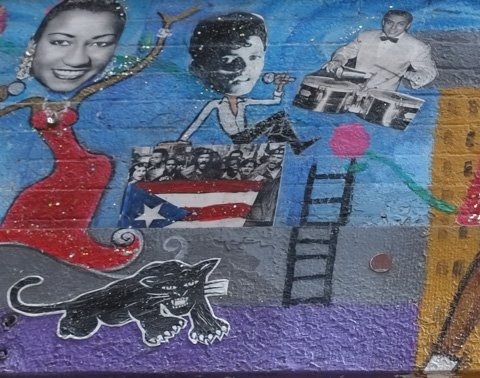
A black panther lurks here too.

part of planet harlem mural by Paul Deo

Planet Harlem Story is a website to visit if you are interested in more of the story behind the mural.

 in part of planet harlem mural by Paul Deo

Another source for more information about the mural and Harlem’s history can be found at ‘City Lore’ (a site about NYC) where this quote is from: “As the growth in the Black Harlem population continued in the 1920s from places like lower Manhattan, the southern US states, and parts of the Caribbean, an artistic and cultural movement grew to highlight the connections between self-expression, creativity, and Black heritage. Harlem specifically became a place for educators, scholars, writers, jazz musicians, singers, dancers, poets, and activists like Alain Locke, W.E.B. Du Bois, Langston Hughes, Zora Neale Hurston, Marcus Garvey, Duke Ellington, Alberta Hunter, and so many more….”

part of planet harlem mural by Paul Deo, Dapper Dan

The word ‘Infinity’ is written on the man’s gold sleeve. His other sleeve says ‘Faith’.

part of planet harlem mural by Paul Deo
famous African Americans from the past

three women in a mural

Spirit of Harlem

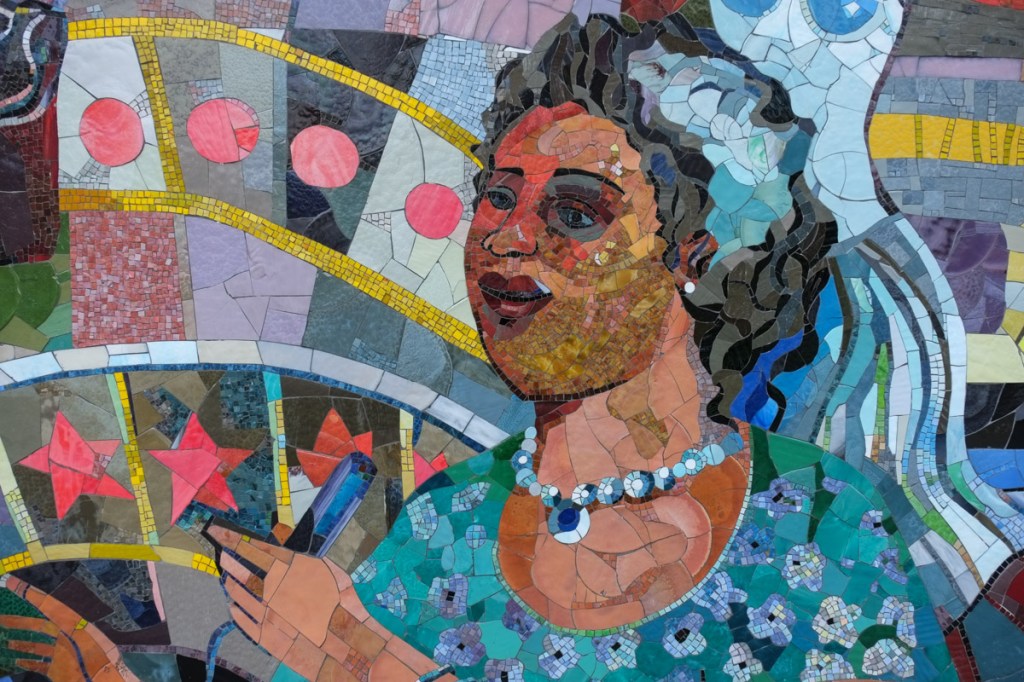
Near 125th subway station (A/B/C) there is a mosaic mural. Original artwork done by Louis Del Sarte and made into a mosaics by Franz Mayer of Munich, 2005. After it was vandalized, it was restored in 2018. It’s a lively scene with musicians and dancers enjoying themselves. Vibrant. Alive.

spirit of harlem mosaic mural in new york city, musicians, drummers, bass players, and women dancing

part of spirit of harlem mosaic mural in new york city, man in blue suit playing drums

spirit of harlem mosaic mural in new york city, brass band, women dancing
spirit of harlem mosaic mural in new york city, man in hat watching musicians
spirit of harlem mosaic mural in new york city, woman floating above dance floor,
spirit of harlem mosaic mural in new york city, black woman dancing and floating
spirit of harlem mosaic mural in new york city, woman with a shiny blue necklace

below: The corner of 125th (also Martin Luther King Blvd) and Frederick Douglas Blvd.

spirit of harlem mural at 125th and Martin Luther King Blvd

spirit of harlem mosaic mural in new york city

small town Ontario murals

As I find more, I will add them here in alphabetical order by town name.

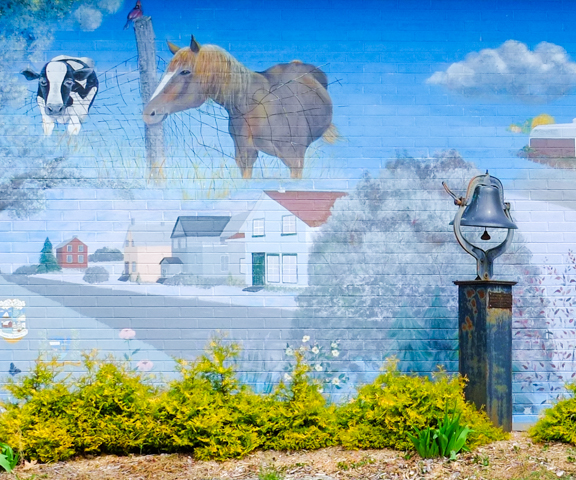
Burnt River: Two halves of the same mural. Rural life – cows, horses, and the old CN train that no longer runs here. The land where the railway tracks ran has been repurposed into a walking trail in summer and a snow mobile trail in winter.

part of a mural on exterior wall of Burnt River post office, some houses, a cow, and a horse

part of a mural on exterior wall of Burnt River post office, a train stopped at a station, a snow mobile.

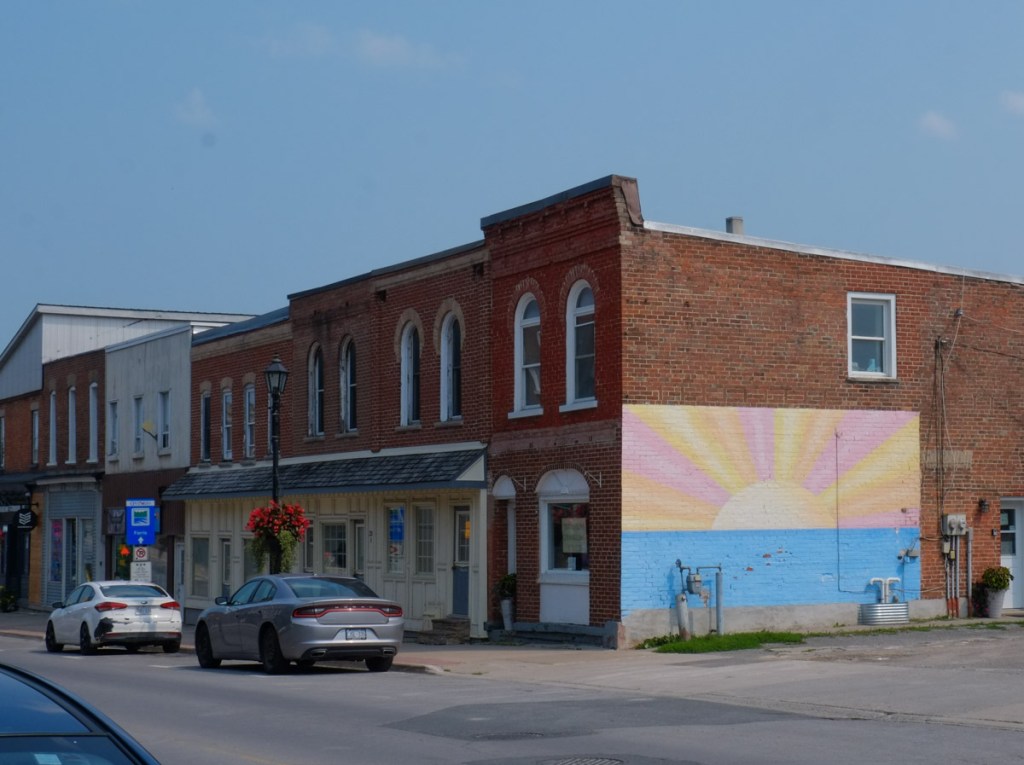
Campbellford: Sunrise over the water. Campbellford is on the Trent River.

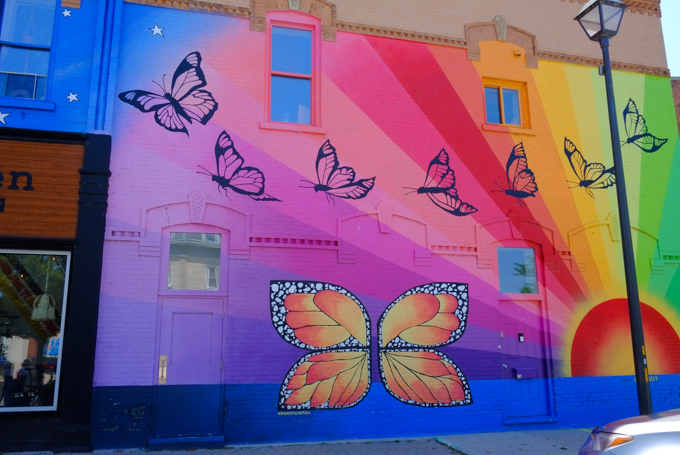
Goderich: Butterflies and rainbows on the corner of Courthouse Square and Montreal Street, downtown.

butterflies and a rainbow in a large mural on the side of a brick building in downtown Goderich

Lafontaine: Profile of a wolf… Legend of Loup Lafontaine – part legend and part true story, written by Thomas Marchildon, a parish priest, in 1955. Since 2002 the town has held an annual Festival du Loup.

mural, wolf head in profile, leaves, berries, nature scene

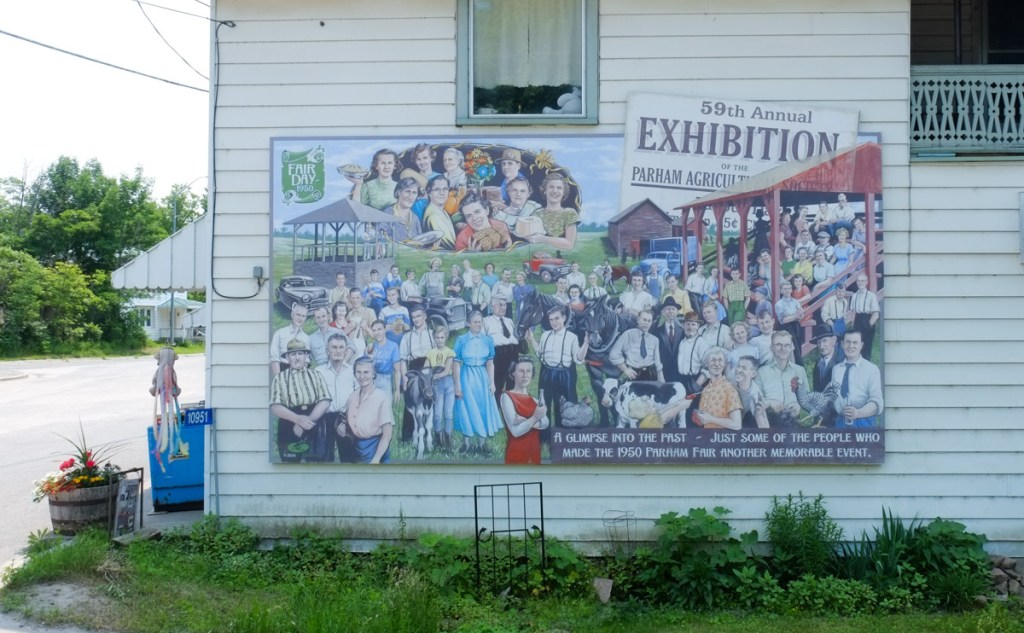
Parham: “59th Annual Exhibition of the Parham Agricultural … A glimpse into the past – just some of the people who made the 1950 Parham Fair another memorable event.”

large mural on the side of general store in Parham Ontario, image of a group of people at the 59th annual Exhibition and Parham agricultural fair, early 1900sm

Sharbot Lake: “The Final Journey”, On June 6, 1891, Sir John A. Macdonald died at his residence in Ottawa. After a state funeral, his body was taken by train to Kingston from the mainline to the K&P at Sharbot Lake.

mural on wall in sharbot lake, portrait of Sir John A Macdonald as well as a train, tells story of Macdonald's trip in the train after he died

Sharbot Lake: Kingston and Pembroke Iron Mining Company. Incorporated 1887. The Railway’s Influence: with the arrival of the railway in 1876 came new prosperity. Sawmills and mines now had easy access to markets. Sharbot Lake soon had several stores, hotels and 3 doctors. This building, built in 1901, was originally the Farmers Bank of Canada.

mural about Kingston and Pembroke iron mining company incorporated in 1887, and the railway's influence in the area, saw mills and mines and easy access to markets.  On the side of building from 1901, the Farmers Bank of Canada

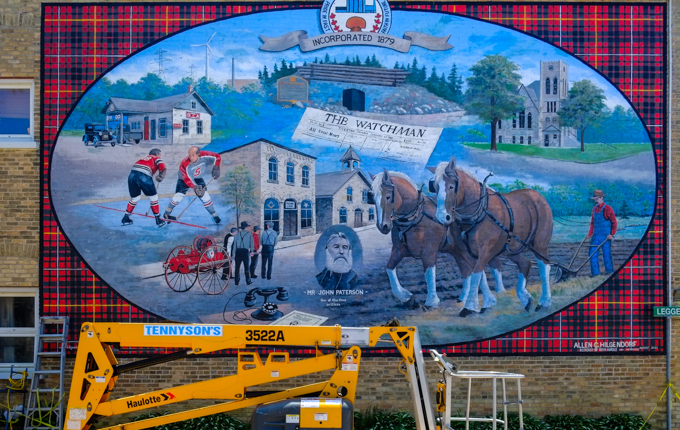
Tiverton: The Watchman – this was the name of the local newspaper. At the top of the oval, “Incorporated in 1879” and at the bottom, a portrait of John Patterson, one of the first settlers. Also shown, the Masonic Lodge, local church, an old car and pickup truck at the B A gas station, horses pulling a plow, and an old fire wagon on the main street. It was originally painted by Allen Hilgendorf in August 2001 then restored by Ruth Hurdle in 2010, and by the looks of it perhaps it is being restored again (photo taken June 2025). Other notes: Although the town was incorporated in 1879, it took the name Tiverton in 1860 when the post office opened there. “The Watchman” newspaper was founded in 1874.

large mural, outdoors, black watchman plaid background with large interior oval containing many images of pioneer life, horses pulling a plow in a field, men playing hockey outside, a church, a wagon on a street with a couple of stores,

Tiverton: Tiverton Platoon 1917, group picture

large photograph of men in uniform, 1917, group shot, about 50 men, title is Tiverton Platoon 1917, on brick wall, outside

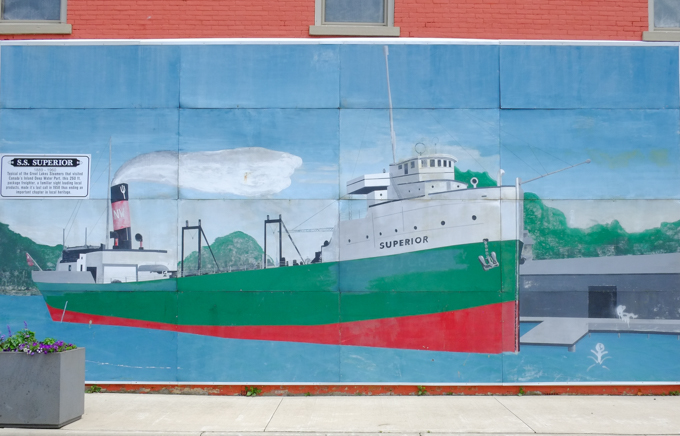
Wallaceburg: The S.S. Superior, a large boat. “1889-1960, Typical of the Great Lake Steamers that visited Canada’s Inland Deep Water Port, this 250 ft package freighter, a familiar sight loading local products, made it’s last call in 1958 thus ending an important chapter in local heritage. “

painting on an exterior wall in Wallaceburg, a large image of the S.S. Supperior, a package freighter built in the 1880s.